Showing posts with label Cement. Show all posts

Monday, 8 June 2015

Completed Video Collaboration: 'Orfeo'


Gravelly Hill Interchange, Birmingham, November 2014


At various intervals in recent months, I’ve alluded to my long hours spent out in the field with my video camera.  Indeed, for a period, through the coldest, wettest period of 2014, it felt like I was out most evenings and weekends, - allowing my camera to maintain a steady gaze at numerous bits of concrete, and generally overlooked urban corners throughout the Midlands.  Luckily, a good selection of such sites are readily available close to my home in Leicester, but my forays also found me in Birmingham, Nottingham and Rugby, at various junctures, (and junctions).


Still From:Andrew Smith & Hugh Marwood, 'Orfeo', Digital Video, 2015


The aim was to collect sufficient source footage for the film collaboration that Andrew Smith and I had agreed should be part of our ‘Mental Mapping’ exhibition at Rugby Art Gallery & Museum.  The opening of the exhibition feels like a good time to finally reveal the finished product here.  I’ve also included a few still shots taken in the same locations as the filming took place.


In fact, ‘Orfeo’ has been viewable on YouTube for a while, but I’ve deliberately held back from too loud a fanfare until now, having being one of those children who always liked to save up all my Christmas presents till the last moment - then open them all at once. 

I shot the footage with no specific agenda, other than to maintain some connection with concrete or cement wherever possible, and to stick to those typically mundane, overlooked, or down-at-heel locations in which I can gauge a city’s pulse whilst feeling strangely separated from it at the same time.  These are the kind of places where a particularly contemplative kind of ambience often collects in deep pools, or where most people pass by so unheedingly as to forget that they are places at all.  Maintaining the concrete theme reflects my abiding fascination with its material and symbolic qualities, but also, tangentially, the impact made on me by the enormous cement plant that dominates the town where we planned to exhibit.


Cemex Cement Plant, Rugby, Warwickshire, December 2014


Around Christmas time, I handed over a brick-sized hard-drive full of such material to Andrew, and returned to my ‘Map’ paintings, - also intended for the same exhibition.  I was delighted to find, a few weeks later, that not only had he devised a script around various passages of my filming, but had begun editing it into some kind of coherent artifact.  He asked me to return to the fray to collect certain specific images, but this was very much a case of just filling in a few small gaps, and still largely a matter of interpretation, (with the instigation reversed).


Still From: Andrew Smith & Hugh Marwood, 'Orfeo', Digital Video, 2015


The final results are everything I could have hoped for from the collaboration, and more.  My hope was always that working at a remove from each other, and with no little trust in the other to pull something out of the fire, would open doors that neither of us might have opened if left to our own devices.  It was a leap of faith, but one that has paid off from my point of view, without a doubt.  Andrew’s well-read literary background, and the fact that he is an inventive writer in his own right, meant that something open-endedly focused on the resonance of place, ultimately morphed into a surreal, absurdist narrative of strange, implied events and perplexing associations.
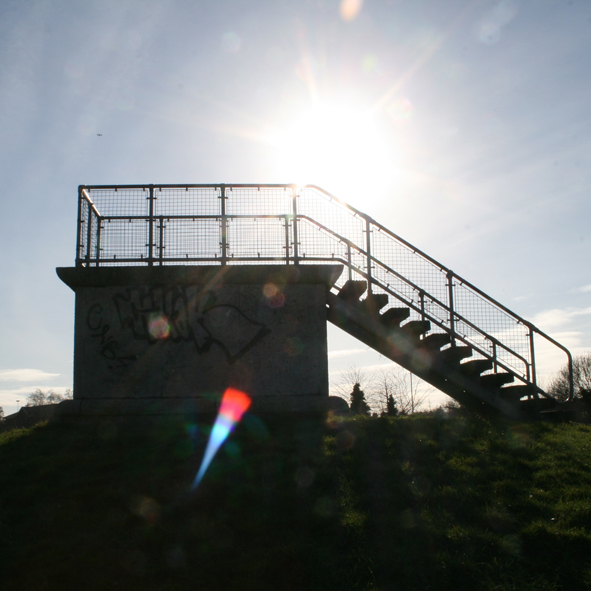

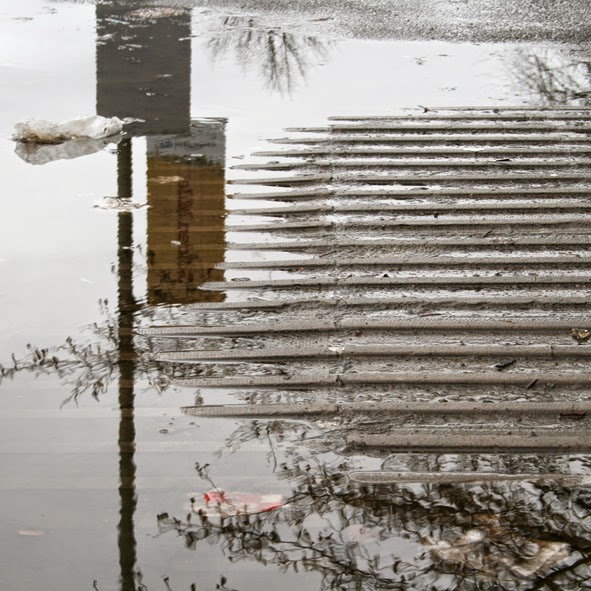
West Leicester, April 2015

Aston, Birmingham, April 2015


If I’m mostly about the reveries that arise from immersing myself in physical geography, I sense that Andrew is as much involved with concocting less-easily chartable landscapes of the mind from within, generally speaking.  As I always suspected, he was able to generate the kind of oblique, allusive narrative, full of clues - but short on definitive meanings, to which I am always drawn, but less likely to generate for myself. 


Still From: Andrew Smith & Hugh Marwood, 'Orfeo', Digital Video, 2015


For what it’s worth, I know that Andrew drew partially on the ideas outlined in Kevin Lynch’s ‘The Image Of The City’ [1], which also exerted a strong influence on my ‘Cement Cycle’ photographs.  Without wanting to make over-grandiose claims, I also detect hints of the non-specific post ‘event’ sensibility of Tarkovski’s ‘Stalker’ [2.].  As the title suggests, there’s an implication of the Orpheus myth in the way that the film emerges from subterranean obscurity into the light.  For a while, I even imagined it under the fatuous working title of ‘Orpheus in the Underpass’.


West Leicester, December 2014


Anyway, I’ll let you judge the film’s potential meanings for yourselves, along with its merits, (or otherwise).  Should you criticise it for being pretentious or self-consciously obscure, I’d ask, “…and your problem with that is - what, exactly?”  To those who may criticise my exposure settings or inept camera work, I can only apologise and offer to try harder next time.  I certainly intend that there will be a next time…


‘Mental Mapping: New Work by Andrew Smith & Hugh Marwood’, runs from 8 – 18 June 2015, at Floor OneGallery, Rugby Art Gallery & Museum, Little Elborow Street, Rugby, Warwickshire, CV21 3BZ.  I’ll be reporting on the exhibition itself very soon.

Both Andrew and I would like to thank Paul Ray for his technical assistance at the editing and final production stages of 'Orfeo'.


[1.]:  Kevin Lynch, 'The Image Of The City', Cambridge Massachusetts, The MIT Press, 1960

[2.]:  Andrei Tarkovsky (Dir.), 'Stalker', Mosfilm, USSR, 1979


Sunday, 10 May 2015

Work In Progress: 'Cement Cycle'


Work In Progress: 'Cement Cycle: Element 1 (Path)', Printed Dims: 29 cm X 29 cm, 2015


One of the reasons for my painting (and indeed, blogging) activities slowing slightly for a few weeks was that I split my focus between that and a photographic project, I’ve opted to call ‘Cement Cycle’.  When Andrew Smith and I agreed to collaborate on our ‘Mental Mapping’ exhibition, I knew I wanted my contribution to be a little wider in scope than solely painting.  I remain highly committed to painting, (or some kind of hybrid form of it), but there’s no doubt I’ve hankered to augment it with work in other media for quite a while.  This was stimulated, in part, by seeing how Andrew’s own practice took a variety of forms beyond painting - and depending on what felt most appropriate), when we both exhibited in a group show in Birmingham, in 2012 [1.].


Work In Progress: 'Cement Cycle: Element 2 (Path)', Printed Dims: 29 cm X 29 cm, 2015


Of course, regular visitors to this blog will know that I spend a lot of time taking photographs, but generally, I’ve only really regarded them as raw material, or a kind of visual diary, - rather than as artifacts in their own right.  I can’t fully explain this; perhaps its because, in an age of almost total photo-image saturation, a painting just feels more like a ‘thing’ with actual presence.   Anyway, the images in this post are the first that I’ve actually considered also putting on a wall as self-justifying pieces.


Work In Progress: 'Cement Cycle: Element 3 (Edge)', Printed Dims: 29 cm X 29 cm, 2015

Work In Progress: 'Cement Cycle: Element 4 (Edge)', Printed Dims: 29 cm X 29 cm, 2015


These ten images represent a selection of concrete or cement-based way-markers that I pass repeatedly on regular cycle commutes to and from my day job.  I often drive to work, but always enjoy those occasions when I can ditch the car and go on two wheels instead.  The alternative route(s) this entails are surprisingly verdant, and largely follow the general direction of the River Soar between the centre of Leicester and its northern periphery.  Just as my recent ‘Map’ paintings relate to relatively mundane local journeys, this alternative route is also very much part of my ‘mental map’ of the city.  As it happens, the source location for ‘Map 1’ and ‘2’, is a nexus of both a ‘Map’ route and my ‘Cement Cycle’ route.


Work In Progress: 'Cement Cycle: Element 5 (District)', Printed Dims: 29 cm X 29 cm, 2015

Work In Progress: 'Cement Cycle: Element 6 (District)', Printed Dims: 29 cm X 29 cm, 2015


The concrete features depicted range from the large scale and visually assertive, such as the cement depot, subway system and river crossing flyover, (which have all featured on this blog before), to the easily overlooked or eminently low-status, such as a section of waterlogged textured paving, or a solitary fence post.  Interestingly, I often notice how the most unassuming or easily overlooked features are those which ultimately impress themselves most on one’s memory of an habitual journey [2.].


Work In Progress: 'Cement Cycle: Element 7 (Node)', Printed Dims: 29cm X 29 cm, 2015

Work In Progress: 'Cement Cycle: Element 8 (Node)', Printed Dims: 29cm X 29cm, 2015


This is something pointed out by Kevin Lynch, an American M.I.T. Academic, whose publication, ‘The Image Of The City’ [3.], constituted a specialised guide for Urban Planning and Architectural Design students of the 1960s and 70s.  Andrew Smith suggested Lynch’s book to me, when we first started laying plans for ‘Mental Mapping’, and I quickly found much in it to chime with my own perceptions of the urban landscape.  Particularly interesting was Lynch’s central acknowledgement of the often highly subjective mental images that city-dwellers compile to aid their navigation of complex environments.  Part of this process involves the investment of familiar, often mundane physical features with emotional or atmospheric resonances far beyond their official status or utility.  Lynch went on to categorise these into five basic archetypes, or ‘Elements’, namely: ‘Paths’, ‘Edges’, ‘Districts’, ‘Nodes’, and ‘Landmarks’.


Work In Progress: 'Cement Cycle: Element 9 (Landmark)', Printed Dims: 29cm X 29cm, 2015


The images from my ‘Cement Cycle’, shown here, are organised in five pairs, according to the same logic.  Each of the versions exhibited will incorporate a text caption inspired by Lynch’s text – but hopefully leaving things ambiguous enough for more open interpretation.  I’m not revealing their content just yet, I’m afraid, - you can’t have all your treats before the actual exhibition.  Each printed image has been laminated onto plastic board; to be fixed flush onto the front of one of the cement blocks alluded to in my previous post.  This should give the illusion of a solid concrete projection when mounted on the wall in Rugby, (Rugby; cement - I’m sure I’ve been though all this already on several occasions).


Work In Progress: 'Cement Cycle: Element 10 (Landmark)' Printed Dims: 29cm X 29cm, 2015


Well, that’s the plan, at least.  I’ve already hinted at the fact that my fettling of the ten concrete supports wasn’t totally without its moments of friction.  Now I just need to satisfy myself that the printing company has actually made them the right size - at the third attempt…


‘Mental Mapping: New Work By Andrew Smith & Hugh Marwood’ will take place between Monday 8 June – Wednesday 17 June 2015, at Floor One Gallery, Rugby Art Gallery & Museum, Little Elborow St, Rugby, Warwickshire, CV21 3BZ.


[1.]:  ‘If A Picture Paints A Thousand Words, Why Can’t I Paint’, Works Gallery, Birmingham, November 2012.

[2.]:  As a Foundation Art student, still resident in my home town of Lincoln, I walked to college every day in the shadow of that city’s huge Gothic cathedral.  And yet, strangely, I retain memories of an age-worn handrail, or a particular dilpidated lamppost - at least as vividly as those of the massed cliffs of ornate architecture looming over me.


[3.]:  Kevin Lynch, ‘The Image Of The City’, Cambridge Massachusetts, The M.I.T. Press, 1960.