Showing posts with label Installation Art. Show all posts

Thursday, 31 July 2025

'We Grown-Ups Can Also Be Afraid', At Attenborough Arts Centre, Leicester


(L.): Francisca Aninat, 'Interior/Exterior Field', Canvas, Cardboard, Newspaper & Thread, 2007
(R.): Mona Hartoum, 'Hot Spot', Stainless Steel & Neon, 2006
(All Images: 'We Grown-Ups Can Also Be Afraid', Attenborough Arts Centre, Leicester, July 2025)


I managed to catch up with my friend Andrew Smith, a few days ago, and we took the time to visit the 'We Grown-Ups Can also Be Afraid' exhibition at Leicester's Attenborough Arts Centre. It proved well worth the effort. Although modest in scale, the show features a well curated selection of stimulating contemporary work from the private collection of David and IndrĂ© Roberts. I won't claim any prior knowledge of them, or of the Roberts Institute of Art, but a modicum of research suggests the latter is a non-profit organisation with considerable outreach and heft. The Attenborough exhibition itself aims to showcase work that engages with a range of the crises and insecurities that haunt our world, without descending to the level of mere sloganeering or shallow didacticism - something which sometimes feels like a limiting factor in so much of the current work littering contemporary galleries across the globe. 

Don't get me wrong, I have no objection to the arts being engaged with socio-political issues. Indeed, I'd even argue that it is a duty of any creative endeavour to acknowledge and critique the times in which it emerges, if it is to claim any relevance beyond being 'mere' decor/escapism. Ultimately though, I suppose I do have a basic requirement for a bit of 'Art' to remain in there too. If I want simplistic solutions, ideologically-driven polemic, or direct calls to action, I'll read a book, attend a protest rally (or some other variety of intervention), watch a documentary, sign a petition, or even sully myself with social media. The aesthetic of the protest placard or campaigning graffiti feels far more vivid on the street than in the art gallery. 


Mona Hartoum, 'Hot Spot' (Detail) With Gallery View


Nina Beier & Marie Lund, 'We Grown-Ups Can Also Be Afraid', Video, 2007


See Above


There, a slower burn or more reflective approach may often have a greater effect, I would argue. Without engaging with any debates over privately accumulated collections, or the nature of the art object as status symbol/luxury indulgence, I prefer to believe that there is still an, admittedly modest, arena in which made/visual artefacts can engage us through aesthetic stimulation - first, philosophic reflection - second, and perhaps morally - third. 

Direct action, the taking of sides, the pursuit of conflicts (be they ideological or military) - these activities all tend to work within traditional, entrenched thought patterns. One side pretends to 'win' while the other stores up grievance. We pick a side and embrace the associated echo chamber of opinion, or else - turn off the news and feel grateful that stuff doesn't (usually) happen here. We go round and round the mulberry bush as cities are bombed, populations are displaced, children starve, chemical plants explode and eco-systems go up in flames. (Your turn today - our turn tomorrow). Alternatively, might it be that through observation, calm reflection, engagement with the absurdity/tragic poetry of catastrophe, or even just through creative endeavour as a gesture of positivity in itself, that more flexible or adaptive solutions might one day emerge? Clearly, no single artwork could ever have prevented Auschwitz, Hiroshima, Chernobyl, Gaza, etc. but could it perhaps eventually stimulate enough critical thinking to persuade us it really wasn't a great idea last time - and still won't be the next time some idiots try it? If I'm simply deluding myself here, at least, in a show like this, I get to distract myself or virtue-signal with something a little more stimulating than a lot of what gets dished-up these days.


Francesca Aninat, 'Interior/Exterior Field' (Detail)


Fiona Banner, 'Mirror Fin, Jaguar', Polished Aircraft Tail Fin, 2006


Anyway, enough with the ill-thought-out philosophising. I had originally planned to discuss, in some depth, the individual pieces from the exhibition that impressed me most. But the reality is that nearly everything affected me to some degree or another. Besides that, the musings above have already taken up both time and space. Here's a rather more superficial prĂ©cis, instead: 


Phyllida Barlow, 'Untitled: Disaster 5', Mixed Sculptural Media & Castors, 2010


Mona Hartoum's, 'Hot Spot' presides over the entire gallery, bathing everything else in its infernal glow and implied heat. It functions as one of those objects that combine elegant simplicity with lasting resonance. Whilst initially intended as a geo-political commentary, it now feels equally well adapted as a symbol of the environmental conflagration now enfolding us us all. It almost feels like it's accumulating disasters as it sits there and gently buzzes to itself.  Nearby, Francisca Aninat allows the accumulated detritus of her cultural origins to accrete in a new corner/location, even as it may have previously felt washed-away through displacement or migration on a similarly global scale. 

Nina Beier and Marie Lund lend the show its title with their video that combines a visual meditation on the mundane environs of a Danish primary school, and a soundtrack in which unseen children rehearse a song listing the potential catastrophic fears waiting to haunt their adult lives. There's something darkly enjoyable about the way the class degenerates into infantile chaos and petty squabbling, even as their teacher struggles to focus them on the nightmares ahead. Meanwhile, Jacco Olivier's video, 'Saeftinghe' approaches things in a different but equally intriguing manner by digitally manipulating his crudely-painted evocations of disaster, conflict and ultimate submersion, as they are visited upon a tract of Dutch landscape. In passing, it impresses me that both videos manage to pack a considerable punch whilst being pretty short in duration by normal art-video standards.


Jacco Olivier, 'Saeftinghe', Video, 2006


See Above


Fiona Banner provokes literal reflection by mirror-polishing the tail fin of a war plane ('Mirror Fin, Jaguar'), questioning the double-think that allows us to find such sleek beauty in the contours of a sophisticated killing machine. It's another of those simultaneously elegant and profound statements that seems to encapsulate something of humanity's gleeful  death-drive. Phyllida Barlow doesn't summon quite the same seductive beauty for her semi-abstract blob of mangled detritus, 'Untitled: Disaster 5', but it appeals to me, nonetheless. In execution, it might be little more than the kind of 'experimental' foamed-together crap pile one might once have found littering the studio floors of numerous art colleges, were it not for the simple, delightful expedient of attaching castors to its underside. A small portion of portable disaster - suddenly, that almost feels like the kind of thing Duchamp himself might have dreamt-up.


Doris Salcedo, 'Atrabiliaros', Shoes, Cow Bladder & Surgical Thread, 1996


More solemn are the shoes of the Latin American disappeared that Doris Salcedo obscures behind stitched viceral membranes, in her small 'Atrabiliaros' instillation. The context is different, but I find it impossible not to see echoes of the Nazi's 'final solution' here too, and ultimately, perhaps it all just boils down to a repudiation of humanity and the futile deletion of individuals in the end. Even more minimal and fleeting in their visual effects are Ayan Farah's stretched blanket pieces. Although resembling highly distilled abstract paintings, they are actually  composed of chemical stains or collected dust, seemingly encapsulating as much time as they do materiality. By applying the residual traces of some implied cataclysm or unwanted transformation, to what should be the fabric of domestic comfort, Farah implies the ultimate fragility of whatever stable life we might attempt to construct. I'm reminded to some extent of the domestic linen that often litters the bombed-out apartments of Gaza, Syria, Kiev, wherever... but also of the grubby bedding of Leicester's own rough sleepers, or the lines of washing in the steel town of Consett, that I once observed from a train window, collecting choking brown dust, even as it dried.


Ayan Farah, Blanket Pieces, 2011


Ayan Farah, 'Nuuk', Sun-Bleached Copper & Dye on Stretched Blanket, 2011


Ayan Farah, 'Eldfell', Volcanic Ash & Dye on Stretched Blanket, 2011


In passing, I'll just mention that all the images here were collected with my smashing new mirrorless camera (its a Canon, for those that care). Such toys don't exactly come cheap and I suppose it might seem like a profligate indulgence, were it not for the fact that I've always regarded a 'grown-up' camera as one of life's essentials. The old DSLR responsible for nearly every image on this blog to date, has effectively reached the end of its working life (bits are literally dropping off), and goes into retirement after perhaps a million depressions of its shutter. Here's hoping this new one lasts as well in the coming years. The fact that the dense text below is legible, from what was boiled-down to a pretty small JPEG file, suggests there's nothing too shabby about it so far. I just need to decipher all those menus now...


'We Grown-Ups Can Also Be Afraid' continues until 19 October at: Attenborough Arts Centre, University of Leicester, Lancaster Road, Leicester, LE1 7HA


Written without A.I. [For better or worse]


Sunday, 7 June 2020

Black Lines Matter: The Work of Glenn Ligon


Glenn Ligon, 'Double America', Neon & Black Paint, 914 mm x 3048 mm, 2012


It would be short-sighted, if not pernicious - and surely indicative of the problem generally, to ignore the waves of anger and protest over the recent death, in Minneapolis Police custody, of George Floyd.


Glenn Ligon, 'Untitled (America)', Oil Stick & Acrylic on Paper, 305 mm x 229 mm, 2007


Glenn Ligon, 'Figure #63', Acrylic, Screen Print & Coal Dust, 1524 mm x 1219 mm, 2010


This is no place to attempt to discuss all the complexities of America's institutional racism (or Britain's, for that matter), and clearly, I can have no real understanding of the everyday lived reality of all that, from the point of view of any BAME person.  This was only ever really intended to be an outlet for my own thoughts about art, in any case.  But sometimes you just have to accept that your own self-indulgent concerns exist within much wider societal or environmental contexts - however insulated your own privileged existence may appear.  Whether this really is the global turning point so many hope for, only time will tell, and the sad fact is, America has been this way before - to relatively little lasting effect.  But it's vital that people keep hoping (and more importantly - pushing) for a breakthrough.  For a variety of reasons, it seems doubtful our species can prevail much longer by maintaining the status quo - and this does feel like a time to stand up and be counted, at the very least.


Glenn Ligon, 'Study For Negro Sunshine #52', Oil Stick, Coal Dust & Gesso, 305 mm X 209 mm, 2010 


Glenn Ligon, 'Warm Broad Glow II', Neon, Paint & Metal (Installation), 
237 mm x 6147 mm x 117 mm, 2011


Glenn Ligon, 'A Small Band', Neon & Paint (Installation), 1899 mm x 20257 mm,
Giardini-Central Pavillion, Venice, 2015


Glenn Ligon, 'Come Out Study #12', Silkscreen on Canvas, 914 mm x 1219 mm, 2014


Naturally, the whole issue of White folks hi-jacking Black folks' struggle is fraught with its own difficulties.  However, many have also pointed out that, as racism is a problem emerging from within white society - white people should also take responsibility, and be instrumental in dismantling it.  An edifice may withstand assault from without indefinitely, if sufficiently fortified - but must eventually collapse if the foundations are also dug away from within.  Also, glib though it may sound - how long can one really go on feeling shame and embarrassment at the crap behaviour of one's own tribe?  Self-respect, and respect for others, must surely be two sides of the same coin.


Glen Ligon, 'Untitled (I Feel Most Coloured When I Am Thrown -  
Against A Sharp White Background)',
Oil Stick, Gesso & Graphite on Wood, 

2032 mm x 76 mm, 1990


Glenn Ligon, 'Untitled (I Am Somebody)'
Oil Stick, Gesso & Graphite on Wood, 
2032 mm x 76 mm, 1991


Being less than techno-adept, or social media-savvy, at the best of times - I'm ashamed to admit the recent social media blackout gesture rather passed me by, in the moment.  In fact, it was a sign of how dim I can be about such matters, that I initially assumed there was just something wrong with my phone.  As it is, some have since critiqued that as a superficial and wholly inadequate response, anyway.  I don't  have too much of an opinion about that - but it's certainly no excuse for just keeping one's head down.  After a little reflection, the best thing to do here seems to be to use this - my primary channel of on-line communication, to feature the work of an artist who has engaged with all of these issues, far more skilfully than I could ever hope to.


Glenn Ligon, 'Stranger #48', Oil Stick, Acrylic & Coal Dust on Canvas, 1829 mm x 1524 mm, 2011


Glenn Ligon, '(Miserable) Life', Oil Stick & Acrylic on Paper, 305 mm x 229 mm, 2008


Glenn Ligon is a New York based African-American artist, of international standing, whose work I first encountered at Nottingham Contemporary, in 2015, during his self-curated 'Encounters And Collisions' exhibition.  I was immediately struck by both the eloquence and elegance of his own work (be it in the form of 'paintings', drawings, neon, or other installations), and by his ability to create consistently seductive formal artefacts which are both conceptually loaded, and culturally engaged.  I was always going to be drawn to text-based work which also remained so in touch with the traditions of abstract painting - but this work seems to go further than just that.  Certainly, I can think of few other artists so capable of simultaneously exploiting the symbolic and visual potential of black and white - and the effect of one on the other, quite so effectively.  Add in Ligon's strong literary sensibilities, and the sheer poetry of so many of his statements (often borrowed from other powerful Black voices), and you have a body of work which communicates more profoundly than any simple slogan.


Glenn Ligon, 'Debris Field #2', Etching Ink & Ink Marker on Canvas, 2896 mm x 2235 mm, 2018


Glenn Ligon, 'Debris Field #5', Etching Ink on Canvas, 2896 mm x 2235 mm, 2018


To achieve all that is a definite achievement in purely artistic terms.  What elevates Ligon's work still further, is his ability to do it whilst remaining inextricably engaged with the centuries-old struggle of Black people to have their lives and voices recognised, and valued as equal. 
    

Glenn Ligon, 'Stranger Study #12', Oil Stick, Gesso & Coal Dust on Canvas, 1016 mm x 762 mm, 2012


Friday, 9 August 2019

'Oscar Murillo: Manifestation' At David Zwirner, London


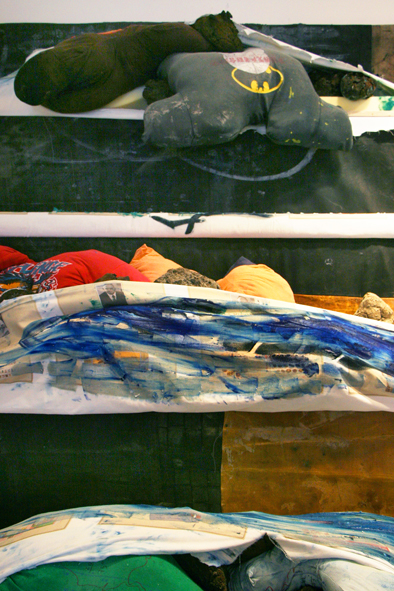
Oscar Murillo, 'Manifestation',  Oil, Spray Paint & Oil Stick On Canvas, Linen & Velvet, 2018-19


For the second time in a few posts, I find myself apologising for writing a report of an Oscar Murillo exhibition, too late for anyone to actually see it.  This time, it's mostly due to my having visited 'Manifestation' at David Zwirner's swanky Mayfair outpost, just prior to it closing - although, admittedly, it's still taken two further weeks to actually file this.  What can I say (excuses, apologies, etc.)? 


 Oscar Murillo, 'Manifestation', David Zwirner Gallery, London, July 2019


We'll just have to fall back on the fact of art production being far more of a continuum, than just a series of finite public events.  And, we're lucky in that respect, where Murillo is concerned.  The individual artefacts may linger, but the seemingly ever-morphing, context-responsive nature of his practice, means they are likely to reappear with freshness and renewed vigour, at another time and place.  Also, Murillo currently seems so prolific that the enthusiast can safely assume that, if they've missed this batch - there'll be a load more new work following along shortly.  Finally, his inclusion on this year's Turner Prize short list, means he's unlikely to fall out of the spotlight any time soon.  In reality, anyone keen to encounter his work for real (and I'd definitely recommend it), can actually do so at the accompanying exhibition - opening soon at Margate's Turner Contemporary.


Oscar Murillo, 'Manifestation', Oil, Spray Paint & Oil Stick On Canvas, Linen & Velvet, 2019,
(Detail Below)


Oscar Murillo, 'Manifestation',  Oil, Spray Paint & Oil Stick On Canvas, Linen & Velvet, 2019,
(Detail Below)


As far as this post goes, there feels little need to write another lengthy diatribe, further extolling Murillo's virtues, given that 'Manifestation' mostly cemented many of the opinions already expressed here after his recent 'Violent Amnesia' showcase at Kettle's Yard, Cambridge.  Of the two, the London show was possibly even more satisfying, purely from a painterly perspective - being largely comprised of a series of ambitious (and often  impressively large), recent paintings.  As I discussed in that earlier post, Murillo feels to me, like an exciting and confident painter - who is also unafraid to branch out in other directions (including various installation, collaborative, and time-based enterprises).  I really do admire and commend him, for that ambition, not least because it slightly mirrors my own recent aspirations (without the 'exciting and confident' part).  However, in Murillo's case, I have to accept that it really is the paintings, or painting-related works, that thrill me most.


Oscar Murillo, 'Chocolate Master After Hans Haake', Wood, Canvas, Fabric, Oil, Oil Stick,
Corn & Clay, 2019, (Detail Below


Oscar Murillo, 'When Tomorrow Becomes Yesterday',  Pen, Pencil, Graphite & Carbon
On paper, With Wood, Perspex & Oil, 2019


Oscar Murillo, 'Perpetual State Of Being', Video, 2018


At David Zwirner, the accompanying works comprised an (admittedly paint-daubed) site-specific installation, ('Chocolate Master After Hans Haake'), a modest, wall-based assemblage (again, featuring a painterly element, and entitled, 'When Tomorrow Becomes Yesterday'), and a video.  Of the three, it was the last, 'Perpetual State Of Being' which captured my imagination most effectively, as a camera wandered at random across a seemingly interminable landscape of abstract marks.  It's a simple enough an idea, and fairly low-tech in its execution (as is most of Murillo's oeuvre) - but an effective one nonetheless.  One of the features of Murillo's nominally static painting that excites me most is its demonstration of how many exuberant ways one might get across a canvas surface.  In the case of 'PSOB' the visual terrain traversed by the camera, and projected at immersive scale - directly onto the wall, makes that sense of restless movement, and of distance travelled explicit.  The title alone, seems to amplify the idea of Murillo's work as something in constant, energetic motion.


Oscar Murillo, '(Untitled) Catalyst', Oil & Graphite On Canvas, 2018


Oscar Murillo, 'Manifestation', Oil, Spray Paint & Oil Stick On Canvas, Linen & Velvet, 2018-19


Oscar Murillo, 'Manifestation', Oil, Spray Paint & Oil Stick On Canvas, Linen & Velvet, 2019,
(Detail Below)


But, as I say, it's those paintings that do it best for me.  All the pleasure I took in Cambridge, from Murillo's arsenal of mark-making devices, his painterly exuberance and celebration of paint's plastic materiality, was once more on display in London, juxtaposed with the more mechanical reconstruction of separate canvas sections and inclusion of printed motifs.  And the inclusion of another 'Catalyst' (of the kind that pleased me so much in Cambridge), demonstrated how the more complex 'Manifestation' works shown here, may well have grown out of their process (as the titling system might suggest).  In fact, the slightly ambiguous dating does allow for the possibility it could equally be the other way round (making the 'Catalysts' some kind of distillation - perhaps?).  Regardless of what order things arrive in, what really seems to matter most, is that sense of Murillo's ideas and forms perpetually evolving and morphing out of each other with a kind of self-generating dynamism.

But, if this most recent bunch are effectively just further milestones along the way - it still doesn't preclude them becoming somewhat stately, at the same time.  The results actually settle into a more contemplative, immersive mode when grouped together in a gallery.  On reflection, my lasting, take-home impression of this exhibition, probably was that very negotiation between that restless churn of each painting - when viewed at close quarters, and the paradoxical sense of repose apparent in each room as a whole.


Oscar Murillo, '(Untitled) Surge', Oil, Oil Stick & Graphite, On Canvas, Linen & Velvet,
2017-19, (Detail Below)


There were also also two more 'Surge' canvases here, to compare with the one shown in Cambridge.  All seem to evoke a sense of inundation on an oceanic scale, threatening to submerge any underlying imagery beneath the waves.  It's tempting to claim that Murillo is another artist with a penchant for working in self-contained series - but, in his case, it feels more organic, and less compartmentalised than that.  Perhaps it would be more accurate to describe these title or motif-connected works as 'families'.  Those familial ties seem to become stretched across both time and territory in his work, with individual motifs constantly  cross-fertilising as they reaching out for fresh soil.  Given his previously acknowledged themes of migration, community, and the stresses on social connectedness exerted by global economics, that sense of a fluid diaspora feels all the more appropriate.


Oscar Murillo, 'Untitled', Oil & Oil Stick On Canvas With Steel Pole, 2016-18


Oscar Murillo, '(Untitled) Surge', Oil & Oil Stick On Canvas & Linen, 2017-19


Oscar Murillo, 'Manifestation', David Zwirner Gallery, London, July 2019, (And Below)


Anyhow - enough waffle.  If Murillo's best work isn't about the sheer thrill of visual encounter, I don't know what is, these days.  Let the pictures tell the real story, then...


'Oscar Murillo: Manifestation' ran between 8 June - 26 July 2019, at: David Zwirner, 24 Grafton Street, London W1S 4EZ

'Turner Prize 2019' (Including Oscar Murillo) will run between 28 September 2019 - 12 January 2020, at: Turner Contemporary, Rendezvous, Margate, Kent CT9 1HG