Showing posts with label Kenneth Goldsmith. Show all posts

Monday, 20 February 2017

Kenneth Goldsmith, 'Uncreative Writing'


Product details
            Paperback: 192 pages
            Publisher: Columbia University Press (30 Sept. 2011)
            Language: English
            ISBN-10: 0231149913
            ISBN-13: 978-0231149914
            Product Dimensions: 1.3 x 14 x 21 cm
            Average Customer Review: 5.0 out of 5 stars
  See all reviews
 (2 customer reviews)
            Amazon Bestsellers Rank: 233,756 in Books (See Top 100 in Books)
                        #86 in Books > Reference > Writing > Poetry
            #259 in Books > Reference > Language > Communication
                   #1358 in Books > Poetry, Drama & Criticism > History & Criticism >  
                       Literary Theory & Movements


Product Description

  Review

    What Goldsmith argues has significant implications for the world of poetry, poetics, and    
    pedagogy. His book contains brilliant moments of exegesis and archival documentation,
    and its keen attention to, knowledge about, and currency in artistic practice makes it as
    much a user's manual as a scholar's tome.--Adalaide Morris, The University of Iowa

    Brilliant and elegant insight into the exact relation of contemporary literary practices and  
    broader cultural changes, explaining how the technologies of distributed digital media
    exemplified by the World Wide Web have made possible the flourishing of a particular type
    of literature.--Professor Craig Dworkin, author of "The Consequence of Innovation: Twenty-
    First-Century Poetics"

    In these witty, intelligent essays, Goldsmith brings his encyclopedic knowledge of radical
    artistic practice to bear on how the rise of the internet has irrevocably changed, or should
    irrevocably change, our existing conceptions of poetry. Goldsmith's practice as artist and
    critic is deeply interesting. His book is sure to generate lively debate among poets, artists,
    literary historians, and media theorists.--Sianne Ngai, University of California, Los Angeles

    Goldsmith achieves a very difficult feat with this book: he writes lucidly about complex and
    avant-garde ideas. As a result, he opens up a vital debate for anyone who cares about
    literature, between notions of traditional creative writing and the set of practices he labels
    "uncreative writing."--Douglas Cowie"Times Higher Education" (01/01/0001)

    Good.--James Franco, actor

    Multimedia artist and executive manager of words, Goldsmith writes a provocative
    manifesto for writing in the digital era, with a treasure trove of ideas, techniques, and
    examples that allow us to make it new--again!--Marcus Boon, author of "In Praise of
    Copying"

    Brilliant and elegant insight into the exact relation of contemporary literary practices and
    broader cultural changes, explaining how the technologies of distributed digital media
    exemplified by the World Wide Web have made possible the flourishing of a particular type
    of literature.
    --Professor Craig Dworkin, author of The Consequence of Innovation: Twenty-First-Century
    Poetics

A stimulating and provoking read, which lays out Kenneth Goldsmith’s ‘Uncreative Writing’ agenda in accessible terms, whilst suggesting plenty of strategies for dragging writing screaming into the digital era.  Goldsmith rightly asserts that literature has failed to take full account of recent technological convolutions, or to properly build upon the advances made by certain pre-digital, Modernist writers.  As he admits, the logical conclusion of his ideas about appropriation or bald transcription, may be a future in which origination or human authorship dwindle away altogether – to be replaced by the automated transfer of information as an end in itself.  That implies our current age may be a mere interim state - but one in which we might still have lots of fun playing with his conceptual strategies, whilst awaiting our ultimate deletion.  Alternatively, (should things prove to be not quite so one-directional as that implies) It's tempting to speculate whether such diversions might equally represent a more resilient ‘spirit’ - one capable of subverting algorithmic logic in somewhat less predictable ways.
- Hugh Marwood, Artist & Blogger.   

    What Goldsmith argues has significant implications for the world of poetry, poetics, and
    pedagogy. His book contains brilliant moments of exegesis and archival documentation,
    and its keen attention to, knowledge about, and currency in artistic practice makes it as
    much a user's manual as a scholar's tome.
    --Adalaide Morris, The University of Iowa

    In these witty, intelligent essays, Goldsmith brings his encyclopedic knowledge of radical     
    artistic practice to bear on how the rise of the internet has irrevocably changed, or should
    irrevocably change, our existing conceptions of poetry. Goldsmith's practice as artist and
    critic is deeply interesting. His book is sure to generate lively debate among poets, artists,
    literary historians, and media theorists.
    --Sianne Ngai, University of California, Los Angeles

    Multimedia artist and executive manager of words, Goldsmith writes a provocative
    manifesto for writing in the digital era, with a treasure trove of ideas, techniques, and
    examples that allow us to make it new--again!
    --Marcus Boon, author of In Praise of Copying

    Goldsmith achieves a very difficult feat with this book: he writes lucidly about complex and
    avant-garde ideas. As a result, he opens up a vital debate for anyone who cares about
    literature, between notions of traditional creative writing and the set of practices he labels
    "uncreative writing."
    --Douglas Cowie"Times Higher Education" (01/01/0001)

    Good.
    --James Franco, actor


Kenneth Goldsmith


 About the Author

    Kenneth Goldsmith is the author of ten books of poetry and founding editor of the online
    archive UbuWeb (ubu.com). He is the coeditor of Against Expression: An Anthology of
    Conceptual Writing and the editor of I'll Be Your Mirror: The Selected Andy Warhol
    Interviews, which was the basis for an opera, "Trans-Warhol," that premiered in Geneva in
    March of 2007. An hour-long documentary of his work, Sucking on Words, premiered at the
    British Library. He teaches writing at The University of Pennsylvania and is a senior editor
    of PennSound, an online poetry archive.


With thanks to: https://www.amazon.co.uk  https://www.amazon.ca and (as ever), Andrew Smith - for the reading list.


Sunday, 15 January 2017

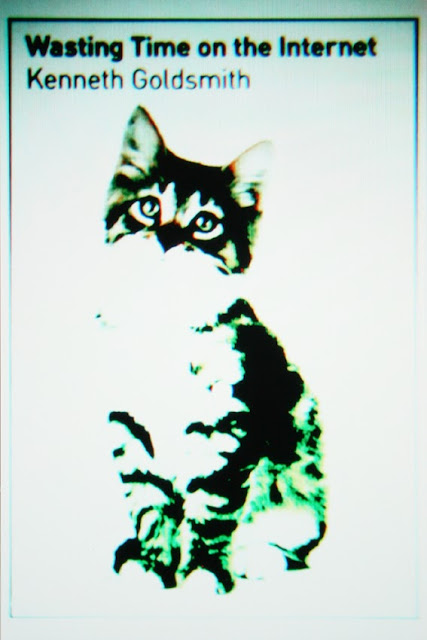
Kenneth Goldsmith, 'Wasting Time On The Internet'


I used the recent festive period to catch up on a lot of reading.  Amongst the texts consumed was 'Wasting Time On The Internet', by Kenneth Goldsmith - a writer I've been meaning to get to grip withs for some time.  It's already influencing my thinking, not least in relation to my own recent attempts to incorporate more writing into my own creative practice, and the main body of this post features a number of direct quotes from its pages.

It's worth mentioning that this, and several of the other titles currently piled by my bed, were suggested to me by my friend and fellow artist, Andrew Smith, a few weeks ago.  Andrew is as well-versed in literature and art theory as he is in visual matters, and an invaluable source of potential influences and research streams whenever we discuss matters creative.  As ever, I came away with a substantial reading list of intriguing stuff, for which I'm immensely grateful.


The following excerpts from 'Wasting Time On The Internet' form no particularly coherent narrative. They are simply passages which jumped out at me on first reading - and which seem pertinent, in one way or another, to my own current thinking. Anyone familiar with Goldsmith's ideas will also recognise that the lifting of existing content verbatim is a particularly appropriate way of interacting with his work.  Indeed, this post already includes too much original text of my own...


“A befuddling mix of logic and nonsense, the web by its nature is surrealist: a shattered, contradictory, and fragmented medium.  What if, instead of furiously trying to stitch together these various shards into something unified and coherent – something many have been furiously trying to do – we explore the opposite: embracing the disjunctive as a more organic way of framing what is, in essence, a medium that defies singularity?” [1.]

“In retrospect, the modernist experiment was akin to a number of planes barreling down runways – cubist planes, surrealist planes, abstract expressionist planes, and so forth – each taking off , and then crashing immediately, only to be followed immediately only to be followed by another aborted takeoff, one after another.  What if, instead, we imagine these planes didn’t crash at all, but sailed into the twenty-first century, and found full flight in the digital age?  What if the cubist airplane gave us the tools to theorize the shattered surfaces of our interfaces or the surrealist airplane gave us the framework through which to theorize our distraction and waking dream states or the abstract expressionist airplane provided us with a metaphor for all-over, skein-like networks?  Our twenty-first century aesthetics are fuelled by the blazing speed of the networks, just as futurist poems a century ago were founded on the pounding of industry and the sirens of war.” [2.]


“Could we say that the act of running or walking in the city is what the act of speech is to language?  Could we think of our feet as our mouth, articulating stories as we journey through the urban jungle?  And in what ways are these stories written and communicated?  When we walk, we trod [sic] upon a dense palimpsest of those who have travelled the same sidewalks before us, each inscribing upon those pavements their own narratives.  In this way, when we walk the city, we are at once telling our own stories and retelling tales of those who came before us.” [3.]


“A great inspiration for the dreamy surrealists was the nineteenth-century flaneur, an idle man-about-town who was the opposite of the zombie.  Like a dériviste (the situationists also claimed the flaneur as a predecessor), he roamed the city alone, allowing himself to be pulled by the flows of the crowds on the grand boulevards.  With no goal in mind, he was a spectator of the urban landscape, viewing the goings-on from the shadowy sidelines.  Whereas the zombie was obsessed with consuming, the flaneur assiduously avoided it, feeling that to buy something would be too participatory.  Instead, he was a world-class window-shopper, haunting enclosed arcades and narrow, winding streets, browsing the displays.  His was a stance of studied ambivalence.” [4.]


“The flaneur is hardwired into the ethos of the Internet: we ‘browse’ the web with our ‘browsers’, ‘surfing’ from site to site, voyeuristically ‘lurking’ from the sidelines…  He is a peripatetic digital wanderer, pulled by the tugs and flows of hids feeds, carelessly clicking from one spectacle to the next.  Instagram is his Louvre, YouTube his Ziegfeld.” [5.]

“What if the poetic has left the poem in the same way Elvis has left the building?  Long after the limo pulled away, the audience was still in the arena screaming for more, but poetry escaped out the back door and onto the Internet, where it is taking on new forms that look nothing like poetry.  Poetry as we know it – sonnets or free verse on a printed page – feels akin to throwing pottery or weaving quilts, activities that continue in spite of their cultural marginality.  But the Internet, with its swift proliferation of memes, is producing more extremes of modernism than modernism ever dreamed of.”  [6.]


[1 - 6]:  Kenneth Goldsmith, 'Wasting Time On The Internet', New York, Harper Collins, 2016.