 |
| Mandy Payne, 'Urban Arcadia', Spray Paint & Oil On Concrete, 2018 |
With the Half Term break, and enjoyably mellow autumn weather, came an opportunity to get out and about, and to take in one or two exhibitions by other artists. It makes a nice change from fixating on one’s own, as I certainly was for much of the year. One such is ‘Out Of Place’ by Mandy Payne, at The University of Nottingham’s Lakeside Arts, Angear Visitor Centre.
 |
| Mandy Payne, 'Out Of Place', Angear Visitor Centre, Lakeside Arts Centre, University Of Nottingham, October 2018 |
 |
| Mandy Payne, 'High Rise II'. Spray Paint & Oil On Veneer Paper Backed Nut Tree On Panel, 2018 |
I’ve met Mandy briefly, a couple of times, at Leicester Print Workshop (where she carried out a two-year residency). It was there that I saw her working on some of the lithographs in this show - and I’d also seen a few of her small, meticulous paintings, at various venues, in recent years. However, this was my first opportunity to see a large selection of her pieces together, and to gain a greater degree of perspective on her work.
 |
| Mandy Payne, (L.): 'Faded Glory'. Lithograph On Paper On Concrete, (R.): 'Changing Spaces', Lithograph & Multiple Monoprints On Paper On Concrete, 2017 |
 |
| Mandy Payne, (L.): 'Stripped Bare', (R.): 'Pretty Vacant' Lithograph & Monoprint On Paper On Concrete, 2017 |
It’s fairly predictable that I’d be drawn to her work, given her fascination with mid-twentieth century Modernist/Brutalist architecture, and her appropriately formal approach to depicting its austere geometries and grids. My own interest in such subject matter is no secret, as is my similar relish for the (often frontal) compositional formality it inevitably inspires. I also share an interest in the idea of failed Utopias, implied by the very subject matter itself. In fact such stuff has become a pretty familiar trope in various quarters, of late. I’ve written about George Shaw’s paintings ofthe mid-twentieth century Tile Hill Estate on more than one occasion, and also about John Grindrod’s engaging survey of Britain’s architectural forays into ‘utopian’Modernism, 'Concretopia'. When I occasionally summon the energy to attend to my Twitter feed, I also find regular bulletins from The Modernist magazine, This Brutal House, and The Manchester Modernist Society - all suggesting this is far from an isolated enthusiasm. I’m often tempted to think it might mostly reflect a nostalgic reframing of the long-abandoned, and seemingly misplaced, idealism of a world some amongst us (of a certain vintage), were born into. The subsequent questioning of our own place in a changing world inevitably follows.
 |
| Mandy Payne, 'Carpenter's Estate II', Spray Paint & Oil On Concrete, 2018 |
 |
| Mandy Payne, 'Gone But Not Forgotten I', Spray Paint & Oil On Concrete, 2018 |
Whatever the motivation, Sheffield-based Mandy Payne has a prime example of surviving Modernist public housing on her doorstep, in the city’s in/famous Park Hill Flats. That complex has presided over Sheffield like a forbidding rampart for decades, and is impressed on my own memory from childhood family excursions there in the 1970s. Park Hill became symbolic of both what might be achieved by a centrally planned public housing policy, but also - what might go awry when progressive idealism, political/financial expediency, and formulaic design ideology conspire to create an inadvertent dystopia. That’s a well-told tale, of course, and clearly open to interpretation and individual prejudices. Either way, our current free-market era has generally sought to deride or overwrite the architectural evidence of the Post War Consensus - either by demolishing or ‘gentrifying’ them (for which, read - often tarting-up beyond the reach of their original tenants).
 |
| Mandy Payne, 'Broken Brutalism', Spray Paint & Oil On Concrete, 2018 |
 |
| Mandy Payne, 'Love Don't Live Here Any More,' Spray Paint & Oil On Concrete, 2017 |
That process of post-modernist renovation and up-speccing has certainly been applied to portions of Park Hill in recent years, but it’s notable that Mandy’s artistic gaze remains resolutely fixed upon the begrimed concrete, austere brutalism and generally dilapidated aspect of its untransformed regions. Her notes accompanying this exhibition claim that gentrification is an issue she’s definitely engaged with, but if I’m honest – I took little in the way of conceptual discourse, or critical analysis from viewing the work itself. Mandy’s work appears primarily visual in its motivations, and sits resolutely in the familiar traditions of painting and printmaking. Her meticulous and often intricate paintings (often executed on small, individually cast concrete slabs) suggest it’s all that delicious interlocking geometry - along with a desire to record the ravages of time and neglect in minute detail, which really concern her. This occasional fracture between an artist’s stated intentions, and whatever slightly differing motives might really be betrayed, is something that interests greatly, as indeed – is the constant tension between the desire to engage with a theme or concept and the often irresistible pull of the purely sensory/visual. It’s also only fair to admit that I’m as susceptible to the immediacy of the primary visual response as the next artist – despite habitual claims to be exploring ‘layers of meaning’ or the pretense of having reached for some supposed heightened degree of conceptual rigour, in my own work.
 |
| Mandy Payne, 'Between Boundaries', Spray Paint & Oil On Concrete, 2018 |
What the resolutely level gaze, uniform illumination, and seemingly objectivising aspirations of Mandy’s chosen style do suggest rather beautifully, however - is a kind of hyper-real freezing of time. This is further magnified by the eerie absence of human life, or evidence of any real animation at all within her chosen spartan settings. There are definite stylistic (as well as historical) similarities here with George Shaw’s carefully depicted estate visions of a world now accessible only through memory. Despite that, her paintings appear to resist the tendency toward photo-realism towards which Shaw’s images have occasionally slid. For him there also seems to be an elusive element of lyricism - suggesting a degree of personal melancholy. Mandy’s images feel, if anything, more depersonalised - and therefore, perhaps more like collective memories than meditations on personal history.
 |
| Mandy Payne, 'Brave New World', Spray Paint On Concrete, 2018 |
My response to Mandy’s interesting use of concrete as a substrate for many of her paintings is firstly, that this is both a pleasingly appropriate idea - and indeed, the kind of thing I could easily imagine having attempted myself in the same situation. However, that is coupled with a slight disappointment that she hasn’t exploited the idea a little less discretely. Careful examination of the paintings is required to reveal that, what appear as carefully painted concrete surfaces, are actually the raw, locally coloured material itself - modulated with carefully sprayed shadows. This incorporation of physical materials comes more to the fore in some of her newer paintings of similar subjects outside of Sheffield. Here, she uses marble slabs as a support - employing its characteristic veining as a more abstract solution to depicting areas of sky. Perhaps she's making more overt reference to the perceived status of rival building materials, and associated issues around low/high-grade accommodation, in the process.
 |
| Mandy Payne, 'Precinct 1', Spray Paint & Oil On Marble, 2018 |
 |
| Mandy Payne, 'Precinct II', Spray Paint & Oil On Marble, 2018 |
That all feels like something I’d personally love to see Mandy push further, and more experimentally, in future work. It might also be something she could exploit further, or more noticeably, by increasing the scale of some of her images (although admittedly, not without a new set of technical challenges). Certainly, their current dimensions, and detailed nature, require her to refine her concrete surfaces to such a degree that the material's characteristic surface qualities are somewhat lost. In addition, my first reaction was that the modest scale of all of this existing work is perhaps also something of a missed opportunity to fully engage with the monumental immensity or engulfing immersion of the environments she depicts. However, on further reflection, it does feel suggestive of domesticity, rather than of the over-imposing or self-aggrandising - both being standard accusations against Modernist architecture. It is thus, an important reminder that what Park Hill’s authors were always supposed to be engaged with, was the provision of livable homes for real people. Ultimately, it may actually be that Mandy is prioritising a more nuanced or balanced consideration of her chosen subject matter, over the more standard sensationalist readings often applied to it.
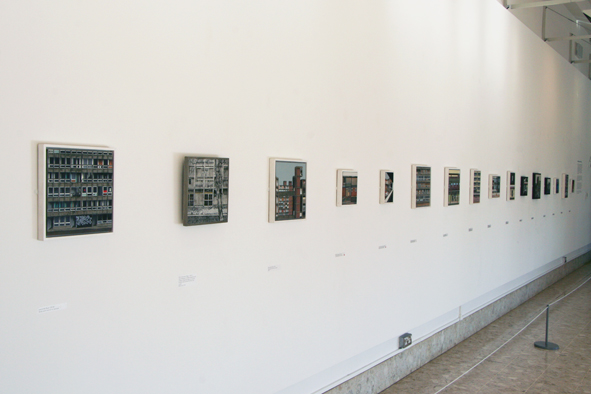 |
| Mandy Payne, 'Out Of Place', Angear Visitor Centre, Lakeside Arts Centre, University Of Nottingham, October 2018 |
I’m aware this
discussion of ‘Out Of Place’ might appear
somewhat hedged about with criticisms, or even like I’m rather crassly trying
to tell Mandy Payne how she should be doing her own work. Hopefully, I’m really just trying to imagine how I would approach it myself – because it does occupy a
stylistic and thematic area I could easily imagine occupying. My
comments actually come from a feeling of real engagement with the work. As it is, and regardless of anything else
written here, I genuinely enjoyed viewing pretty much everything in Mandy’s
show, and also the way it all hangs together in its current, beautifully
illuminated venue. There’s
relatively little time remaining to view the exhibition, but I’d definitely
recommend it, should you have the opportunity.
Mandy Payne: 'Out Of Place' continues until 28 October at Angear Visitor Centre, Lakeside Arts, University Park, Nottingham, NG7 2RD


