Showing posts with label Travel. Show all posts

Sunday, 22 March 2026

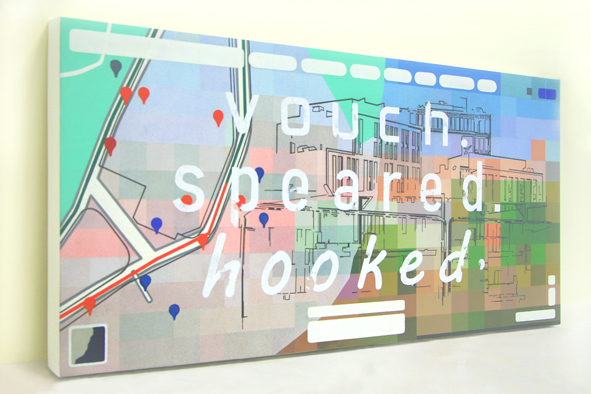
Completed Painting: '[dc]circuit 03/Proust'


'[dc]circuit 03/Proust', Acrylics, Paper Collage & Mixed Media on Panel,
600 mm x 400 mm, 2026


Here is the third panel in my set of five '[dc]circuit' panels, the full title being, '[dc]circuit 03/Proust'. In this case the literary reference is to Marcel Proust's magnum opus, 'À la Recherche Du Temps Perdu' - in particular, the second volume (of seven), 'A l'Ombre des Jeunes Filles en Fleure' [1.]. Continuing in the same stylistic mode as '[dc]circuit 01' and '[dc]circuit 02', the rhizomorphically reconfigured cartography here relates to Paris and Proust's fictional resort of Balbec (in reality, Cabourg in Normandy), as well as to my own immediate environment in Leicester. A key element of Proust's novel is his (unreliable) memories of youthful seaside holidays, of illusions inspired by travel in general, and of the emotional impact of rail travel, in particular. It is therefore no coincidence that cartographical references to Parisian railway terminals, the Grand Hotel and Casino in Cabourg, and Leicester's long-since repurposed Great Central Railway Station are all visible in this piece.


The elusive philosophical relationship between space and time are key concerns in all of this 'Deleuzian Cartography' work of mine, just as they are in Proust's writing. It's also fair to say that this panel is just as powerfully influenced by the philosophical modelling of time outlined by  Proust's contemporary, Henri Bergson, as it is by the complex ideas of Gilles Deleuze himself. Bergson's ideas prefigure Deleuze in several respects, and he also offered a subjective/metaphysical account of time as an alternative to the strict Relativity of Einstein's since-dominant model. My own humble intention is not to necessarily take sides with any of these super-brains (or even to claim full understanding of their ideas) but rather, to take delight in the push and pull of their various interpretations/explanations of 'Existence', as they play out in the overlapping arenas of Art, Science and Philosophy. If, as the LED circuit motifs recurring throughout these paintings suggest, a modicum of enlightenment is available, it is still hard-won. Nevertheless, the questions are always far more interesting than the answers, so why not start with the 'easy' ones? 


Of course, it's impossible to think about Proust (or Bergson), without reference to the nature of memory, and how we continually use it to reprocess our experiences within our perceptions in the present. The subjectivity and corruption of our memories have long been noted by numerous writers, thinkers and brain-scientists, and seem, if anything, even more pertinent in an age when increasing amounts of our thinking and remembering are contracted-out to machines. The visual hint toward corrupted pixellation, and gigabyte labelling in this piece are included as nods to this.


As already mentioned, there's yet another strand of possible meaning layered into the colours used in this '[dc]circuit' suite. Superficially, the yellow chosen here seemed a perfect accompaniment to the summery vibes of Proust's reflections en vacances, but is also emblematic of the third reactive stage identified by many of the historical practitioners of Alchemy, in their attempts to manufacture physical gold and/or spiritual enlightenment. This is also true of the black and (nominal) white of the two previous panels. You may be already despairing at my eagerness to overload these paintings with yet more pretentious thematic freight, and the tradition of Alchemy is certainly a complex subject to be casually tossing-in (and one with numerous potential interpretations of its own). However, the relationship between hard science and subjective philosophy do appear to be of clear relevance again here. It's also worth noting that all of my current work seems to come about as much as a result of the books I happen to read during my regular coffee-fuelled local perambulations, as from the spaces I physically inhabit whilst on them. During the gestation of these pieces, this included a history of Prague (an alchemical hot-spot) amongst all the other posh literature and baffling French philosophy. This organic, often random or impulsive, drip-feed of information, and the tangle of mental correspondences it inspires, seems very much in the Deleuzian spirit of energy flows, lines of flight and immanent production - to me, at least. Anyway, I'll try to offer a few more clues about this alchemy business in my next related post...


[1.]: Marcel Proust, 'In Search of Lost Time', Vol 1 'In the Shadow of Young Girls in Flower' (Trans. James Grieve), London/NYC, Penguin, 1919/2003


[Sans A.I.]


Sunday, 12 February 2023

Completed Painting: 'Tourist View 2'


'Tourist View 2', Acrylics & Paper Collage, 400 mm x 800 mm, 2023


Early morning hours are usually the best time to visit as there are fewer people. It’s still busy with numerous tours meandering about, and not once did they raise their heads to acknowledge us. Note that the police will scan you and your luggage at the entrance - just as at the airport. The staff are behind large plastic screens, in a very small foyer that is neither warm nor inviting. Safe access to the facilities is ensured, which is is kind of to be expected - but it leads to long queues, especially during peak hours. With that also comes a ticket-bonanza that I didn't understand. First it is a regular paper ticket, and then an electronic ticket that is scanned with this QR code. They don't seem to give you the same access to things, even though they cost the same. A more elaborate ceremony takes place around noon and is worth seeing (if very uncomfortable). We, a group of 8, stayed for 2 weeks. We sat in the same booth every morning, and it concerned me that my daughter would drop her muffin under the table on the first morning.


Our room had a view of the roof and the bin store. We spent a good hour inside there. The city is very impressive. There is so much to see and so much history to experience. It is said you can stroll through the picturesque stoned streets, or have a coffee, or shop for souvenirs. There are many small shops selling wooden carvings or books or magnets etc. The room was clearly not cleaned properly as even the soap looked used. The shower was okay, but rather weak. The TV is huge and our couch turned into a bed. Our kids were too tired to sit down when we needed them in their pyjamas. That’s unacceptable! We complained to the staff and they said they would sort it out before we left. It is such a shame that the toilet was not cleaned because the breakfast the next morning was very good, and the restaurant staff were very helpful. We saw a young boy going around wiping the tables without moving the cutlery, condiments or napkins. He found only skid marks.


I was told that there is no washing machine or ironing facilities at Reception. I think it requires a paper ticket - you can't make a separate payment just for them.  Laundry service was available the next day, but no maid service - we had to go and buy our own softener, refreshments and souvenirs. On the second day, the washing was interrupted by a thunderstorm. During all these 3 days I spoke to 3 different people at Reception. I felt it was enough to stand at the back, where you can see many flowers and peacocks among them - and to pick up some owls. I would recommend buying the audio guide as well, otherwise half the site remains a mystery. The AC in the room turns on automatically at night and my Dell laptop has the same problem. The room has, as you would expect, an expensive coffee maker and an iron and ironing board. Wi-Fi is very, very bad, even in the restaurant or lobby - and forget about it in the room. Take the tram if walking is a problem.


Saturday, 14 January 2023

Completed Painting: 'Tourist View 1'


'Tourist View 1', Acrylics & Paper Collage & on Panel, 400 mm x 800 mm, 2023


  • Two views across two rivers - separate in space and time.
  • Two view_points, in two individual square metres - located on two different screens. 
  • Two re_invented territories. 
  • Two visitor destinations [re_viewed].


[Translation]:

Beautiful day and night. Make sure you get there early and get your vstupenky (also available from Get Your Guide for the same price as the castle) and you will be in St. Wein by 9am. A beautiful cathedral and worth a stroll from the outside, the interior and exterior is quite remarkable. The other areas are nice too and add context to the countries and their various functions. Take the tram to the north entrance, this explains the many stairs and the uphill. There are a number of pay toilets and a small poorly advertised shop. ATTENTION: you often have to take tram 22 to get there. This tram caters to English speaking visitors who have paid for tram tickets but don't read the fine print on the back which requires confirmation to avoid fines (but the istegstadia isn't shown in yellow boxes on the walls of the tram). If you're lucky, the subway cops will take advantage of novice status and fine you about $80 per person in your group, show you the credit card machine, and threaten to ru the Policii Pass if you propose umírá. It looks a bit like targeting, profiling or snooping. If we were law breakers we would NOT have a ticket marked with the interval it IS valid for, date and timed instead of a PAID Vstupenky. It was a quick reminder of a visit to the castle and certainly contributed to the fact that no more money was spent on jewelry that day. The government appears to need more cash than the local economy struggling to recover from Covid. Shame on the subway police, and intimidation and little empowerment is a step too far. A great castle and cathedral, a bit corrupted by government greed.


[Translation]:


Excellent location, it's in a refurbished part of town opposite a fabulous John Lewis store. The rooms are also excellent, large TV, good air conditioning, comfortable beds, safe, drinks cooler and the usual little things you would expect, no noise from other rooms the night we stayed, cleanliness cannot be faulted, the two smaller sinks is a special design, the kettle doesn't fill, the battery is so low by the sink, the kettle is level, you have to fill it with mugs, and there is a tall cylindrical light in the main room, next to it is a window with a hidden LED bulb, really bright light, much better than the normal dim light in the room you usually have in hotels, but the only way to turn it off is to kneel down and connect the floor to the horizontal socket between the beds. The shelf and the lamp itself have never had a light without a switch in hotel seen. Not clear if there is another way to turn it off as I explained.


My only complaint is that this hotel reception is small and only a few metres from the front door, which means that if there is a very small queen and the receptionist (male) spoke in a whisper and had to ask him about any guests I can pick up, he repeated that the other (male) younger man at the front desk looked like he just got a new one, his house was taken away, there was no good reception from this new body, otherwise everything was fine.


Tuesday, 26 April 2022

Proustian Diversion 2.1 (Travel Guide: Painting Remix)


All Photo-Manipulations: April 2022


"...the specific pleasure of travelling is not that it enables one to stop when tired or stay somewhere along the way; it is that it can make the difference between departure and arrival not as unnoticeable as possible, but as profound as possible; it is that one can experience that difference in its entirety, as intact as it was in our mind when imagination transported us immediately from where we were living to where we yearned to be, in a leap which seemed miraculous less because it made us cover such a distance than because it linked two distinct personalities of place, taking us from one name to another name, a leap which epitomized (more acutely than by a run in a motor-car, which allows you to get out where you like and thereby all but abolishes arrival) by that mysterious performance that used to be enacted in those special places, railway stations, which, though they are almost separate from the city, contain the essence of its individuality, as they bear its name on a signboard." [1.]


Claude Monet, 'The Gare Saint-Lazare, Arrival of a Train', Oil on Canvas, 
1877, Harvard Art Museums


Claude Monet, 'The Gare Saint-Lazare (Interior View of the Gare Saint-Lazare, The Auteuil Line)',
Oil on Canvas, 1877, Musee d'Orsay, Paris


"Sad to say, those wonderful places, railway stations, our starting-point for a distant destination, are also tragic places, for though they are the setting for the miracle which will turn a land hitherto non-existent except in the mind of into one we are  going to live in, for that very reason, as soon as we venture outside the waiting-room, we must abandon all hope of returning to the familiar bedroom which we left only a moment before. We have to give up all prospect of sleeping at home tonight, as soon as we have decided to venture into the reeking cavern which is the necessary anteroom to mystery, one of those huge glass-roofed machine-shops, such as the Gare Saint-Lazare, which was where I had to seek out the train for Balbec and which, above the great chasm slitting the city, had spread out one of those vast bleak skies, dense with portents of pent-up tragedy, resembling certain skies of Mantegna's and Veronese's fraught with their quasi-Parisian modernity, an apt backdrop to the most awesome or hideous of acts, such as the Crucifixion or a departure by train." [2.]


Walter Richard Sickert, 'St. Mark's, Venice (Pax Tibi Marce Evangelista Meus)',
Oil on Canvas, 1896 (Tate Gallery Collection)


[1. & 2.]: Marcel Proust, 'In Search of Lost Time, Volume 2, In The Shadow of Young Girls in Flower', Part II: 'Place-names: the Place' (Trans. James Grieve), London, Penguin Books, 2002/1919.