Saturday, 15 February 2020

John Walker: 'New Paintings' At Ikon, Birmingham


John Walker, 'Still Life I', Oil on Canvas, 2018


I was over in Birmingham recently, visiting my friend Andrew Smith, and found myself at Ikon, reacquainting myself with the paintings of John Walker, after nearly four decades.

Birmingham-born Walker seemed to have garnered quite a lot of favourable attention, around the time I was studying Fine Art, in the early 1980s.  And yet, as an abstract painter -  and one whose work was largely landscape-derived, it also felt like artistic fashion was fast leaving him behind.  Behind his roughly scumbled brushwork and clotted surfaces, and despite the suggestion of recessive or theatrical illusionistic space, in his work - the fact remained that Walker was rooted in the essential language of formal abstraction.  In 1982, when I was hesitantly moving in a similar direction, that could often feel like the increasingly obsolete language of a previous generation.


John Walker, 'Recent Paintings', January 2020


John Walker, (R) 'Passage', 2015 & (L) 'Ripple', 2017, Oil On Canvas


John Walker, (R) 'Nomad II', 2018 & (L) 'Looking In', 2017, Oil On Canvas 


A year earlier, Norman Rosenthal's massive 'A New Spirit In Painting' survey at The Royal Academy had laid down a pretty unmissable marker.  It covered a wide gamut of styles, and included not a few established names.  However, the message was still pretty clear: if painting was to contradict the 'painting is dead' brigade, in a world where photography and Conceptualism had apparently claimed the future - it wouldn't be by extending the legacy of Modernist abstraction, apparently.  I remember trudging round the Academy, wanting to be pleased by the sheer quantity of painting on offer, and yet simultaneously perplexed that there was so little of kind of stuff I had begun to identify with.  Richard Diebenkorn, Robert Delaunay, and assorted Cubists and colour-field painters, were my newly-found heroes -  but now, no one else seemed particularly interested in them.  Expressionism was definitely a thing, but it was the figurative, German kind - not the American abstract variety.  The figure definitely trumped landscape, where subject or sources were concerned.


John Walker, 'St John's Bay Red, Yellow, Blue', Oil On Canvas, 2011-18 (Detail Below)


Of course, with the benefit of hindsight, it's now possible to see how I was there, just as painting had taken an official right-turn into what became labelled Post Modernism.  At the age of 19, however, I rather lacked the perspective to appreciate that - taking it all rather too personally, instead - I fear.   When I discovered Walker, in the library of Bristol Polytechnic's Arts Campus, shortly afterwards, I was pleased to find a contemporary abstractionist of the kind I wanted to affirm, but equally disappointed to note he was already resorting to depicting skulls alongside his trademark folded planes.  They felt like corny shorthand for some synthetic, non-specific angst - and like he was suddenly trying to play catch-up, with a spot of fashionable cartoon voodoo.   And that was pretty much the last time I thought much about him - until I walked into Ikon, with Andrew, 38 years later.  


John Walker, 'Fishing With Tom And Les', Oil On Canvas, 2017


John Walker, 'Lowe Lode', Oil On Canvas, 2019


Well, the good news is, the skulls are gone (although replaced by the occasional cut-out fish), the language is once more, resolutely abstract, and the overall context - clearly landscape derived.  Ironically, though, it's now me that has come to accept that the natural landscape (be it Cornish coastline, or American desert), isn't really my subject at all - and that painting in its pure sense, isn't even really my first language any more.  But, enough about me - this is supposed to be about John Walker's painting.  This deep into his career (and indeed - his life) there seems to be some vindication, in this late work, of the idea of sticking to one's guns, or at least reconnecting with one's original motivations.


John Walker, (R) 'John's Bay Pollution', 2017 & (L) 'Ripple', 2017, Oil On Canvas 


As for the paintings themselves, there's clearly no lack of confidence or assertion there.  Walker evokes his current adopted home environment, on the New England coast, with a vocabulary of crudely-daubed  angular waveforms, parallel bands, wonky chequerboard grids, truncated ellipses, and those occasional dangling fish motifs.  Although distinctly maritime, the palette is bold and direct, sometimes reverting to a monochrome (or something close-to) scheme of largely unmixed colour - often contrasting with clean whites, and with an impact that might be described as emblematic.  There's a distinct echo of Jasper Johns or even Frank Stella in all those repeating rhythms of lines and alternating stripes - although they're being employed here for far more imitative, and far less conceptual reasons, it should be recognised.


John Walker, 'Tidal Change', Oil On Canvas, 2017


John Walker, 'Place', Oil On Canvas, 2018


For, what Walker is actually doing, is to both distill and compile his landscape experience into a collision of separate glimpses and impressions.  This is the kind of simultaneity first devised by Cezanne, before being fully capitalised upon by Braque, Picasso, and the subsequent waves of Cubists, who followed them.  It also feels related in some way (albeit - with far less west coast shimmer, or refined elegance) to Diebenkorn's distillations of a coastal landscape.  Actually, a more apposite connection might be with a painter like Peter Lanyon, whose synthesis of the Cornish landscape famously came from swooping over it in gliders, and whose energetic, looping calligraphy and sweeping painterly gestures captured, within them, both time and motion.  Like Lanyon, Walker eschews the horizontal skyline (the portrait orientation of these canvases is no accident), and all those repeating stripes and zig-zags must surely chart the endless rhythm of waves, possibly observed on separate tides, and subject to varying marine temperaments. 

However, whilst Lanyon's best work appears to soar above his coast in a vortex of light, weather, and free movement, these paintings by Walker describe a far more rugged, and possibly constrained, situation.  The geometry may be wonky, but it's structural nonetheless - suggesting perhaps the funnelling of ocean tides between harbour walls, jetties or quaysides.  Walker may evoke the sea, but he appears to do so with his feet firmly on dry land.


John Walker, 'Nomad I', Oil On Canvas, 2018


Another feature which strikes me is his almost wilfully careless approach to paint application, along with the stark economy of much of this work.  In Lanyon, there is often a veiling of colours, or a kind of overwriting of marks, however rapidly they may have been laid down.  However, in many cases, Walker's marks appear to be the first and only thing he put down, before simply moving on to the next, equally slapdash statement.  In this situation, it's the accumulation, and the method in which those marks are all packed into the overall composition, which give the painting its sense of gravity.  In this respect, the paintings remind me of the way Patrick Heron's late garden paintings became comprised of hastily-sketched, and increasingly insubstantial, notations for the plants he wanted to describe - whereas he might have once immersed the viewer in lush fields of unbroken colour.


John Walker, 'Nomad II', Oil On Canvas, 2018


Is this something that happens to certain painters as they work on into old age - I wonder?  Does the urgency to still make paintings press up against the dwindling away of the time remaining in which to do so?  If I'm honest, the lack of tension in so many of Walker's marks, or concern over their perceived 'quality', disappointed me rather on first viewing.  First impressions can, of course be deceptive, but even now, I find these canvases far more pleasing when viewed across the room, or even - as here, in miniature reproduction.  In either case, a degree of internal tension returns as the image becomes more condensed upon the retina.  If his direct, unmodulated attack, represents a thoroughly courageous, and unselfconscious method of painting (as it certainly does), my own, rather more weaselly sensibilities are still drawn more towards those canvases upon  which a degree of layering, modulation, or visible over-painting has occurred.


John Walker, 'Stern View', 2017, Oil on Canvas


John Walker, 'Black Paint', Oil On Canvas, 2015 (Detail Below)


John Walker, 'John's Bay Pollution', Oil On Canvas, 2017 (Detail Below)


Perhaps then, John Walker is one of those artists with whose work I'm destined to always have a slightly strained relationship, (despite approving of it whole-heartedly, in principle).  Perhaps it's just a question of commitment.  Walker seemingly wields his brush with the minimum of hesitation or concern for the crippling niceties of painting.  He also pushed on through the vicissitudes of fashion, and inconvenient Art History, to pursue his core vision, regardless.  I, on the other hand, gave up even trying to be anything as noble or straightforward as a pure painter, some years ago.


John Walker: 'Recent Paintings', continues until 23 February, at Ikon, 1 Oozells Square, Birmingham, B1 2HS

'A New Spirit In Painting', ran from 15 January - 18 March 1981, at: The Royal Academy of Arts, Burlington House, Piccadilly, London W1S 3ET


Sunday, 9 February 2020

'Constructed City' 11: C


All Images: 'Constructed City' Screen Prints (Work In progress), Leicester Print Workshop,
February, 2020


...And the Cyan layer goes on to the first of my CMYK separated photographic 'Fragments'.  The aim is to print a small edition of these as straight as possible, with the occurring at a later collage stage.  Inevitably though, a few minor accidents, and a few deliberate experiments have crept in along the way too.  I'll see exactly what I've actually got, once the black goes on.  With valuable Half Term hours on the horizon - that should be achieved by the end of this month.


Monday, 3 February 2020

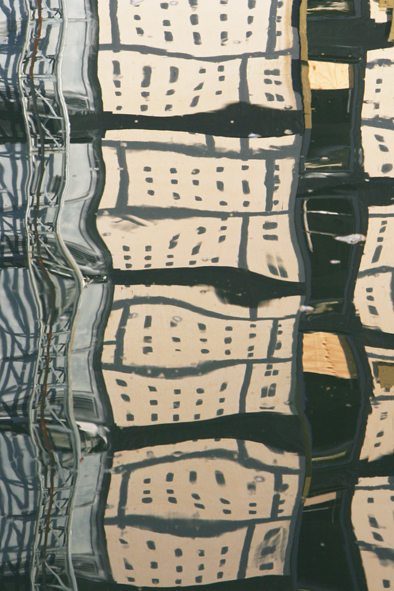
Deconstructed City (See - I've avoided titling this, 'On Reflection')


All Images: West Leicester, February 2020


...Because sometimes it's difficult to avoid the old cliches.  It can be a real drawback of maintaining a 'visual stimuli first' approach to one's art, I suppose.  I've thought (and written) quite a bit about the matter in recent times, as I've reflected on how I most successfully operate creatively.  It's pretty indisputable, at this stage, that whatever possible readings or theoretic/conceptual subtexts, I might aspire to in my work, it always feels more convincing when they are filtered through something I've seen (or picked up) out there in my immediate environment.  For me, the spontaneous thrill of recognising something via the senses (and therefore, a millisecond or two faster than the brain can process it), is always a slightly more vivid thrill than can be gained through research or the piecing together of ideas and narratives.  That stuff's all important, and hopefully integral to the final outcome - but the fact remains that evolution put my eyes just in front of my brain, looking outwards.


The drawback, of course, is that such unfiltered visual thrill-seeking can sometimes lead one to the kind of unquestioning eye-candy, that might have once graced the pages of something like 'Amateur Photographer' magazine, sometime back in the 1970s.  The danger is only amplified on a rare January day of crystalline sunlight, vivid blue skies, and a pleasingly undulating river surface - as happened here.


I suppose I could tell you these images constitute a knowing variant on my routine documentation of major construction projects - or that they subvert all that systematic constructivism, and are critiquing the expedient redevelopment of my already highly-structured environment.  I could even pretend it really is a retro-savvy appropriation of a bygone photographic trope.  But, if I'm honest - these are nothing more than a pleasurable diversion, and will likely play no actual part in the 'Constructed City' project at all.  I took them simply because, in the moment, it all just looked bloody lovely.


Sometimes - perhaps that's still enough.  You know - it's that really obvious kind of beauty. 


Friday, 31 January 2020

'Constructed City 10': Y/M


All Images: 'Constructed City' Screen Prints (Work In Progress), Leicester Print Workshop,
January 2020


Progress continues apace, and the yellow, and much of the magenta, have gone down on the first of my 'fragments'.  These colour-separated images will ultimately supply a wholly photographic element within my proposed 'Constructed City' composites, and I'm hoping there'll be quite a few.  One thing at a time though; for now I just need to concentrate on keeping that registration as tight as possible.


'Fragment' (Source Image), Photo-Manipulated Digital Image.


Thursday, 23 January 2020

'Constructed City 9': Clocking Back On


All Images: 'Constructed City' Screen Prints (Work In Progress), Leicester Print Workshop,January 2020


Having filled-in the Festive print studio recess with a bit of cheeky painting action, I got back into Leicester Print Workshop, the other weekend, and picked-up from where I exited 2019, with the 'Constructed City' project.


I spent an hour or two laying down another grey layer on some of my still-active prints (which, like everything else, should ultimately form sections of something larger), but the main effort really went into preparing some new screens.  These will be used to print the first CMYK element of the project, and thus represent a significant step forward in a project that, for purely logistical reasons, is progressing incrementally.


In the long-run, there'll be a number of these photographic CMYK sections, and it occurs to me that their actual printing should become fairly rapid (being largely a matter of mechanically reproducing already resolved images).  Hopefully, that means the whole project will feel like it's accelerating into 2020.  We can but hope.


There's little else of significance to say just now - so I'll detain you no longer, and we can all just get on with our day.


Tuesday, 21 January 2020

Completed Painting: 'Untitled (From The New School) 13'


All Images: 'Untitled (From The New School) 13', Acrylics & Sprayed Glitter Paint On MDF,
30cm X 30 cm X 10.6 cm, 2020


After starting the year with a somewhat self-indulgent look back (over four decades of popular music, no less), it's time to redress the balance with something new.  This recently completed piece is the latest in my occasional (but definitely still on-going) series of 'From The New School' paintings.  It feels far too long since I had anything actually finished to show, although there's plenty of work in progress - with my 'Constructed City' and 'This S(c)eptic Isle' projects still occupying most of my thoughts.  Pleasingly, I'm working with a little more energy and consistency again, these days - but it's simultaneously the case that gestation periods seem to have extended within both those enterprises.


In that context, producing these little panels provides a useful punctuation within the overall continuum.  I tell myself that just delivering 'product' really shouldn't matter, and yet... They're kind of therapeutic, too - with each providing a compact and self-conscious opportunity to adopt a different aesthetic or mode of painting within a standard format.  You can read far more about the rationale behind the series here.  Suffice it to say, it feels highly appropriate that I've been able to paint every one of them on the premises, at lunchtimes and after hours, around my employment as a School Technician.


In this case, I reverted back to the crisp formality (and a pretty similar palette) of the very first two.  The challenge here was to make an unashamedly shiny version, using various metallic paints.  It came about after repeatedly bemoaning the tendency amongst certain of our GCSE Art students to 'improve' their exam work with an unexpected application of glitter (or even sequins) - regardless of how inappropriate to the image that may seem.  I decided to join them, rather than trying to beat them - and to find out what happens if you commit whole-heartedly to something you might otherwise dismiss as slightly kitsch.  After all, Chris Ofili, Fiona Rae, and centuries-worth of religious artists all tried the shiny stuff - and it hardly held them back.


I won't pretend the painting's shimmer doesn't cheer me immensely - so perhaps the kids really are onto something.  All joking aside - it's all too easy to see any piece of work through one's own Western, and possibly Modernist, Art glasses.  No single culture or tradition has the  monopoly on aesthetics or taste, after all - does it?


More importantly still, it also gave me an excuse to buy the aerosol can of glitter paint I'd been secretly hankering after in B&Q, for so long.


Sunday, 19 January 2020

Simon Reynolds: 'Rip It Up And Start Again' / Playlist 15


Despite all the obvious contra-indications, out there in the wider world, I've perversely commenced the new year/decade in a generally positive mood.  If, as seems the case, the species is so resolutely keen to embrace calamity, both locally and globally - then perhaps the only way forward is to just ignore all the nonsense, and focus on stuff one has control over, with as much creative energy as can be mustered.  If the psychos and idiots are so determined to spread misery and suffering wherever they can - then perhaps seeking joy and constructive fulfilment, in defiance, can become a quasi-political act in its own right.  Whatever the philosophical validity of that may or may not be, it feels like I've been able to skate over the first few days of 2020 with relative alacrity, and even make a few small steps forward, in various directions.  Is it not then, perhaps equally counter-intuitive, to be starting the new decade with a singularly retrospective post?  Well, I never claimed to be a slave to logic - did I?

What this actually is, is one of my occasional playlists - this time stimulated by reading Simon Reynolds' entertaining survey of the immediate Post Punk years, 'Rip It Up And Start Again: Post Punk 1979 - 1984' [1.], over the festive period.  It's a book I meant to read for years, but only recently - when chancing upon its cheeky pink cover, whilst Christmas shopping, did I finally get round to doing something about it.  It turns out that Reynolds' admittedly solipsistic account of the period's music chimes pretty well with my own memories (and indeed, for the most part, musical biases), and is a substantial, but never less-than-entertaining, read for anyone keen to plunge back through the mists of time.


I myself was a little slow to fully appreciate the raw appeal of Punk, having already emotionally invested in a more Proggy milieu, in my early teens, before the new sounds properly seeped east of the A1.  Thus, despite turning 15, in 1977 - my first proper perusal of the Sex Pistols, Clash, etc. was perhaps closer to Reynolds' own, in being experienced slightly second-hand, and already through the filter of what came immediately after.  Though we didn't really understand it at the time, there is probably much to commend his central thesis: namely, that Punk, in its purest form, was always destined to be a somewhat reductive dead end - and actually over before it really began.

With the benefit of hindsight, it's really not that difficult to see the basic blueprint of gobby teenage rebellion, shouted over speeded-up Rock & Roll licks (and with an associated distain for anything more literate or musically expansive), as an end of something, as much as a beginning.  If the Stalinist approach of many contemporary journalists in 1976 was to assert a kind of year-zero for popular culture, fuelled by the cleansing fire of anarchic nihilism -  they were less constructive in suggesting what else one might listen to, once it rapidly became predictable and just a bit tiresome, in 1977.  Regardless of whether or not it's all just really Reynolds' attempt to validate his own youthful experience (or, indeed - mine) - it does feel like those acts who emerged or matured over the next few years, were the ones who broke rather more rewarding new ground, whilst still seeking to preserve that revolutionary impulse.  They may have encouraged Rock and Pop music to mutate, rather than simply negating it (as some originally desired), but they did so in a variety of unpredictable and cross-cultural forms - admitting previously unheard voices, and often still sounding surprisingly fresh, even today.  Certainly, many provided interesting routes out of what had undeniably become something of a cultural impasse, even if only at the second attempt.

It's perhaps  worth noting that the turn of that decade was also one of political and social turmoil - just as is this.  Back then, however, it still felt like much was up for grabs - and that doing something interesting and energetic with a guitar, synthesiser (or trumpet), might even, one day, just help to topple Racism, Sexism, Capitalism, traditionalism (or whatever else you've got).  However naive and misguided that may now seem, it is difficult not to feel just a little nostalgic for such a time.  Mostly though, it's just a load of popular entertainment - is it not?  Anyway, regardless of their cultural significance (or otherwise), here are a few of my own personal faves from the period... 


1:  Magazine, 'The Light Pours Out Of Me'


Howard Devoto proved more prescient than most in chafing against the musical limitations of strict Punk form.  Being something of an existentialist nay-sayer by temperament, he responded instinctively to its energetic nihilism, but was both too literate, and too appreciative of louche, eclectic predecessors - like Bowie or Roxy Music, to really thrive within it.  Having formed, and promptly departed The Buzzcocks, and helped to bring The Sex Pistols to Manchester, he formed Magazine - a band of actual musicians, more suited to translating his expanding vision and ambitions.

Magazine's second album, 'Secondhand Daylight' is, for me, their most complete artistic statement.  However, I've enthused about that on here before - so here's one of the stand-out's from their slightly more energetic debut outing, 'Real Life'.  The opening  bars are as atmospherically doomy as anything by fellow Manchester miserablists Joy Division, and Devoto's lyric and vocal delivery certainly prioritise paranoia and sourness, over mere aggression.  John McGeoch's guitar slashes and screeches abrasively enough, but Dave Formula's keyboard work is all about adding ambience and texture.  As many have pointed out, the very presence of a keyboardist alone, was enough to distance the band from many Punk purists - let alone one with the faintly proggish virtuosity Formula would demonstrate on numerous other Magazine recordings.


2:  A Certain Ratio, 'Sextet'


A little like Magazine, and also from Manchester - A Certain Ratio never really capitalised on their considerable early promise.  They have stood the test of time pretty well, though - and continue to garner critical acclaim to the present day.  I first heard them during my Art Foundation Course year, when they were sometimes mentioned in the same breath as Factory label-mates Joy Division.  If both bands exuded the same, post-industrial despondency (underlined by eerily similar lead vocal stylings), ACR distinguished themselves by attempting to incorporate polyrhythmic percussion and brass into the mix.  Awkward though the results could sometimes sound, they were correct in their belief that 'bringing the funk' might provide a better route out of stale rock traditionalism, than simply accelerating the same old guitar licks.

Second album, 'Sextet' is their real masterpiece (the debut, 'To Each...' having been somewhat flattened by Martin Hannett's overly-meticulous production).  There's a pleasing angularity to many of the songs, and a genuine strangeness in the marriage of downbeat, even robotic, vocals with what would, in another context, be regarded as party music.  Joy Division might later reinvent themselves as New Order, and go on to achieve something a bit similar with programmed keyboards, but ACR were there first, and with trumpets (and whistles), and real percussion.


3:  The Pop Group, 'Thief Of Fire' 


The Pop Group (Mark Stewart Really Is A Very Tall Man)


I arrived in Bristol, in 1981, just as local Post Punk pioneers, The Pop Group, were ceasing to operate as a unit.  I sometimes like to tell myself I might have just caught one last live outing, perhaps without really even knowing what I was witnessing (there were a few nights like that) - but it seems unlikely really.  It's more likely I remember Rip Rig & Panic - the outfit that featured two former Pop Group members, existed in parallel for a few months, and outlived it by yet more.  Either way, that original band still stand out as one of the most vivid and experimental acts of the period - as well as precursors of much of what would later be labelled 'The Bristol Sound'.

The Pop Group's debut album 'Y', is a long way from any form of smoked-out Trip-Hop, however.  It's a  twisted melange of Funk, Dub and Free Jazz, topped off by Mark Stewart's frantic, highly politicised, vocals.  At certain points, the album detaches itself almost completely from anything resembling accepted musical logic, with only Dennis Bovell's capable production holding it all together.  'Thief Of Fire', is a completely convincing opener, for all that - utilising a propulsive, stuttering, rhythmic structure to pull the listener in, before abandoning them amongst a morass of free-form sax and fragmented rhythm guitar.  By the time you've reached the song's last squawks , there's no real way back.  You might as well just submit to what follows.


4:  The Au Pairs, 'Playing With A Different Sex'


The Au Pairs: Pretty Much As I Remember Them - Back In 1981


I definitely did see The Au Pairs though (whose debut album this is), one enjoyable evening, at Bristol Polytechnic.  Being located on the very periphery of the city, and well removed from its more happening locales, our place of study attracted rather less visiting bands than any self-respecting art college probably should.  As a result, I went to a variety of the events that did occur, on spec. (particularly in my first year), on the principle that something is better than nothing; also that it's definitely what a proper art student should be doing.  The Au Pairs were far better than just 'something' though, and I retain fond memories of their gig, after nearly forty years.

They were another band to successfully explore the interface between Punk attitude, and danceable rhythms, and it's easy to forget how, even just restricting the guitar to a largely rhythmic role, and affording the bass a more active one (albeit within a standard four-piece format) could feel radical at the time.  This was, after all, an era in which Disco could still be dismissed -  often on largely homophobic grounds, and making 'credible' music was generally assumed to be a boy's game.  The Au Pairs further bucked that trend with a fifty-fifty gender split, and (more importantly) by dealing with contemporary subjects, including the overtly political, from a resolutely female perspective.  Leslie Woods' dispassionate approach to songwriting, and the band's overall purposefulness, indicated that young women would no longer be satisfied to just look fetching in a bin bag and ripped nylons, while the boys made all the racket.


5: The Slits, 'Cut'


When it came to the girls having a go, things didn't get much more rambunctious, or the racket - more glorious, than the slits first album.  Ari Up, Viv Albertine, Tessa Politt and Palmolive took Punk's do-it-yourself ethos to heart, and simply got up and played -  regardless of instrumental (in)ability, or the sensibilities of boring (usually male) musos and connoisseurs.  Giving absolutely zero shits, proved their greatest strength.  Lacking the ability to play serious, blues-based music, even if they'd wanted to - they invented their own stripped down, angular kind of bastard Pop-Reggae hybrid thing instead.  Characterised by Ari's atonal, Germanic vocals, and a truly infectious sense of abandon - their songs often touched on 'real' topics, but avoided any earnestness.  They just don't get stale.

If I'm honest I came a little late to the Slits, although I do remember the album laying around on our battered sixth form Hi-Fi in 1979.  It was hard to miss that artwork, really.  The band may have chosen to go topless but, by also plastering themselves in mud - they represented an Amazonian antidote to passively decorous femininity.  I saw the light a few years later - but in '79, was still probably a little too much in the camp of the aforementioned 'connoisseurs' to fully appreciate the album's ramshackle charms.  How dim can you be?


6:  The Durutti Column, 'The Return Of The Durutti Column'


'The Return Of The Durutti Column': Early Copies Had A Situationist Sandpaper Sleeve,
 But This Is The Rather More Benign Version I Bought.


I spent the my few months after leaving home, in a traditionally spartan bedsit, in Bristol's Redland area.  I'd started to make a few new friends, but still had a pretty restricted social life away from college.  My room was in a large, dilapidated Victorian villa, each of whose implacable doors appeared to obscure a discrete life into which I had no insight.  I'd occasionally hear muffled noises behind one door or another - but rarely met anyone in the hallway.  However, one evening, I did bump into a vaguely friendly young woman, who lived in the attic room.  She invited me in for a pot of tea, and this was what she played as we chatted.


Recorded in 1979, Vini Reilly's most memorable album wasn't quite like anything else I'd heard before.  I knew some of Brian Eno and Robert Fripp's ambient work, was familiar with at least one Leo Kottke album - and could hear certain similarities with both.  Nevertheless, the combination of Reilly's plangent, jazz-inflected guitar work, and Martin Hannett's primitive programmed beats, invented treatments and typically glacial production, chart their own distinct territory - with that slightly awkward quality that seems to characterise so much material of the period.  I've treasured the music, along with the small, isolated memory, ever since.  Hang on - have I told this story before?


7:  Martin Hannett (With Crispy Ambulance), 'Concorde Drone'


Martin Hannett


The late Martin Hannett wasn't just Factory Records' contrary production genius of choice - he generated a quantity of original material too.  This darkly atmospheric and beatless curio, from 1981, could have been recorded yesterday, and demonstrates just what a pioneer Hannett was, at a time when Eno was still pretty much the only widely-known Ambient game in town.  I certainly had no inkling of this stuff back then, and only discovered it relatively recently - amongst a wealth of other fascinating excavations, on the retrospective compilation, Martin Hannett & Steve Hopkins, 'The Invisible Girls'.


8:  The Beat, 'Mirror In The Bathroom'  


Reggae and its Dub variants gained a lot of much-needed traction during the Punk and Post-Punk years.  There was a shared rebel sensibility between bands like The Clash or The Ruts, and Britain's much put-upon black youth.  An implicit critique of festering British values, and the deep racism at their core, became explicit in such movements as The Anti-Nazi League, and Rock Against Racism.  But for all that, when bands like The Clash (or, more questionably - The Police), attempted to emulate black musical tropes - it was still essentially white kids trying to nick black sounds.  However, the Post-Punk Ska revival (or 'Two-Tone Movement' - after the label with which many of its proponents were initially associated), did at least get as far as multi-racial line-ups, and a little deeper investigation of some of Jamaican music's pre-Reggae heritage.

At its worst, the genre could easily degenerate into retrogressive heritage schtick, and all the bands involved experienced some questionable relationship with certain sections of their, often-skinhead, audience.  But the top tier, of The Specials, The Beat, The Selector, Madness (at the time), et al, did manage to advance a progressive blend of politically-inflected Pop, Ska, and Soul, usually delivered with genuine Punk energy.  My particular favourite was always The Beat, and 'Mirror In The Bathroom' is still my pick of the slew of untouchable singles from their 1980 solo album, 'I Just Can't Stop It'.  Its musically perfect study of narcissism descending into mental illness, seems even more apt today.  It's also a fine showcase for the talents of saxophonist, Saxa (aka. Lionel, Augustus Martin) - a man who had played with both Prince Buster and Laurel Aitken, back in the day.


9:  Steel Pulse, 'Handsworth Revolution'


Steel Pulse: Definitely Some Of The Best Locks In The Business


After which, it would seem churlish not to include this, from another of Birmingham's finest.  Steel Pulse sounded as committed and convincing as anything actually from Jamaica, when they emerged.  This, their 1978 anthem, still sounds as effective a call to arms as anything by Bob Marley (still the only conscious Reggae artist many people had actually heard, at the time).  I myself, arrived in Bristol in the wake of the St. Paul's Riot - an event that effectively blew the safety valve off what was still a heavily ghettoised city).  Other cities would follow suit in the coming months, as the fault lines in British society became ever more exposed. I myself, went on to expand my musical education, and gain further insights into the true state of the nation, in bass-heavy Bristol (even if only from the perspective of a privileged white art student).


10:  Wire, '152'


I have a bizarre half-memory of first encountering Wire on the 'Magpie' children's TV show.  It must have been very early in their history, and I can only suppose some researcher was tasked with finding some band that might exemplify the new(ish) Punk(ish) sounds, but be relied upon to resist gobbing at the camera, or calling Mick Robertson a 'long-haired fucker'.  But the earliest it could have been was 1976, and I'm not quite sure why I was still watching 'Magpie' at 14.

Wire started out with a pretty minimal Punk blueprint, but by 1979, and this - their third album, they were really fulfilling their potential amongst Post-Punk's premier Art Rock experimentalists.  Its release on the old, Prog-heavy Harvest label was a pretty major clue - as was the refined abstract artwork (lacking any identifying text - a la Pink Floyd, and still a particular favourite of mine).  The music retained many of their typical sharp edges and instantly-recognisable chugging guitars.  But it also covered a far-wider range of musical possibilities than before - shuffling weird instrumental passages and spoken tone poetry into the pack, alongside their often infuriatingly hooky melodies.  By turns, it managed to be as shadowy and portentous as Joy Division, as impassively oblique (not least -  lyrically) as Eno, and as infectious as The Buzzcocks.  Not a bad trick, if you can pull it off.


[1.]:  Simon Reynolds, 'Rip It Up And Start Again: Post Punk 1979 - 1984', London, Faber & Faber, 2005.