Saturday, 16 March 2013

Ice Age 2: 'Arrival Of The Modern Mind'


Over the years I've always made regular trips to London, primarily to visit galleries and exhibitions, but for more general explorations too.  Regrettably, over the last decade my increasingly arthritic knee joints have limited my once extensive perambulations around Southwark, The City, The East End, Clerkenwell and other resonant quarters of the city.  Accordingly, I've become much less ambitious about the distances I can cover and more careful in my travel plans.  My recent trip, a few weeks ago, proved just how curtailed my abilities to wander freely around the capital have become but, less dispiritingly, also included a visit to the most affecting, thought provoking exhibition I've seen in years.


'Female Figurines', Kostienki Site Complex, Russia, Mammoth Ivory,
26,000 - 22,000 Years Old

As previously mentioned, I visited The British Museum's 'Ice Age, Arrival of The Modern Mind' exhibition after viewing the inspiring BBC 2 'Culture Show Special' program on the subject.  I expected to be engaged by the exhibits but was unprepared for just how exciting they'd prove.

Aside from a rather expressionistic audio-visual presentation on cave painting, small-scale sculptural artifacts occupy the majority of the show, some dating back over 40,000 years ago.  As the title indicates, the basic premise is that they mark the very beginnings of Modern European Humanity.  At this point, Homo Sapiens walked out of Africa, interacted with the Neanderthals and underwent an explosion of artistic, technological activity in a harsh new climate.  To emphasize this idea of them being essentially us, the show also includes a few modern artworks demonstrating visual correspondences with the main exhibits.  It's a fascinating point but I found these fairly superfluous, although potentially useful to visitors less familiar with the canon of Modern Art.


'Venus of Lspugue', Lespugue, France,
Mammoth Ivory, Approx 23,000 Old

In all honesty, the Ice Age pieces are so captivating, and unique that they require no augmentation.  I guess we all have a general, often clichéd, idea about Palaeolithic art but I was genuinely amazed by the unexpected delicacy and sophistication of this stuff.  Within moments I was peering at the stunning opening piece, the famous 23,000-year-old 'Lespugue Venus' from France and marveling at both the delicate precision with which the buttocks were delineated, and the seemingly modern nature of the figure's stylization.  To learn of its influence on Picasso is almost unnecessary; it looks like a piece of early 20th Century Cubist sculpture.


'Lion Man', Stadel Cave, Germany, Mammoth Ivory, Approx 40,000 Years Old

This sense of wonder at the expressiveness, observational clarity and technical skill on display never abated throughout the exhibition.  They can be seen in the forethought and imagination needed to sculpt the 40,000 year old, German 'Lion Man' statue by visualizing the hollow cavity within a mammoth's tusk [1.].  They are also evident in the minute precision of a tiny, dynamic water bird carving that I fell in love with.  I was even more startled by a skillfully articulated, 26,000 year old puppet, found in an isolated Czech grave alongside a skeleton with periostitic joint damage.  Whilst intrigued by the idea of its owner having been a shaman or high status individual, I also felt immense empathy towards an ancient ancestor with dodgy knees.


'Diving or Flying Water Bird', Hohle-Fels Cave, Germany,
Mammoth Ivory, Approx. 40,000 Years Old 
'Articulated Puppet Figure', Brno, Czech Republic,
Mammoth Ivory, Approx. 26,000 Years Old

The small scale of these artifacts can be explained logically by the need for portable possessions for a nomadic people following the herds between campsites and cave refuges and, indeed, many of the pieces are perforated, indicating they were intended to be worn.  However, it's amazing how carefully incised and delineated much of the decoration is when one considers the difficulty of working so minutely with an edged tool one must make first by napping a flint.


'Incised Drawing of Young Male Reindeer', La Madeleine, Framce,
Reindeer Bone, 16,000 - 12,000 Years Old

As the European climate warmed appreciably approximately 20,000 years ago Palaeolithic art experienced something of an innovative Renaissance and It's fascinating to watch these drawing skills evolve from the earlier painstaking patterns of hatched lines and dots into the elegant, fluid, linear mode used to describe game animals in the exhibition's later pieces.  Matisse would be proud of such line work.


'Incised Drawing of Two Deer', Le Chaffaud Cave, France, Prepared Bone,
16,000 - 12,000 Years Old

This transition from early to later styles is particularly interesting with reference to the depiction of the female form.  It's hardly surprising that fertility and reproduction would preoccupy such a small, vulnerable population attempting to prevail against hostile conditions.  As the show demonstrates, early female figurines were numerous and often place stylized emphasis on pregnant bellies, full breasts and ripe fecundity.  Stylized female genitalia number amongst the earliest cave wall pictograms and one small carving in the exhibition even seems to depict the act of giving birth.  There is evidence that many Paleolithic artists may actually have been female. [2.]  

'Dolne Vestonice Woman', Dolne Vestonice.
Czech Republic, Fired Earth,
31,000 - 27,000 Years Old

However, it's striking that later representations of women, from the period after the ice sheets retreated north, tend to be sleeker; more abstracted; even more polished.  Could it be that, at a time of slightly easier living conditions and, one assumes, growing human populations, a woman's aesthetic sex appeal became as important as her fertility?  Did a wider range of available food sources partially liberate some men from constant hunting to develop their own ideals of more objectified feminine beauty?  Might the integration of ornate decoration and ingenious functionality in the later tools and weapons; the presence of a fascinating spinning disk 'toy' and a flamboyant set of delicate beads and garment 'trimmings', indicate the value of status symbols; the enjoyment of leisure (or play) time; or even fashion consciousness, amongst our distant forebears?  It's hard not to see some of the obsessions of our own decadent, pleasure-addicted societies emerging even back then.


'Willendorf Venus', Willendorf, Austria, Limestone
& Red Ochre, Approx. 25,000 Years Old.  The Most
Famous of All Palaeolithic Female Figures
'Female Figure', Laugerie Basse,
France, Mammoth Ivory, Approx.
13,500 Years Old

The exhibition left me thinking hard and feeling rather moved by the whole experience.  Certainly, it offers a powerful affirmation of our own identity as a species and it's hard not to feel a kinship with those distant ancestors, (a little of whose DNA we all now share), resolutely defying the odds to instigate everything we have become.  However, I felt a powerful personal connection too.  Evidence of specific 'studio' areas of certain caves filled with discards or practice pieces [3.], and researches into the time needed to produce many of the artifacts, suggest that the practice of art and craft was valued and validated as a specialism right from the get-go.  It appears that the sensibilities and activities intrinsic to my own sense of self are, rather than a peripheral, mildly eccentric indulgence as sometimes suggested, actually fundamental to what makes us all Human. 

On protesting legs, I hobbled out of The British Museum into 21st Century London, and thought about the vast distances we've all walked to get this far.


'Ice Age Art, Arrival of the Modern Mind' runs at The British Museum, London, until 26 May 2013.  Trust me, - you should take a look.


[1.]:  German Experimental Archaeologist Wulf Hein has analyzed the sculpture by using authentic techniques to make a painstaking reproduction from fossilized mammoth ivory.  He estimates it took approx. 400 hours of constant work to produce the original, suggesting the artist may have been excused those duties more associated with mere survival, at least during its production.  The tusk was carefully cut to allow the apex of its internal pulp cavity to form the division of the statue's legs.

[2.]:  Early cave paintings include numerous examples of negative prints produced by spitting pigment around the artist's left hand.  Overall dimensions and individual finger length indicate that many of these were female.  The prime example is the 'Panel of Hands' from Spain's El Castillo cave.

[3.]:  Numerous fragments of equine sculpture, found together at the Spanish Istuaritz site, may indicate the existence of a designated sculptor's studio within the cave at least 13,500 years ago.

Saturday, 9 March 2013

Ice Age 1: The Current Climate


Apologies, as once again I'm composing a post somewhat after an event.  I actually began writing this about a month ago as the exhibition 'Ice Age, The Arrival Of The Modern Mind' was opening at The British Museum.  Unsurprisingly, the BBC produced a piece of 'proper', informative T.V. to tie-in with, possibly, the most significant exhibition in some years.  This post began in response to it.


I don't watch much television these days but Andrew Graham-Dixon's 'Culture Show Special' on Ice Age Art proved both instructive and inspiring; sufficiently so that I quickly amended plans for a day in London and spent some considerable time in the actual exhibition.  For now I'll concentrate on my thoughts about the program, as originally intended.  Synchronicity of ideas always excites me and it connected rather startlingly with several other, superficially unrelated, issues that currently occupy my head space.


Andrew Graham-Dixon on 'Ice Age Art, A Culture Show Special', BBC2:
A Mission To Educate & Inspire Indiscriminately


The program showed A.G-D. stumbling around various Spanish caves with a torch to reveal cave paintings before visiting the British Museum to marvel over sculptural artifacts as they were curated in London.  In a fascinating section, he also visited a German Experimental Archaeologist, named Wulf Hein, who spends his time researching the methods used to produce such items.  That gentleman may have one of the most specialized and engaging jobs in the world.


Andrew Graham-Dixon on 'Ice Age Art, A Culture Show Special', BBC2

'Ice Age Art, Arrival Of The Modern Mind' Exhibition, British Museum, 2013
  
Amongst the show's wealth of information and amazement surrounding the sophistication of artworks produced over such vast timescales in the deep past, two specific points really struck a chord with me. In his introduction, our presenter stated…

"Everywhere you look in a great modern city like London, you're surrounded by evidence of man's extraordinary cultural achievements; his resourcefulness; his technology, but if you project yourself back through all the layers of the past, to our earliest history, you'll find that it all stems from one fundamental, extraordinary human attribute:  the desire, the impulse to create" [1.].


'Bison Cow', Zaryask, Russia, Mammoth Ivory & Red Ochre,
Approx. 22,000 Years Old

 Towards the end, contemporary sculptor and erstwhile anthropologist, Anthony Gormley pointed out that the Ice Age was a period when human populations were dwarfed by those of animals, for which their art shows such reverence, and seriously jeopardized by the harshness of their frozen living conditions.

"I think that we need to remember that Art was an essential tool, it wasn't just spears and scrapers, our populations were so small so threatened by ice; by immediate freezing over of all of the things that we need to sustain ourselves, that Art was the thing that provided the vehicle, imaginatively, for us to believe in our own survival" [2.].


Education Minister Michael Gove:  Somewhat Less Of A Mission To
Educate & Inspire Indiscriminately

 I was immediately prompted to reflect on the current public debate over The Coalition Government's proposed education reforms and Education Secretary Michael Gove's moves to devalue Creative Arts and Design-Technology subjects within the school curriculum and promotion of a narrow academic bias instead.  I won't get involved in an extended educational discussion here, (it could go on for some time).  Suffice it to say that his dangerous proposals strike me as perniciously short-sighted, particularly at a time when the full implications of successive British governments promoting banking and the non-productive service sector at the expense of manufacturing, innovation and a properly mixed economy are staring us in the face.


'Portrait Head' (L) & 'Mask' (R), Dolni Vestonice, Czech Republic,  Mammoth
Ivory, 31, 000 - 27,000 Years Old.  The World's Oldest Known Portrait.

I value the Comprehensive State education I received in the 70s immensely and, ironically, might even agree that some of the basic, essential skills and knowledge I had access to back then have been sorely neglected or 'dumbed-down' in intervening years.  But to deny equal status to all facets of human achievement and to shape a curriculum through which less academically orientated students are frustrated or more imaginative and 'vocational' achievements devalued, (when did that label become so derided?), IS JUST PLAIN WRONG.  Gove's recent policy reverse over the proposed wonky EBacc qualification is welcome and received much media attention.  Sadly, I'm yet to be convinced that he, or the narrow interests he serves, have suddenly acquired anything like a holistic view of education, or that it will significantly alter the fundamental trend of his misguided reforms.


'Perforated Horse Head Adornment', Duruthy Cave, France,
Limestone, 13,800 - 13,500 Years Old

Many of the ancient artifacts under discussion are simultaneously utilitarian tools and exquisite artistic expressions. Furthermore, as Andrew Graham-Dixon revealed, they seem closely related to a profound ecological understanding, had an important social aspect, and even reveal the ability to respond musically and ritualistically to the physical environment.  It’s revealing that apparent specialists were permitted the time needed to refine them in the face of profound existential jeopardy.  Surely, it's powerful evidence of how inextricably linked and just how intrinsic to human existence the Arts, Technology and "the impulse to create"[3.], really are.  This stuff was part of what makes us human from the time we walked out of Africa.  To discard it now would be like willfully chopping off a limb.


'Flute', Hohne Fels Cave, Germany,  Vulture Wing Bone, 42,000 - 40,000
Years Old.  The World's Oldest Known Musical Instrument

'Decorative, Hooked End Of Weighted Spear Thrower (Mammoth)',
Montastruc, France, Reindeer Antler, 13,000 - 14,000 Years Old


Our own government seems to suggest that the only way to mend our failing economy, (and shore up an increasingly discredited ideology), is to construct an inequitable, nostalgic education model in which many of those very modes of thought needed to survive and prosper are neglected or snobbishly despised.  It seems ironic that the BBC's featured specialist in Ice Age manufacturing techniques is German.  He lives and works in a society that, apparently, gives equal status to academic knowledge, culture and manufacturing, and enjoys the most robust of all post-war European economies.  He hardly seemed like a duffer to me.  Get yourself down the British Museum Mr. Gove!


'Panel Of Hands', El Castillo Cave, Spain.  At Least 40,000 Years Old

I made a couple of other connections while watching 'The Culture Show'.  Both sprang from its depiction of the famous, prehistoric reverse-stenciled hand paintings in Spain's El Castillo Cave.  I find these fascinating and have already referred to them in a previous post when I made a link between them and a contemporary fragment of hand-printed street art that I found in a Leicester back street.


Negative Hand Prints, Ball Discs & Graffiti, Burleys Flyover, Leicester, 2013

The impulse to leave such marks obviously remains strong as more recent photographs of mine demonstrate.  While carrying out a 'psychographic' examination of a current favourite locale, I came across numerous handprints high up on the filthy concrete of an elevated road support. Being negative images, these are even closer in nature to the prehistoric examples and, being inaccessible to normal reach, must also have required both effort and collaboration to produce. (That the accompanying cock & balls motif lacks some of the sensitivity of prehistoric depictions suggests that we cannot risk any further neglect of artistic skills in our own schools). 


Negative Hand Prints, Ball Discs & Graffiti, Burley's Flyover, Leicester, 2013

And whilst on the subject of genital graffiti…

What is singularly intriguing about El Castillo's 'Panel Of Hands' is that their scale and finger length indicate they may have been female.  Later, in his program, A.G-D. showed us a remarkable cave of surreal water-sculpted complexity that contains apparent multiple depictions of female genitalia.  Is it possible that a female-dominated caste of artist was at work in prehistoric Spain?  Might even the shaping of limestone formations into strangely pelvic concavities and the numerous labia-like pictograms be spectacular celebrations of female fertility and sexuality; of the most fundamental mode of creation?  Please, tell me it's not all just pornographic doodling.


'Venus De Lespugue', Lespugue, France, Mammoth
Ivory, Approx. 23,000 Years Old


Jenny Saville, 'Propped', Oil On Canvas, 1992

Thinking about all this I was reminded of German painter George Baselitz's heavily reported (at the time)comment that women are unsuited to becoming great painters.  I'm hoping he was taken out of context, or merely performing a crass piece of self-publicity, and doesn't actually expect us to take him seriously.  Actually, Baselitz's conflation of market value with artistic success to prove his point suggests he has little of interest to say on the matter, (sadly, it also blows my theory about insightful, well-rounded Germans out of the water).  Either way, perhaps he should take a look at the 'Panel of Hands' then have a word with Jenny Saville, Fiona Rae and many others.

'Ice Age, Arrival Of The Modern Mind' runs until 26 May 2013 at The British Museum, London.  I would urge you to take a look if you have any interest at all in who and what we are.


[1.], [3.]:  Andrew Graham-Dixon, 'The Culture Show - Ice Age Art: A Culture Show Special', BBC 2, First Broadcast: Saturday, 9 February 2013.

[2.]:  Anthony Gormley, 'The Culture Show - Ice Age Art: A Culture Show Special', BBC 2, First Broadcast: Saturday, 9 February 2013.

Thursday, 28 February 2013

Beneath


This post relates to a photographic excursion I made to Birmingham's 'Spaghetti Junction' with my friend Dave Weight at the very start of the year.  Admittedly, it's somewhat 'after the event', partly through a backlog of other things to write about, and also because it's taken a while to sort and post-produce the numerous photos taken on the day amongst the other strands of creative activity I have in hand currently.


It's been a slightly incoherent start to the year artistically, with numerous ideas and themes vying for attention and several projects in research or preparation but relatively little finished product as yet.  As ever, it's apparent that time management and prioritization are essential skills for an artist to develop.  Behind all the exciting spontaneous stuff, some kind of organizational framework is vital if you're to see things through and stay sane in the process.  It's doubly important for those compelled to work in pockets of time around the demands of a day job.


These images weren't collected as raw material for anything specific but may feed tangentially into several themes that I propose to develop over coming months.  Less obliquely, they do coincidentally relate to Shaun Morris' motorway paintings and, his various research images from similar locations, as discussed in recent posts.  Shaun's 'Stolen Car' exhibition is over now but his own blog reveals he is still very involved with these 'sub-arterial' realms so it seems appropriate to chip in my own two-pennyworth.  Sadly, I haven't achieved anything approaching the stunning 'Blade Runner'-esque atmospheres of his recent collaboration with photographer Laura Gale.  Having discussed the potential dangers lurking in such locations at night with Shaun recently, I'm pleased to see he gathered his courage and came back with such booty.

Photo:  Laura Gale & Shaun Morris

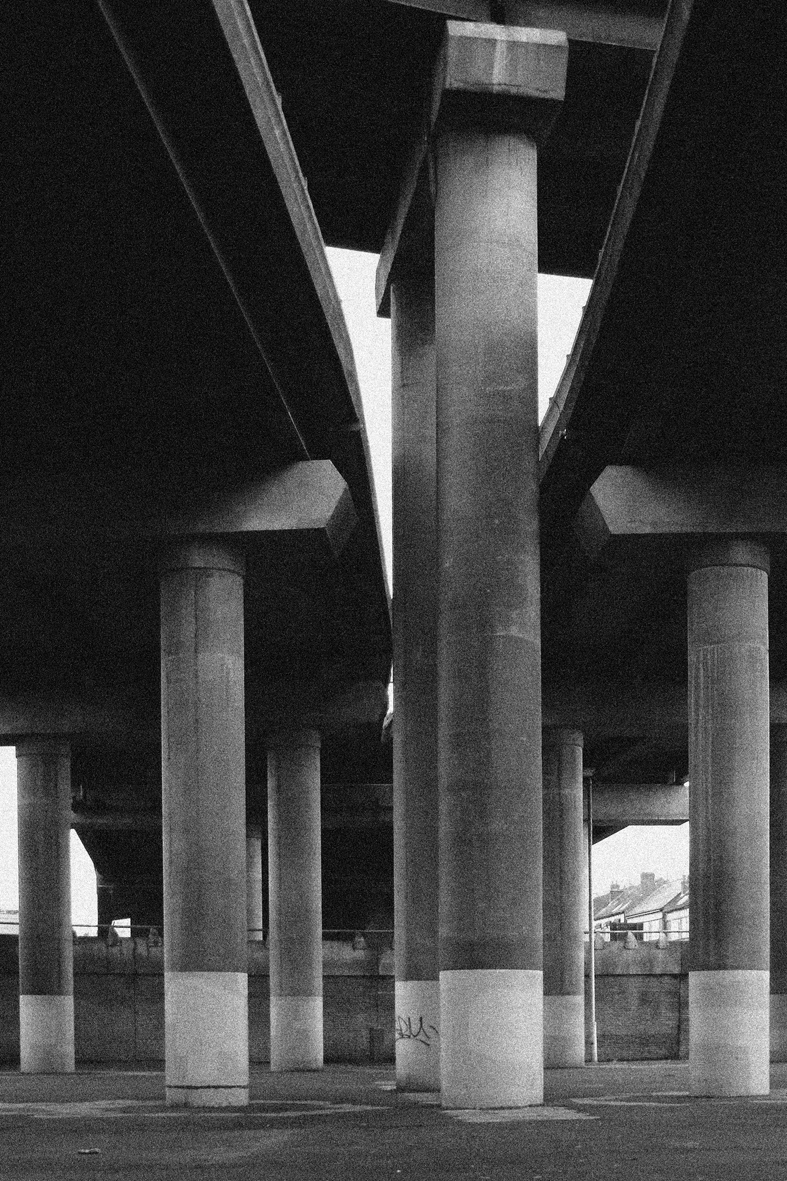
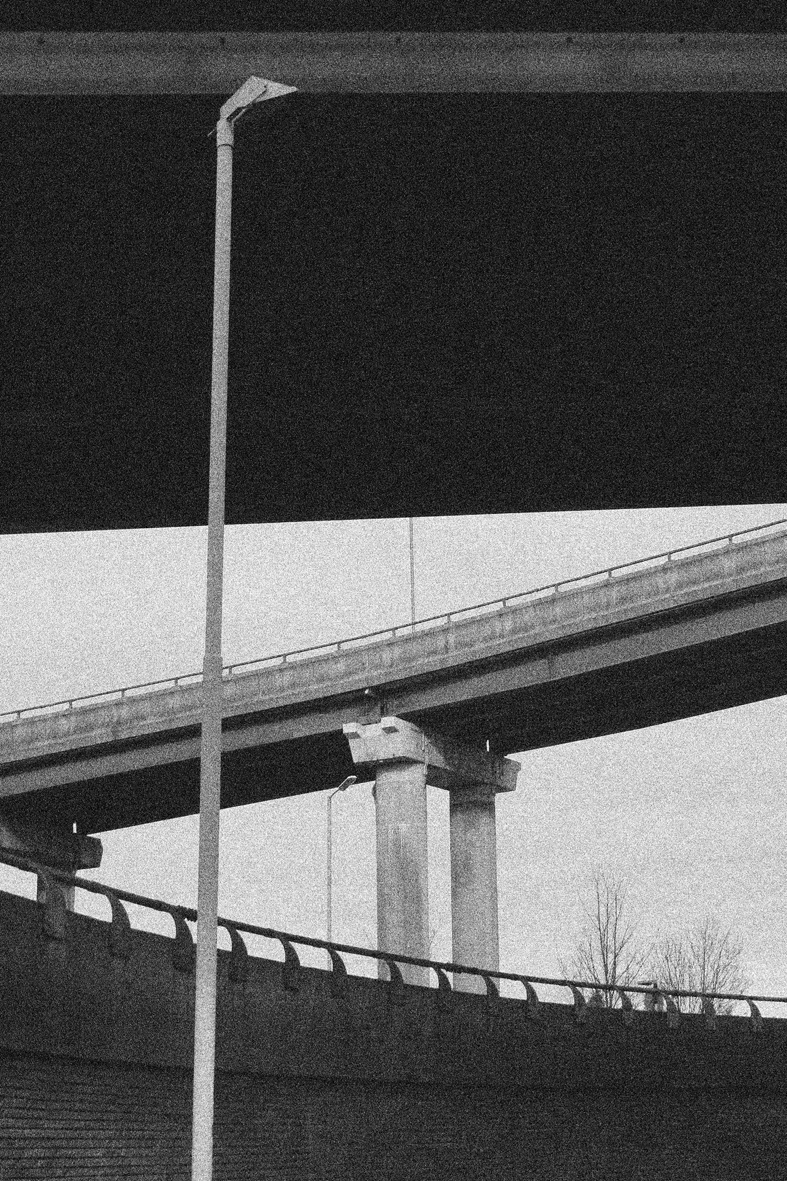
Dave and I made our own foray into the concrete world beneath the M6 and the Gravelly Hill Interchange on an early January day of varying light conditions.  I'd originally envisioned the trip over a year previously and we'd discussed it as a more specific intention one night last November whilst exiting Birmingham and peering down as our car left the Aston Expressway to join the main Motorway heading East.


A combination of intuition, map reading and prior consultation of Google Earth suggested Salford Circus as an ideal starting point, and so it proved.  At the centre of this busy roundabout lies a subterranean concrete garden, fed by subways on all sides, from which one can gaze up at several interconnected, elevated carriageways, whilst surrounded by their immense columnar supports.  My own fantasy was of a primeval forest of vast trunks, or even the legs of an immense prehistoric beast.  Dave also, quite rightly, likened them to enormous, vertical cigarettes.  I just hope his hypnosis isn't finally wearing off.

Photo:  David Weight

Although physically connected to its (surprisingly residential) surroundings via pedestrian underpasses, there is a distinct psychological, even hallucinatory isolation about this circular clearing.  It feels like a definite vacancy on the map and one of those contemporary sites that exist only as an interstitial space between planned features.  I was also struck by the quaint, neglected attempts by 70s planners to create a planted communal space of shrubs, hexagonal pavers and textured walls.  They suggest an obsolete utopian attitude to the world they thought they were creating, indeed, the world I myself grew up in.  The film of shade-tolerant algae tinting the paving slightly green speak both of the ultimate triumph of entropy but also, (interestingly, in such a Brutalist environment), of nature, over human ambition.


Predictably, I was reminded of JG Ballard's novel 'Concrete Island' although, unlike his protagonist, we had no trouble leaving our island when the time came.  We lingered for some considerable time and I took numerous still shots but also became increasingly interested both in the immersive sonic qualities of the site and the possibilities of shooting scratch video footage of my progress through the darkened subway tunnels into the light of the 'forgotten world' itself.


Leaving Salford Circus we mounted a road bridge and then descended onto the towpath of the Birmingham and Fazeley Canal.  Just a few metres along, directly beneath the motorway is Salford Junction where it meets the Grand Union and Tame Valley Canals and it became apparent that the visual adventure had only just begun.  This complex, multi-layered world of waterways, bridges, small buildings, pipe work and power lines is rendered all the more dramatic by its seclusion beneath the motorway's massive canopy. It concentrates various historical phases of transport infrastructure at the same point, and I marveled at how civil engineers had created such a knot of interconnected routes and stratified development over the decades.  I'm also delighted by the realisation that, despite the utilitarian motivation and economical imperatives of their work, an inevitable by-product is the unintentional creation of these zones of wonder.


Photo:  David Weight

Even on a relatively overcast day there is a peculiar quality of light down there, partially caused by light reflecting back from the water towards the underside of the massive road above.  It's far from being a uniformly grey environment and I began to perceive a strange, mellow golden illumination bathing the surrounding concrete and stone surfaces.  Inevitably, there is plenty of graffiti too, punctuating the scene with insistent calligraphy and splashes of synthetic colour.


Loads more shots were taken and we indulged in a little benign trespassing, despite numerous health and safety notices.  Following the line of the road above rather than the diverging towpath, allowed us to end our expedition at a large electrical transformer.  It's inherent dangers were rendered less forbidding by the polychromatic gaiety of graffiti combining with the bold hazard graphics designed to warn us away.  Needless to say, we survived to tell the tale.  Once again, we became fascinated by the acoustic landscape of this place, particularly as it was enlivened by the periodic clattering percussion of trains alongside the constant rush of road traffic overhead.


Photo:  David Weight


I left with a head full of sensory impressions, convinced that we had only scratched the surface(s).  I certainly plan to go back for more before very long.