Sunday, 19 October 2014

Janek Schaefer: 'Lay-By Lullaby'


On previous occasions, I’ve mentioned my fascination with the acoustic environment of many of the locations I find myself lurking around with my cameras.  This has become obvious again in the last few weeks, as I’ve been getting out and about in search of subject matter and footage for my proposed video collaboration with Andrew Smith.  Given my penchant for hard urban surfaces, subterranean features, and those strange territories beneath elevated roadways, it’s no surprise that the resonating sound events of passing traffic, fragments of distant voices, and the ever-present background ambiences of the modern, industrial world, have all impinged on my consciousness of late.

Which caused me to reach for my copy of Janek Schaefer’s album, ‘Lay-By Lullaby’ [1.], on returning from another stint of filming, the other night.  It’s a recent acquisition that had become somewhat overlooked amidst a stack of other ‘must-hears’.  As often happens though, it was just a case of waiting until it became properly relevant to a current train of thought, and naturally rose to the top of the pile of its own accord.


Janek Schaefer,  Multi-Media Guy


Schaefer is a London-based Sound Designer, Composer and Multi-Media Artist of Polish/Canadian origin, with an international reputation.  His work is more often heard in gallery or installation settings than in concert venues, and is generally very site-specific in both origin and playback.  Occupying a similar musical territory to artists like Philip Jeck, Christian Fennesz, so-called Isolationists like Biosphere or Scanner, and the wider ambient and electro-acoustic fields in general, he can be regarded as something of an established, Art Music star.  His chosen sound palette generally eschews beats, relying on atmospheres, evocative composed elements, electronic treatments, samples, field recordings, (and on occasion, an innovative, three-armed turntable), to achieve his sonic environments.


Janek Schaefer In Performance


As often occurs with this kind of stuff, one’s experience of the sound is greatly enhanced by an understanding of its context or conceptual framework.  I also find that Brian Eno’s [2.] original codification of Ambient Music as something integrated with an environment, that might be played quietly, or partially ignored as part of the furniture, doesn’t always work quite so well any more.  It’s not that it isn’t a perfectly valid idea, just that there’s so much of it now that any novelty has effectively left the form per se.  I listen to plenty of this sort of music, but do find that, once obvious structure, rhythm, lyrical content or melodic hooks are removed, a little more foregrounding or attention to detail are necessary if a piece is to avoid becoming just another pleasant, generic mulch of non-specific atmospherics [3.].  I have used ‘Lay-By Lullaby’ for the purpose its title suggests, falling asleep to it more than once, but actually find its nuances and distinguishing features are better appreciated once a little volume is applied.


Janek Schaefer, 'Lay-By Lullaby', Installation, 'Collecting Connections' Exhibition,
Agency Gallery, London, March 2013


In the event, ‘LL’ avoids this problem and has a pretty clear identity, derived primarily from Schaefer’s use of beautifully manipulated radio static and the sounds of passing vehicles as primary elements within his overall sound.  The road noises were apparently sourced late at night from a point, close to his own studio, where the M3 motorway passes the end of the road where author J G Ballard famously lived.  If this reference to Ballard seems like yet another case of ‘the usual suspects’, his ability to prefigure so much of the psychosis of modern life, (both good and bad), still feels pretty relevant even after we’ve learned to take so much of it for granted.  ‘Crash’ [4] and ‘Concrete Island’ [5.] both remain (in)famously arresting explorations of our psychic and existential relationship with cars and the infrastructure that supports them.  Seemingly, both were inspired, at least in part, by the construction of the motorway so close to his home.


J G Ballard, Outside His Shepperton Home (Photographer Unknown)


What Schaefer does, rather beautifully, is to evoke both the sense of passing traffic, witnessed in the depths of the night, from a stationary vehicle, and of a nocturnal car journey on sparsely populated roads.  The strange calm, hypnotic rhythms and insulated alienation of such situations are all things many of us will have experienced.  Indeed, for me, the disconnectedness of driving along such routes, alone in the still hours, has sometimes felt akin to being far out at sea.  The variety of Schaefer’s vehicle noises is complex and varied, (and something I’m becoming quite a connoisseur of, as already mentioned).  The sonic differences between a single idling engine, the distant, textural wash of traffic en masse, or the sudden explosion of a rapid vehicle passing a stationary point at close quarters, are marked and all evocatively employed here.


The Wonderful Footbridge Over The M3 Motorway, Close To J G Ballard's Home
(Photographer Unknown)


The use of static crackle is also really impressive.  It’s hardly a novel technique, (Burial being just one of numerous producers who have employed its emotional resonances and textural potential in recent years).  Schaefer is sophisticated in his manipulation of it, finding various sizes of audible ‘grain’ and employing it as veils of texture, multiple layers of environmental sound, and even as a variety of sonic substance which might be structured and sculpted, on occasions.  Most of the time, he avoids actual radio programme content, so that, when the occasional fragment of disconnected speech does intrude, it’s all the more effective, - implying that there is still a human world out there somewhere.  The occasional brief elements of implied melody that emerge might serve a similar purpose, but for me, they generally feel less like radio transmissions and more like part of Schaefer’s own mental soundtrack.

Again, this relationship between driving and radio is hardly a new idea, but it’s still a pretty resonant one.  Most drivers will know how much they come to rely on their car’s stereo to provide mental stimulation or as an aid in constructing some kind of soundtrack, particularly for a solitary journey.  I’m reminded again of Chris Petit’s wonderful and strange British road movie ‘Radio On’ [6.], - a film that explores similar ideas and is a masterpiece of road-bound alienation and evocation of the world as viewed through a windscreen.  I also recall a long journey, some years ago, when several work colleagues and I drove home from an exhibition installation job in London, in the early hours.  We were all physically and mentally shattered and it was my turn to drive.  One by one the car’s other occupants fell asleep and I was left alone with my thoughts, switching channels to stay awake as mile after mile of the unfamiliar and largely deserted M11 unfolded before me.  We made it home in one piece, but I’m still not quite sure how.


The individual sections of ‘LL’ flow together pretty smoothly, but they are numbered as a separate implied radio transmission, and careful listening reveals that each indeed has its own distinguishable identity.  ‘Radio 101 FM’ opens with some dramatic vehicle sounds before embarking on a sonorous passage of profoundly melancholy organ tones, which alternate with some distinctly disturbing, transmitted white noise.  ‘Radio 103 FM’ introduces what sounds like some distinctly Baroque chamber music, as traffic hisses gently in the background.  ‘In Radio 104 FM’, the passing vehicles once more burst into our world at close quarters whilst a repeatedly strummed arpeggio and gently brushed snare calls to mind a David Lynch/Angelo Badalamenti movie soundtrack.  The foreboding melody that replaces it is even more emotively Lynchian but is itself replaced by a handful of plucked harp strings, a general wash of undulating road noise, and what may be rain on the windscreen.

And so, the album unfolds.  The guitar arpeggios return in ‘Radio 106 FM’, accompanied by the tinkling of crystalline chimes, whilst the fluctuating drones of ‘Radio 107 FM’ remind me of KLF’s wonderful, ambient ‘Chill Out’ album [7.].  A distant suggestion of jazz trumpet weaves its way though ‘Radio 109 FM’ and the snares and harp strings re-emerge to punctuate the following track.  If there is a noticeable quickening of the traffic noise towards the end of the album, during ‘Radio 112 FM’, it might suggest a world re-awakening around dawn, but there’s nothing as obvious as an implied through narrative in ‘Lay-by Lullaby’ overall.


Janek Schaefer, 'Asleep At The Wheel', Multi-Media Installation, IF Milton Keynes International
Festival, 2010

Film Still From:  Janek Scaefer, 'Asleep At The Wheel', Multi-Media Installation,  IF
Milton Keynes International Festival, 2010


In conclusion, it’s worth noting that ‘Lay-By Lullaby’ appears to be something of a more reflective companion piece to the ambitious multi-media installation, ‘Asleep At The Wheel’ [8.], that Schaefer constructed for Milton Keynes International Festival, in 2010.  That project contained a more didactic, sociological and ecological agenda, and comprised sound, film, interractive elements, (in the form of cars), light, literary resources and a highly immersive, atmospheric staging.  It appears to have featured at least some of the same sounds that re-emerged on this later album.  It was also staged in a disused Sainsbury’s supermarket, something that echoes one of my own photographic stamping grounds.


Supermarket Car Park, Belgrave Road, Leicester, December 2012


The ‘Lullaby’ itself has also been presented via a small installation on more than one occasion [9.].  In these situations, it is played back, on a loop, through speakers embedded in a pair of recumbent traffic cones and connected to a car stereo in a small carrying case.


Janek Schaefer, 'Lay-By Lullaby',  Installation, Ace Hotel, London, 2014


[1.]:  Janek Schaefer, ‘Lay-By Lullaby’, 12K, 2014

[2.]:  Or, should that be Erik Satie’s?

[3.]:  In fairness, this may be as much to do with my own over-saturated perceptions as with the intrinsic qualities of any particular piece.

[4.]:  J.G. Ballard, ‘Crash’, London, Jonathan Cape, 1973

[5.]:  J.G. Ballard, ‘Concrete Island’, London, Jonathan Cape, 1974

[6.]:  Chris Petit (Dir.), ‘Radio On’, UK/West Germany, BFI/Road Movies Filmproduktion/NFFC, 1979

[7.]:  KLF, ‘Chill Out’ KLF Communications, 1990

[8.]:  Janek Schaefer, ‘Asleep At The Wheel’, Site-Specific, Multi Media Installation, IF Milton Keynes International Festival, 2010


[9.]:  Including:  Janek Schaefer, ‘Collecting Connections’, Exhibition, Agency Gallery, London, March 2013


Saturday, 11 October 2014

Concrete 1: Going Back Under


Beneath Clifton Boulevard At Junction With Queen's Drive, Nottingham, October  2014


After several months of concentrating on static, (and heavily collage-based), imagery, I’ve been out and about with my video camera again in recent days.  I did a lot of filming through last winter, both through the windscreen of my car and in the wind and rain as part of my ‘Belgrave Gate Project’.  However, progress on all that has been somewhat sporadic and is, for now, on the back burner again, so that footage is yet to see the light of day, (although, it's certainly not forgotten).


Belgrave Flyover (Since Demolished), Belgrave Circle,
Leicester, 2013


This time round though, I’m amassing footage with a, literally, more concrete aim in mind.  A few weeks ago, Multi-Media Artist, Andrew Smith and I were lucky enough to secure an exhibition slot at Floor One Gallery at Rugby Art Gallery & Museum.  The Gallery allocates the unfilled slots in its exhibition programme on a first come - first served basis and we’d failed twice before, so this was very much a case of third time lucky.  The exhibition will take place in June 2015 and has already been titled ‘Mental Mapping’.  At the moment, our plan is to exhibit work that represents Andrew and myself individually, but also to collaborate on a joint piece, - which is where my filming comes in.

The plan is to produce an artists’ film triggered by the theme of concrete and cement.  My own fixations with hard, urban environments, and my existing use of motifs such as Leicester’s Belgrave flyovers, Spaghetti Junction and miscellaneous subway systems, mean I’ve already spent many hours meditating on the material qualities of concrete.  When the chance to exhibit in Rugby presented itself, it just felt impossible to totally ignore the importance of cement manufacture to that town’s economy.  Indeed, the physical presence of an immense Cemex cement manufacturing plant looms large over the whole town and might be seen as the literal source of many of the concrete edifices I’ve been drawn to in my photographic expeditions around the British Midlands.


Cemex Plant, Rugby, Warwickshire, February 2013


Actually, I’d already photographed the cement plant on a murky February day in 2013, without any particular end in view, after attending the Private View of Shaun Morris’ ‘Stolen Car’ exhibition, also at Floor One [1.].  I first met both Shaun and Andrew when they invited me to participate in the ‘If A Picture Paints A Thousand Words…’ Exhibition [2.] in Birmingham in 2012, so this all still feels like several planets periodically lining up.


Shaun Morris, 'The Gap', Oil On Canvas, 2012


It also makes me reflect that one of the things I’ve really come to appreciate about the whole ‘creative process’ palaver is the idea of an open-ended continuum.  Ideas, motifs, themes and all varieties of visual stimulus arrive when then arrive, often in the most accidental or serendipitous manner.  The important thing is to keep documenting such experiences however I can, on the assumption that they may become just what I’m looking for, months or years up the line and in unexpected ways.  Similarly, if I can just keep resolutely working away, even if feeling a bit underwhelmed by the results sometimes, loose ends will gradually start to tie themselves up, and small breakthroughs be made, in their own time.  It’s about capitalising on potentially rewarding situations, rather than trying to force a particular issue.

A large part of this is the conversations one might have with other artists or people whose general input can be seen as constructively engaged.  This is definitely a reason for working collaboratively.  I have a tendency to labour away in a fairly insular manner when left to my own devices, and it’s easy to get lost in a comfort zone or to become over-dependent on old habits of thought.  Thus, the process of working on ‘Time Passages’ at Melbourne Festival a few weeks ago, and now this collaborative project with Andrew, both feel like valuable ways of usefully shaking things up to less predictable effect.


Painting By Andrew Smith. (Specific Details Unknown).


My original idea was to start filming with a certain type of apparently static subject and fixed camera position in mind, then invite Andrew to respond with his own textual and conceptual interpretations, ultimately coming together to edit the results into something, (hopefully), coherent.  However, my start to filming was somewhat delayed by the need to complete and tie-up the loose ends of the Melbourne project.  In that time, Andrew has already started to suggest some interesting themes and textual starting points which are, inevitably starting to colour the way I select potential subjects, or look at those that might appeal for wholly visual reasons otherwise.  It’s also more than possible that he’ll want to contribute some visual content of his own, as he’s made more than one film of his own in the past.  Indeed, it was Andrew's willingness to work across a variety of media, and to place an idea at the centre of his process whilst always producing a captivating artefact of some sort, that first impressed me about his work.

This kind of ongoing dialogue, and the potential to be creatively ‘nudged’ in unexpected ways as events unfold, is exactly what I would hope for from a healthy collaboration.  It’s still very early days, and I don’t want to be any more specific about the project at this stage, but I’m really enjoying finally getting out there with the camera, collecting footage and the baffled stares of passing motorists, and am feeling increasingly excited about the whole idea as the days go by.


Beneath Clifton Boulevard At Junction With Queen's Drive, Nottingham,
October 2014
Beneath Clifton Boulevard At Junction With Queen's Drive, Nottingham, October 2014


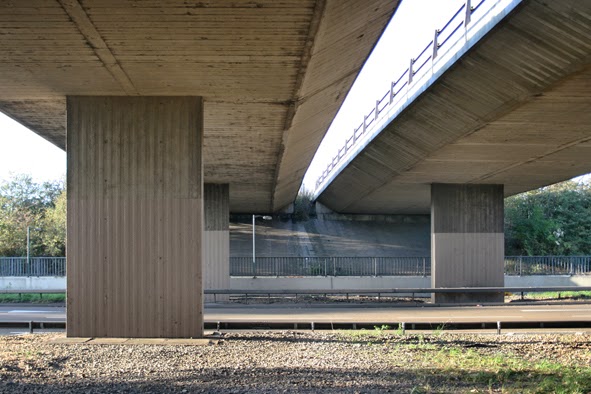
Which is all a long-winded way of explaining why, as most of the images here show, I found myself under another multi-level road interchange, in one of those little ‘holes in the map’ where the public rarely venture.  In this case, it was the junction of Nottingham’s Queens Drive and the section of the city’s A52 Ring Road known as Clifton Boulevard.  Although nowhere near as extensive as Birmingham’s Gravelly Hill/Spaghetti Junction, this spot does have certain similarities, and I’ve had my eye on it for some time.


Beneath Gravelly Hill Interchange, Birmingham, February 2013


Just like at ‘Spag’, it’s possible to sail over in a car, (as I have done a thousand times), and remain relatively oblivious to the complexity of it’s intertwining dual carriageways, on/off ramps and ground-level roundabout.  Once one gets right underneath however, one immediately recognises that particular dynamic, and somewhat alien quality that such sites always exude.  Progress around the only sectors of the roundabout deemed to be of interest to pedestrians is achieved via an undulating subway system, (which will also require further documentation, when time allows); meaning that access to the very centre of things is somewhat ‘unofficial’ and necessitates a well-timed sprint across the roundabout in heavy traffic.  That also lends the territory within an appealing ‘forbidden island’ quality as one wanders amongst the clusters of monumental, slab-sided concrete supports and gazes up at the undersides of the elevated carriageways overhead.


Shuttering Patterns, Junction Of Clifton Boulevard & Queen's Drive, Nottingham, October 2014

Shuttering Patterns, Junction Of Clifton Boulevard & Queen's Drive, Nottingham, October 2014


What really creates the drama here, is the existence of a third level of single carriageway flying over the main junction in an elegant, sweeping curve.  As at Gravelly Hill, this results in the spectacle of a really tall support, inserted into the gap between lower sections of road, and of increasingly complex and dynamically sectioned views ‘beyond’ and ‘between’.  The visual interest of the concrete surfaces themselves is considerably enhanced by the heavy-grained texture of the wooden shuttering used to construct them, and the contrast between the raw surfaces and the glossy-anti-graffiti coatings applied up to a certain height.  The latter glistened seductively in the late afternoon sunlight when I was there.  Indeed, the quality of autumnal illumination transformed the whole experience, with expanding wavelengths of golden light and lengthening blueish shadows combining to create real visual riches.  A current fascination for me is the movement of shadows cast by passing traffic and, when the sun was brightest, I felt located at the centre of a swirling vortex of these, both above and all around.


Uppermost Carriageway, Junction Of Clifton Boulevard & Queen's Drive,  Nottingham,
October 2014
Uppermost Carriageway, Junction Of Clifton Boulevard & Queen's Drive, Nottingham, October 2014


Mention should also be made again of the phenomenal sound world that exists in such places.  All those hard, multi-facetted concrete surfaces, and the enclosing canopies above, mean that traffic noise bounces around the entire arena in really exciting and complex ways.  The dynamism of all this was accentuated at Queen’s Drive by the speed at which the traffic is travelling, resulting in a ceaseless series of rapid sonic events.  To be honest, in the hands of an accomplished sound artist, the material collected by my camera’s external microphone would probably become at least as interesting as anything my lens might have captured.  Either way, the contrast between all that implied action, and a (nominally), static, monumental environment, is one of the really involving qualities of a site like this.


Beneath Clifton Boulevard At Junction With Queen's Drive, Nottingham,
October 2014
Beneath Clifton Boulevard At Junction With Queen's Drive, Nottingham, October 2014


This interface between action and stasis was rather poignantly underlined by the presence of a distinctly ill-looking, lone pigeon.  Remaining almost motionless at the foot of a pillar, it observed me passively, making no attempt to move when I approached.  It was still there when I left and, if those were its last few minutes of life, as I suspect, I can only hope it gained a little entertainment from watching some weirdo with a camera where it least expected to find one.


 Beneath Clifton Boulevard At Junction With Queen's Drive, Nottingham, October 2014

Expiring Pigeon, Junction Of Clifton Boulevard & Queen's Drive, Nottingham, October 2014


At this stage, I’ve no idea how much, if any, of the footage I shot here will make it into our final film, but, either way, I suspect I’ll be investigating this particular site again before too long.


[1.]:  Shaun Morris, 'Stolen Car: New Paintings By Shaun Morris', Floor One Gallery, Rugby Art Gallery & Museum, 9 - 22 October 2013.  It’s worth noting that Shaun’s suite of ‘Stolen Car’ paintings focuses heavily on his own favourite section of elevated roadway, in this case, the M5 Motorway close to his family home in West Bromwich.  I’ve been attracted to similar locations for decades, but never actually used them as subjects until recently.  I can only hope again that it’s a case of Shaun’s example having legitimised a category of subject for me, rather than of me merely ripping him off.

[2.]:  'If A Picture Paints A Thousand Words Then Why Can't I Paint: An Exhibition Of Work By Five Artists From Across The Midlands', (Indigo Octagon), The Works Gallery, Birmingham, 13 - 23 November 2012