Showing posts with label Stolen Car. Show all posts

Thursday, 7 April 2016

Luxury's Disappointments


All Images: Central Birmingham, March 2016


These three images were collected close together, the other day - just outside Birmingham's 'exclusive' Mailbox shopping centre, (let's call a spade a spade).  In one way or another, they seem to point towards the priorities of a society fixated on the notion of 'luxury'.  They also tap into my uber-anoraky interest in urban parking provision.

I guess the first would make the point more eloquently if that were a newer, properly top-of-the-range Merc, but it still seems to suggest how, with ever louder exhortations to 'aspire', - directed at a population increasingly divided between 'haves' and 'have-nots', some will always grab their taste of the high-life in whatever opportunist manner they can.

That car can only have been joy-ridden, can't it? The jaunty angle at which it has been 'parked' in one of the city centre's most heavily regulated parking zones surely speaks volumes.  I also love the wonky tilt of the status-symbol bonnet mascot.  Has someone tried to pry it off - do you think?  What really delights me is the way the slow, heavy-handed response of officialdom appears be to simply impose one parking fine after another.  If only as much diligence were applied to analysing the societal tensions and priorities that may have contributed to the situation in the first place, - or even to just towing it away after a couple of days.  Who's ultimately liable to pay those fines, I wonder?


In my fantasy, I'd like to think the (possibly, shop-lifted) champagne packaging was discarded by the departing joy-riders, (it was very near the car), - although the two events are probably unrelated in reality.

Either way, it seems to suggest something of the decadence, deluded appeal, and race for instant gratification of the 'Champagne Lifestyle'.  When sipped on a special occasion, a glass of bubbly is, of course, one of life's great pleasures, (a Champaign Socialist?, - me?).  When glugged by the bottle-full, and the box - discarded in the street to become part of the general mulch of detritus, it seems to suggest something rather different.


Right, I'm off to put on my hair shirt, eat a bowl of gruel, and find an improving pamphlet to read...


Saturday, 11 October 2014

Concrete 1: Going Back Under


Beneath Clifton Boulevard At Junction With Queen's Drive, Nottingham, October  2014


After several months of concentrating on static, (and heavily collage-based), imagery, I’ve been out and about with my video camera again in recent days.  I did a lot of filming through last winter, both through the windscreen of my car and in the wind and rain as part of my ‘Belgrave Gate Project’.  However, progress on all that has been somewhat sporadic and is, for now, on the back burner again, so that footage is yet to see the light of day, (although, it's certainly not forgotten).


Belgrave Flyover (Since Demolished), Belgrave Circle,
Leicester, 2013


This time round though, I’m amassing footage with a, literally, more concrete aim in mind.  A few weeks ago, Multi-Media Artist, Andrew Smith and I were lucky enough to secure an exhibition slot at Floor One Gallery at Rugby Art Gallery & Museum.  The Gallery allocates the unfilled slots in its exhibition programme on a first come - first served basis and we’d failed twice before, so this was very much a case of third time lucky.  The exhibition will take place in June 2015 and has already been titled ‘Mental Mapping’.  At the moment, our plan is to exhibit work that represents Andrew and myself individually, but also to collaborate on a joint piece, - which is where my filming comes in.

The plan is to produce an artists’ film triggered by the theme of concrete and cement.  My own fixations with hard, urban environments, and my existing use of motifs such as Leicester’s Belgrave flyovers, Spaghetti Junction and miscellaneous subway systems, mean I’ve already spent many hours meditating on the material qualities of concrete.  When the chance to exhibit in Rugby presented itself, it just felt impossible to totally ignore the importance of cement manufacture to that town’s economy.  Indeed, the physical presence of an immense Cemex cement manufacturing plant looms large over the whole town and might be seen as the literal source of many of the concrete edifices I’ve been drawn to in my photographic expeditions around the British Midlands.


Cemex Plant, Rugby, Warwickshire, February 2013


Actually, I’d already photographed the cement plant on a murky February day in 2013, without any particular end in view, after attending the Private View of Shaun Morris’ ‘Stolen Car’ exhibition, also at Floor One [1.].  I first met both Shaun and Andrew when they invited me to participate in the ‘If A Picture Paints A Thousand Words…’ Exhibition [2.] in Birmingham in 2012, so this all still feels like several planets periodically lining up.


Shaun Morris, 'The Gap', Oil On Canvas, 2012


It also makes me reflect that one of the things I’ve really come to appreciate about the whole ‘creative process’ palaver is the idea of an open-ended continuum.  Ideas, motifs, themes and all varieties of visual stimulus arrive when then arrive, often in the most accidental or serendipitous manner.  The important thing is to keep documenting such experiences however I can, on the assumption that they may become just what I’m looking for, months or years up the line and in unexpected ways.  Similarly, if I can just keep resolutely working away, even if feeling a bit underwhelmed by the results sometimes, loose ends will gradually start to tie themselves up, and small breakthroughs be made, in their own time.  It’s about capitalising on potentially rewarding situations, rather than trying to force a particular issue.

A large part of this is the conversations one might have with other artists or people whose general input can be seen as constructively engaged.  This is definitely a reason for working collaboratively.  I have a tendency to labour away in a fairly insular manner when left to my own devices, and it’s easy to get lost in a comfort zone or to become over-dependent on old habits of thought.  Thus, the process of working on ‘Time Passages’ at Melbourne Festival a few weeks ago, and now this collaborative project with Andrew, both feel like valuable ways of usefully shaking things up to less predictable effect.


Painting By Andrew Smith. (Specific Details Unknown).


My original idea was to start filming with a certain type of apparently static subject and fixed camera position in mind, then invite Andrew to respond with his own textual and conceptual interpretations, ultimately coming together to edit the results into something, (hopefully), coherent.  However, my start to filming was somewhat delayed by the need to complete and tie-up the loose ends of the Melbourne project.  In that time, Andrew has already started to suggest some interesting themes and textual starting points which are, inevitably starting to colour the way I select potential subjects, or look at those that might appeal for wholly visual reasons otherwise.  It’s also more than possible that he’ll want to contribute some visual content of his own, as he’s made more than one film of his own in the past.  Indeed, it was Andrew's willingness to work across a variety of media, and to place an idea at the centre of his process whilst always producing a captivating artefact of some sort, that first impressed me about his work.

This kind of ongoing dialogue, and the potential to be creatively ‘nudged’ in unexpected ways as events unfold, is exactly what I would hope for from a healthy collaboration.  It’s still very early days, and I don’t want to be any more specific about the project at this stage, but I’m really enjoying finally getting out there with the camera, collecting footage and the baffled stares of passing motorists, and am feeling increasingly excited about the whole idea as the days go by.


Beneath Clifton Boulevard At Junction With Queen's Drive, Nottingham,
October 2014
Beneath Clifton Boulevard At Junction With Queen's Drive, Nottingham, October 2014


Which is all a long-winded way of explaining why, as most of the images here show, I found myself under another multi-level road interchange, in one of those little ‘holes in the map’ where the public rarely venture.  In this case, it was the junction of Nottingham’s Queens Drive and the section of the city’s A52 Ring Road known as Clifton Boulevard.  Although nowhere near as extensive as Birmingham’s Gravelly Hill/Spaghetti Junction, this spot does have certain similarities, and I’ve had my eye on it for some time.


Beneath Gravelly Hill Interchange, Birmingham, February 2013


Just like at ‘Spag’, it’s possible to sail over in a car, (as I have done a thousand times), and remain relatively oblivious to the complexity of it’s intertwining dual carriageways, on/off ramps and ground-level roundabout.  Once one gets right underneath however, one immediately recognises that particular dynamic, and somewhat alien quality that such sites always exude.  Progress around the only sectors of the roundabout deemed to be of interest to pedestrians is achieved via an undulating subway system, (which will also require further documentation, when time allows); meaning that access to the very centre of things is somewhat ‘unofficial’ and necessitates a well-timed sprint across the roundabout in heavy traffic.  That also lends the territory within an appealing ‘forbidden island’ quality as one wanders amongst the clusters of monumental, slab-sided concrete supports and gazes up at the undersides of the elevated carriageways overhead.


Shuttering Patterns, Junction Of Clifton Boulevard & Queen's Drive, Nottingham, October 2014

Shuttering Patterns, Junction Of Clifton Boulevard & Queen's Drive, Nottingham, October 2014


What really creates the drama here, is the existence of a third level of single carriageway flying over the main junction in an elegant, sweeping curve.  As at Gravelly Hill, this results in the spectacle of a really tall support, inserted into the gap between lower sections of road, and of increasingly complex and dynamically sectioned views ‘beyond’ and ‘between’.  The visual interest of the concrete surfaces themselves is considerably enhanced by the heavy-grained texture of the wooden shuttering used to construct them, and the contrast between the raw surfaces and the glossy-anti-graffiti coatings applied up to a certain height.  The latter glistened seductively in the late afternoon sunlight when I was there.  Indeed, the quality of autumnal illumination transformed the whole experience, with expanding wavelengths of golden light and lengthening blueish shadows combining to create real visual riches.  A current fascination for me is the movement of shadows cast by passing traffic and, when the sun was brightest, I felt located at the centre of a swirling vortex of these, both above and all around.


Uppermost Carriageway, Junction Of Clifton Boulevard & Queen's Drive,  Nottingham,
October 2014
Uppermost Carriageway, Junction Of Clifton Boulevard & Queen's Drive, Nottingham, October 2014


Mention should also be made again of the phenomenal sound world that exists in such places.  All those hard, multi-facetted concrete surfaces, and the enclosing canopies above, mean that traffic noise bounces around the entire arena in really exciting and complex ways.  The dynamism of all this was accentuated at Queen’s Drive by the speed at which the traffic is travelling, resulting in a ceaseless series of rapid sonic events.  To be honest, in the hands of an accomplished sound artist, the material collected by my camera’s external microphone would probably become at least as interesting as anything my lens might have captured.  Either way, the contrast between all that implied action, and a (nominally), static, monumental environment, is one of the really involving qualities of a site like this.


Beneath Clifton Boulevard At Junction With Queen's Drive, Nottingham,
October 2014
Beneath Clifton Boulevard At Junction With Queen's Drive, Nottingham, October 2014


This interface between action and stasis was rather poignantly underlined by the presence of a distinctly ill-looking, lone pigeon.  Remaining almost motionless at the foot of a pillar, it observed me passively, making no attempt to move when I approached.  It was still there when I left and, if those were its last few minutes of life, as I suspect, I can only hope it gained a little entertainment from watching some weirdo with a camera where it least expected to find one.
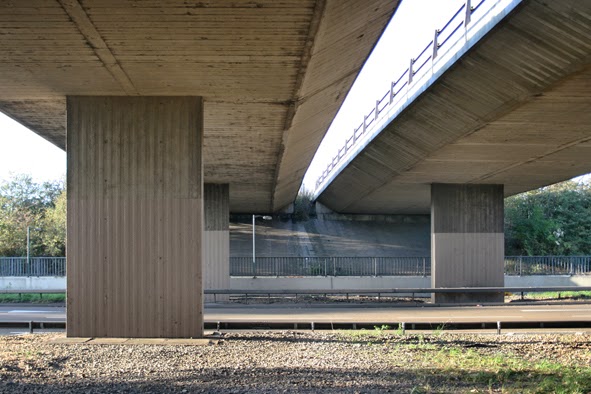

 Beneath Clifton Boulevard At Junction With Queen's Drive, Nottingham, October 2014

Expiring Pigeon, Junction Of Clifton Boulevard & Queen's Drive, Nottingham, October 2014


At this stage, I’ve no idea how much, if any, of the footage I shot here will make it into our final film, but, either way, I suspect I’ll be investigating this particular site again before too long.


[1.]:  Shaun Morris, 'Stolen Car: New Paintings By Shaun Morris', Floor One Gallery, Rugby Art Gallery & Museum, 9 - 22 October 2013.  It’s worth noting that Shaun’s suite of ‘Stolen Car’ paintings focuses heavily on his own favourite section of elevated roadway, in this case, the M5 Motorway close to his family home in West Bromwich.  I’ve been attracted to similar locations for decades, but never actually used them as subjects until recently.  I can only hope again that it’s a case of Shaun’s example having legitimised a category of subject for me, rather than of me merely ripping him off.

[2.]:  'If A Picture Paints A Thousand Words Then Why Can't I Paint: An Exhibition Of Work By Five Artists From Across The Midlands', (Indigo Octagon), The Works Gallery, Birmingham, 13 - 23 November 2012


Tuesday, 28 January 2014

Shaun Morris: "Black Highway' At Nuneaton Museum & Art Gallery


Shaun Morris, 'Dropped', Oil On Canvas, 2013


It’s been a pretty good start to the year as far as exhibition visits go.  Having already zoomed over to Birmingham for the survey of Photorealism at Birmingham Museum & Art Gallery, I found myself heading west again the other day; this time for the Private View of Shaun Morris’ ‘Black Highway’ show at Nuneaton Museum & Art Gallery.


The exhibition marks the culmination of two years of Arts Council funded work on Shaun’s part.  The paintings and drawings on display represent his first concerted attempt to explore landscape subjects and, specifically, the liminal ‘Edgeland’ terrain beneath the M5 and M6 Motorways, near the Towns of Oldbury and West Bromwich, to the northwest of Birmingham.  Shaun grew up here, in what is still known as The Black Country, and his atmospheric, nocturnal views of this man-made environment are informed both by personal memory and his reflections on a the changes befalling a region once famous as a cradle of the Industrial Revolution.


As in much of Britain, manufacturing industry has been allowed to dwindle away in the Black Country Towns over recent decades, resulting in a loss of employment opportunities and of local pride and identity; something that Shaun has witnessed himself through the prism of his own family’s circumstances.  If Shaun’s paintings aren’t necessarily angry in any overt manner, they do evoke a variety of melancholy, and perhaps, disappointment with the alienation of Twenty First Century life - speeding heedlessly overhead to somewhere (or nowhere), else.  It’s no accident that he borrows titles heavily from his beloved Bruce Springsteen, a songwriter whose music provides the soundtrack to the show, and draws on the similar ‘blue-collar’ experience of his own New Jersey homeland.


I’ve already written at some length about the earlier paintings that featured in Shaun’s ‘Stolen Car’ exhibition last year, so now I’ll concentrate on my thoughts surrounding the newer pieces and the changes that have occurred as the overall series evolved.


  • The most obvious development in the later paintings, subject-wise, is the inclusion of water.  Whereas earlier canvases focused on the paddocks, pylons and minor roads beneath the motorways, now we see a canal, sliding in and out of the shadows like a reflecting serpent.


Shaun Morris, 'The Serpent', Pastel On Paper, 2013

  • It always feels eerily still, down here in Morris-land.  Not a breath of wind disturbs mirror of the canal’s surface.  Shaun is quick to exploit the compositional potential of doubling and reversing that this affords.  These paintings are reflective in two ways and, as a result, move towards an emphasis on abstract shape beyond mere straightforward description.


Shaun Morris, 'Nighttime', Oil On Canvas, 2013


  • Somehow, this moves the paintings beyond the sense of a haunted personal narrative that was such a feature of ‘Stolen Car’.  Under much of the ‘Black Highway’, the sense of complete absorption into a particular environment comes before any sense the events or memories that might unfold within it.


Shaun Morris, 'Weightless', Oil On Canvas, 2011


  • Could this erosion of descriptive detail, and consequent blurring of specific identity, echo the transformations that have overtaken this whole region?  Does this reduction of a subject towards formal concerns, recall the plight of a community once rooted in proud tradition but now shifted towards increasing disconnectedness and anonymity? 


Shaun Morris, 'The Gaze', Oil On Canvas, 2013


  • The Artist is adept at capturing the artificially tinted nocturnal skies above man-made environments and the sodium and halogen illumination that saturates them.  Much of ‘Stolen Car’ was immersed in sickly amber and orange, which still remains, but several of the newer paintings also undergo spectral shifts, through pinks and violets and into sombre blues.  'The Gaze' takes its identity from the floodlit green of an industrial building’s cladding, (a new keynote motif within the series), whilst ‘Drift’ blazes with coral pink.


Shaun Morris, 'Drift', Oil On Canvas, 2013-14


  • As ever, beyond the light, lies profound shadow, often simplifying forms into overpowering silhouettes.  ‘Black Highway’ is a perfect description as well as an evocative title.  This flattening of form, and the heightening of tonal contrasts around edges, may be one reason why several paintings now tend towards a variety of soft proto-Cubism and the ordering of the image into cutout shapes.


Shaun Morris, 'Beneath The Surface', Oil On Canvas, 2013

  • There’s another sensibility at work here though too.  ‘Beneath The Surface’ and ‘Curtain’, demonstrate a far more nuanced approach to the abstraction of parallel columns.  We recognize these as concrete road supports but, in imagination, they also become the trunks of a forest.  In ‘Beneath The Surface’ a serpentine branch meanders amongst the reflected verticals, reinforcing the illusion, whilst it’s possible to double take the upper strip of canal-bank foliage as the lower edge of a forest canopy.  The customary orange and violet are shifted down tonally to evoke an atmosphere of arboreal as well as aquatic gloom. 


Shaun Morris, 'Curtain', Oil On Canvas, 2013

  • The most distilled, (and my favourite), painting in this show is ‘Curtain’.  Across a panoramic format, are distributed a number of irregular vertical bands, loosely handled and brushy of contour.  With a subdued, mostly tonal, palette of violet, green, blues and greys amongst the prevailing black, it totally blurs the distinction between columns and trees and between positive and negative spaces also.  Indeed, this ambiguous dialogue between light and dark, and between solidity and space, is the key pictorial theme within all of this work. 


Shaun Morris, 'Memories' (L), Oil On Canvas, 2011, (From 'Stolen Car' Exhibition)

  • Just like the earlier 'Memories', where concrete structure became subsumed in a screen of broken foliage, ‘Curtain’ exists at the very edges of recognizable depiction.  I don’t know if this is a new way forward for Shaun, or just one element of his vocabulary, but it’s impressive to see him travel the road between representation and near-abstraction within the same few motifs.


Shaun Morris, (Clockwise From Top L), 'The Black Country', Factory', The Cut',
'Under Stars',
All Oil On Canvas, All 2013

  • Much of all this is, not surprisingly, rehearsed via smaller, paper-based works in pastel and oil.  On the larger scale, Shaun’s energetic brushwork often skates across areas of the canvas at great speed, and, just occasionally, leaves me craving a little more structural rigour to match his monumental subject matter, (I speak as one whose own paint handling too easily tends towards the pedestrian or overly deliberate).  The smaller pieces help to rectify this, supplying, as they do, more concentrated versions of similar imagery.  On occasions, I am reminded of Whistler’s famous ‘Nocturne: Blue & Gold – Old Battersea Bridge’.


James Abbott McNeill Whistler, 'Nocturne: Blue & Gold -
Old Battersea Bridge',
 Oil On Canvas,  1872-75


I don’t know if ‘Black Highway’ marks the final culmination of a particular phase in Shaun’s painting or what might lie ahead for him.  Whether or not there are more motorway visions to come, the existing paintings constitute an impressive body of work and I hope they justify at least some of his aspirations when he embarked upon them.  It will be interesting to see how the learning they constitute will carry into future paintings, regardless of subject matter. 


It was great to see so many of the paintings hanging together in Nuneaton, and also, to catch up with Shaun himself and his fellow Indigo Octagon artists, Chris Cowdrill and Andrew Smith.  I was also interested to chat to Sian Stammers, another Midlands artist with Edgeland concerns and the organiser of the ‘By The Way’ exhibition that I wrote about last year.


Design: Chris Cowdrill


'Black Highway' continues at: White Gallery, Nuneaton Museum & Art Gallery, Riversley Park, Coton Road, Nuneaton, until 2 March, 2014.