Monday, 8 August 2016

Padding Up


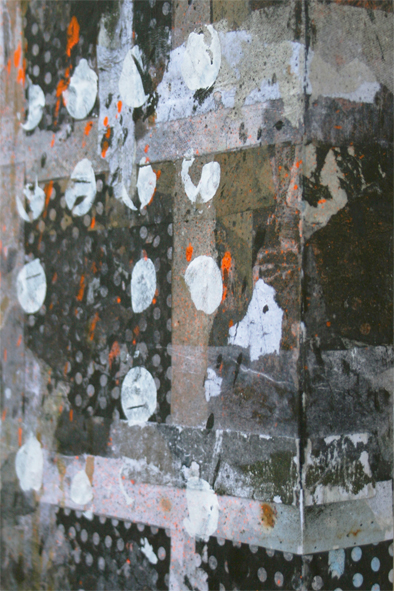
The images shown here were produced on an iPad as part of a little personal challenge, related to the school field trip to Birmingham I accompanied a few weeks ago.


All Images: iPad Image, (Manipulated Photographs), June 2016


It’s one of the paradoxical aspects of history that those who live through momentous change are sometimes less aware of the drama of it all than those who rationalise accounts of it from outside or after the event.  Individual lives tend to be lived on a domestic or routine basis, to a day-to-day rhythm - rather than than in big chapters of underlined significance.  My formal education sketched in the transformative upheavals of the Industrial Revolution, and even some of the twentieth century turmoil that shaped the society we were born into.  However it’s easy to forget that we are currently living through a period of possibly even greater societal, environmental, and above all, technological transformation.

Don’t worry though, I’m not about to embark on a major dissertation on the way digital technology is altering all aspects of human life; but rather just a briefer discussion of one new way it has recently touched on my own practice.  To return to that original thought for a moment though – it is now possible for those of us of ‘a certain age’, to actually gain a little perspective on the massive changes that have occurred, even over the few decades of our own span.


As a child, I remember my father occasionally discussing ‘The Machine Room’ at the local Bank where he worked.  It was, I like to imagine, a room occupied by one or two primitive calculating engines - possibly housed in wardrobe-sized cabinets, not unlike those employed by archetypal Bond villains in their flip-top volcanoes [1.].  I also remember, at the age of seven, watching grainy monochrome footage of Neil Amstrong fluffing his lines and bouncing around on the Moon, - his ever utterance punctuated by an electronic ‘bleep’.  Journalists and Historians never tire of telling us how the computing power harnessed in that achievement was no more than that of the scientific calculators we wielded as GCE O-Level students, less than a decade later.  And it was, of course, a tiny fraction of that packed into the domestic lap-top device on which I type this, or the pocket gizmo on which you may well be reading it.

So far - so familiar.  Such technological advancement over half a century may seem impressive - but already, not as surprising as it once might.  None of the school children I encounter daily at work can have any real concept of a world in which their every task isn’t electronically assisted, or most of their social interactions aren’t digitally networked.  And the graph of exponential change accelerates ever more acutely.


For an admittedly arms-length, late adopter - like myself, each new attempt to up-skill myself often involves investing considerable mental effort to learn something that, it turns out, the cool kids all regard as last year’s news [2.].  Even in my mid fifties, I can’t help wondering at what point I’ll just have to sink back in exhausted bafflement - finally resigned to letting it all pass me by, as the robotic Care Assistant patiently spoons lukewarm soup into my mouth.

Well, I’m not quite there yet.  Indeed, if anything, my current attitude is one of slightly more enthusiastic embrace of the new toys, and not least, of the ways they might aid and abet my creative practice.  I’ve talked a lot in recent months about my urge to incorporate different or new media within my overall ambit, and (more relevantly here) - a desire to acknowledge some sense of Process, and the inescapable influence of The Digital Realm (note the portentous capitals) within my own work.  I’ve often mentioned (probably to the point of tedium) viewing Tate Modern's impressive ‘Painting After Technology’ display - not least because it was one my most influential gallery experiences of recent years.  It is possibly no accident that many of the artists on display there were of a similar vintage to myself [3.].


Anyway, in an attempt to embrace somewhat more of, what some in educational circles term a ‘Growth Mindset’, I have started to compile a scratch wish-list of technological devices or methods with which I have yet to interact meaningfully [4.].  Baffling though that may be to many who regard them as old news, Smartphones and Tablet devices are high on that list.  I’ve carried a Smartphone for a couple of years now, but without really unlocking its potential much beyond texting, emailing and taking the occasional shaky photo.  My experience of iPads, (other electronic tea trays are available – obviously), was even more limited before I made these images.  Somewhere in my mind, I’d created a false division between those gizmos you pilot with a keyboard/mouse combo, and those with greasy screens that you rub with your fingers.

Anyway, it’s clear the novelty of mobile (soon to be wearable or surgically implanted) technology isn’t wearing off anytime soon, and, more to the point, that many folk have already been using them, in numerous creative ways, for a long time.  Thus, as our students clicked away with a variety of cameras, (and, comfortingly, - also drew in sketchbooks), I braved the ignominy of being “one of those twonks who wave iPads around”.  I deliberately set about collecting photos that could then be manipulated in a fairly immediate manner, on the same device.


The results are probably pretty trite and, whilst resolutely urban, don’t particularly relate to much else in my current work.  In some respects, they’re little more than those never-ending, neon scribbles we all made back when the possibility of making any kind of image on a computer screen first suggested itself.  I did enjoy making them though - not least for their rapid immediacy, and the potential for a kind of photographic/digital sketchbook, to which they point.  I relish the idea of combining a photographic moment with a more organic intervention, made at the speed of thought and gesture of a swiped finger.  I was also pleased to discover that the cut-down version of Photoshop I used, (something I believe the young people are calling an ‘App’ – imagine!), offered just enough of it’s big brother’s potential – particularly in the interaction between layers, layer modes and filter effects.

Strangely, I can even imagine that working like this might even encourage me to draw more than I have done of late, and for images to evolve with more spontaneity than has sometimes been the case.  The other point worth making is that, as with all digital ways of working, the scope for versioning and variations on a theme is pretty limitless; and that’s something that’s been clearly preoccupying me all year.  


Will I be doing more of this kind of thing in the near future?  Like a lot of stuff recently, these images merely scratch the surface of something novel (to me), but they do seem to suggest considerable possibilities.  The trick, as ever, will be to work out how to integrate that into my wider practice.  Or, for now, it might just imply loads more fun playing around with something new.


[1.]:  This is probably over-romanticised fantasy.  I never saw the fabled Machine Room.  In passing, I did however visit my Dad’s workplace on a couple of occasions when he was summoned to open the branch for the Police - because the alarm had gone off after hours.  It turned out to be simply a new alarm system bedding in, but how was a schoolboy even allowed to accompany adults into the scene of a possible bank robbery?  I can only conclude it really was a different world, (never mind being locked in the car outside a pub with a packet of crisps!) 

[2.]:  That glib reference, is in itself, quite illuminating.  The large comprehensive secondary school I attended in the 1970s possessed only one or two primitive, student-accessible computers that I’m aware of.  Only the elite Mathematics and Physics students inducted into the lunchtime Computer Club used them.  Those of us with aspirations to attend Art College, or go on to study English or Humanities at University would chuckle at their briefcases and mystifying punch cards.  The ‘Cool Kids’ - they definitely weren’t.  (To be honest – neither was I really, but I did feel like I was destined to breathe the same air as them).

[3.]:  I’ve queried before, whether younger folk might themselves regard all this self-reflexive focus, on the novel characteristics of technologies they just take for granted, as slightly quaint.

[4.]:  Loth though I am to credit Donald Rumsfeld with anything good, I do find his oft-derided concept of ‘Known Unknowns’ surprisingly useful.  In fact, the most superficial research reveals that, perhaps not surprisingly, he didn't originate the idea at all.


Sunday, 7 August 2016

Advance Notice: 'A Minor Place' Exhibition At Artists Workhouse


We're a week into August, and the Exhibition, 'A Minor Place' - featuring work by Shaun Morris, Andrew Smith, and myself, will open at the end of the month.  It's high time we changed up a gear with the publicity, so...


Design: Chris Cowdrill (Thanks, Chris)


While we're at it, here's a copy of the Press Release that accompanies the show:


Press Release

‘A Minor Place’

An exhibition of painting, printmaking and other artworks by

Hugh Marwood       Shaun Morris      Andrew Smith

The Artists Workhouse, The Royal Victoria Works, off Redditch Road, Studley, Warwickshire, 
B80 7AU

Saturday 3rd September to Sunday 11th September 2016

Private View on Saturday 3rd September 6.30-8.30pm

This exhibition at The Artists Workhouse presents work by three Midlands based artists: Leicester based Hugh Marwood, and Birmingham’s Shaun Morris and Andrew Smith. Working across a range of practices including drawing, painting, printmaking, photography, text and video the exhibition, in its broadest terms, presents as its overarching theme different imaginative responses to the urban environment.

The work on display is striking in its diversity but shares an interest across the exhibition in the ‘minor places’ of the urban world: the lost voices and forgotten messages; the haunted spaces and interim states; in fragmented texts and uncoupled phrases; the encrypted clues and overlooked evidence; erasures and amendments; erosion and decay.

In Hugh Marwood’s heavily collaged paintings references abound to routes, surfaces, edifices; and particularly the written texts found in those places.  However, the work is equally about the trains of thought and feeling they trigger, and generally tends towards nominally abstract distillations - rather than to recognisable depictions.

His current thematic preoccupations are with ideas of absence, disappearance and erasure.  Increasingly, the visual triggers to which he is drawn, suggest vacant spaces, degraded materials, and deleted or fragmented messages.  The resulting work thus focuses on fragments and vestiges, - on vanished meanings, lost voices, and what barely remains.  It is a catalogue of ghosts and memories.

Many of Marwood’s themes play out through the medium of paint, (or a kind of hybrid, collage-heavy, form of painting).  However, increasingly, other media comes into play - including photography, printmaking, and, on occasion, video and written pieces.  The aim is to arrive at a situation where imagery and ideas can evolve and mutate from each other, and switch between different media, in a fluid and almost limitless manner.

In artist Andrew Smith’s work the idea is to use 'the urban environment', ideas and texts about it, features of it in physical or image form, as material, or as floating signifiers that can be reinscribed or reconfigured in different aesthetic and ideational contexts: one example, with regard to the latter, might be, broadly speaking, the psychogeographical, in the sense of features of the urban landscape being made readable as indices of the psychological.

Andrew’s paintings and prints also involve chance meetings.  With some of the paintings – reading the map one way – you might trace a short journey from object to photograph to painting.  Following this route leads to minor territories on the edges of the iconic and the indexical – the latter through some references to blurs and shallow focus.  Having arrived in these territories what follows might be a process of recognizing signs (or not), and perhaps circling memorials of an accident.

The prints present removals from various locations.  For example, ordinary objects, left on the street, having already suffered the body-blow of being discarded, float bodilessly, illustrations of their former selves – they respond to their transformation and relocation with either (futile) anger or placidity.

Shaun Morris’s paintings and prints represent the artist’s interest in exploring the nocturnal edgelands and hidden landscape underneath the motorways that pass over the Black Country and Birmingham. As well as depicting some unusual abstract and dislocated images and sensations based on the reflections in the canals, other scenes focus in on the many transit hubs and depots that back onto the canals or are dotted alongside the motorway and their population of parked lorries and other, often strange looking, vehicles.

There is a doomed romantic quality in many of these large paintings of truck or lorries, yet there is also something vaguely unsettling and menacing in these black windowed, still cabs at night.  The artist explains his interest in the idea of them looked nostalgic on one hand and futuristic on the other: parked, seemingly abandoned, at the side of the road, highway or canal in a post-oil world.


There'll be loads more about it in coming posts but, for now, at least you know.  Many of you may be wondering about the location, so here are a couple of links to Artists Workhouse:

https://artistsworkhouse.com

https://artistsworkhouse.com/category/up-and-coming/  

Studley may not be a familiar place name but, trust me, it's easy to get to via the motorways, and only a step away from Birmingham, Stratford, Warwick, and numerous other West Midlands cultural hotspots.  Come one - come all.


More soon...


SaveSave

Monday, 1 August 2016

Completed Printed Paintings: 'Extracted Fragments Series'


'Extracted Fragment 1'  Acrylics, Paper Collage, Adhesive Tape, Ink, Spray Enamel French Polish
Misc. Solvents & Screen-Print On Panel, 30 cm X 30 cm, 2016


Following my recent post about the works shown here in progress, here’s one showcasing the final results.  The challenge was to combine on the same panels, my well established methods of painting and collage, with an element of screen-printing.  As already mentioned, my recent forays into printmaking have never really been focused on the idea of becoming a ‘pure’ or specialist printer, but more part of a general desire to incorporate it as just another possible avenue of expression within my overall practice.  These days, my attitude towards unfamiliar media, (or those whose surfaces I’ve only scratched), tends to be - why not have a go if it feels appropriate?  


Detail Of Above


I’m reminded of a student in the year above me, on my Fine Art Degree at Bristol Polytechnic, in the early 1980s, who cheerfully produced large, bold canvases - combining screen printing and expressionistic slathers of paint, in a pleasingly direct manner.  I’m ashamed to say I don’t even remember his name.  However, I was struck by the way he would screen photographically-derived imagery straight onto his canvases, seemingly unperturbed by the criticisms of tutors who suggested he should commit to one tradition or the other, or that that the results lacked any solid foundation in drawing.  It seems baffling that such limiting attitudes should have prevailed so long after the example of Rauchenberg, Warhol, and a whole generation of Pop artists, decades before.  It’s perhaps even lamer, that it took me many more years to shrug off my own fixation with the ‘struggle’ to wrest an image out of the mud of tortured paint or endlessly erased charcoal, which had frustrated my own progress for so long.


'Extracted Fragment 2', Acrylics, Paper Collage, Ink, Spray Enamel, Various Solvents
& Screen-Print On Panel, 30 cm X 30 cm, 2016

Detail Of Above.


'Extracted Fragment 3', Acrylics, paper Collage, Ink, Spray Enamel, Misc Solvents
& Screen-Print On Panel, 30 cm X 30 cm, 2016 

Detail Of Above


Don’t get me wrong, - I love a good Giacometti, or Auerbach, as much as the next person, (probably more, to be honest) and have spent many rewarding hours in life rooms, over the years.  Nevertheless, I’ve worked with much greater freedom since I gave up agonising over the defects in my drawing skills, or obsessing over the noble ‘impossibility’ of it all.  In fact, I haven’t drawn much at all of late, preferring to source imagery through the camera lens or the chance operations inherent in collage techniques, and yet have generated work far more fluently, (and processed many more ideas), as a result, than I ever did previously.  I’ve also recognised that the incorporation of text to suggest ideas, or as clues to possible meaning is perfectly valid, as far as I'm concerned.


'Extracted Fragment 4', Acrylics, Paper Collage, Ink, Spray Enamel, French Polish, Misc
Solvents & Screen-Print On Panel, 30 cm X 30 cm, 2016

Detail Of Above


Another reality is that, since I began seriously working on my own stuff again, some years ago, relatively little of it could be labeled as ‘pure’ painting at all.  In fact, the vast majority of it has, (with varying success), lain in a kind of hybrid zone - somewhere between painting and collage.  Although my anorakish tendency is to often to list specific materials, much of it might simply be labeled ‘mixed media’.  Thus, appropriation, translation of mechanically harvested imagery, scrambling of media within an individual work, or the cheerful absorption of new (and sometimes untutored) methods into my overall practice, all feel like various parts of my becoming the sort of artist I was probably always meant to be.  Somewhat tentatively, I seem to be embracing some of the sampling or remixing sensibilities characteristic of modern musicians, within my own visual practice.  It’s a shame it took me so long to become a ‘contemporary artist’ but hey – we can only move forward from where we are now.


'Extracted Fragment 5', Acrylics, Paper Collage, Ink, Spray Enamel, Misc Solvents
& Screen-Print On Panel, 30 cm X 30 cm, 2016

Detail Of Above


'Extracted Fragment 6', Acrylics, Paper Collage, Ink, Spray Enamel, French Polish, Misc
Solvents & Screen-Print On Panel, 30 cm X 30 cm, 2016

Detail Of Above


Anyway, I’m in grave danger of just repeating the same old story, I realise.  That is, nevertheless, the context in which these new pieces currently swim.  It may explain why the not-really-that-groundbreaking idea of combining collage, paint and screen-printing in a single work (or series of eight) feels so significant within my own practice.  Getting a little over excited about small personal breakthroughs is part of the deal for plenty of artists, I suspect.


'Extracted Fragment 7', Acrylics, Paper Collage, Ink, Spray Enamel, French Polish, Misc
Solvents & Screen-Print On Panel, 30 cm X 30 cm, 2016

Detail Of Above


That notion of these eight panels as individual components comprising a series is very important.  My idea was to produce a small body of work in which certain motifs might be repeatedly recycled in slightly different forms and combinations each time.  This idea of imagery being re-versioned or mutating through repetition is a common thread in all of my current output.  Of equal importance is the whole area of ‘process’, and the translations and scope for repetition that arrive as imagery passes through different media, and back and forth between the analogue and digital realms.  The reproductive nature of the screen-printing process needs no explanation, and its compatibility with the materials already employed in the panels (barring one small technical glitch), made it an obvious way to promote those ideas.


'Extracted Fragment 8', Acrylics, Paper Collage, Ink, Spray Enamel, French Polish,  Misc
Solvents, Pencil, Coloured Pencil, Ballpoint Pen & Screen-Print On Panel,
30 cm X 30 cm, 2016

Detail Of Above


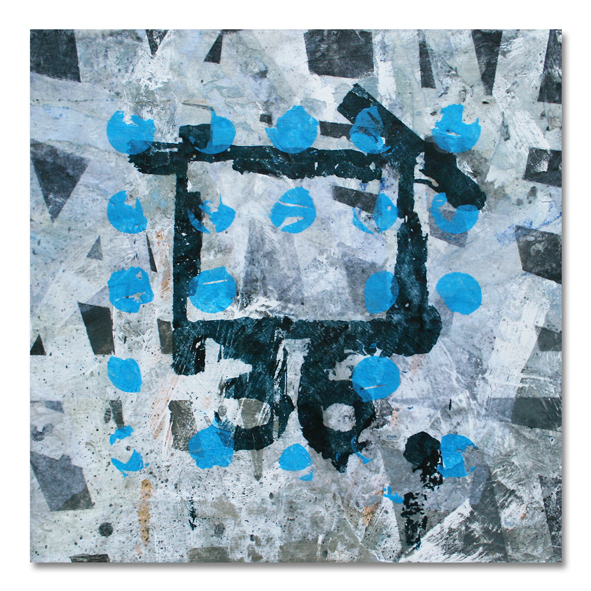
In terms of specifics, the TRA# tag, and the 36-frame motifs separately distinguish four panels each, with a third grid of heavily degraded spots (actually perforations) linking the two sub-series.  Each element was extracted from an individual photograph - being a neat snippet of graffiti, the vestige of an industrial door numeral, and a detail of a smoking bin, respectively.  Although serving as simple clues to the urban environment, each, in its own way, makes reference to ideas about lost messages, discards, absences, cancellations, vestigial clues, coded texts or entropic processes.  It also occurs to me there’s a tenuous link between the residual tape frame accompanying No. 36, and the framing characteristics of the # symbol in what is quite literally a hash tag.  One could even go so far as to suggest that each motif signifies a kind of blank portal.  I’m retrofitting these secondary associations, even as I write.


South West Leicester, May 2016


South West Leicester, May 2016


Central Nottingham, November 2015


Anyway, the ‘Extracted Fragments’ series is what it is really: It represents a small step forward technically, and another take on the idea of repetition within a standard model - in which processes of sampling and reproduction are made integral and overt.  My intention is that some, if not all of the panels should appear in the forthcoming ‘A Minor Place’ exhibition, with Shaun Morris and Andrew Smith, in Studley, Warwickshire.

More information about that should appear here soon.