'Shut 2', Acrylics & Paper Collage On Panel, 120 cm X 90 cm, 2012
I’ve just
finished my latest painting, titled ‘Shut 2’.It’s
been a few weeks in production and a couple of significant events occurred
since I posted about its preparatory development stages.One of these was the ‘If a Picture Paints a Thousand Words…” exhibition in Birmingham in which I participated, as also discussed in
recent posts. I'm sure that the thought processes
it triggered, and the potential of Birmingham to provide source material for future artworks, will percolate through next year’s work.
Study For 'Shut 2', Acrylics & Paper Collage On Paper, 60 cm X 45 cm, 2012
Study For 'Shut 2', Acrylics & Paper Collage On Paper, 60 cm X 40 cm, 2012
However, the origins of ‘Shut 2’ precede that show and it’s actually more revealing to relate it to another important
influence, namely October’s visit to Walsall, (itself, a stone’s throw from
Brum), to see Fiona Rae’s exhibition, - ‘Maybe You Can Live On The Moon In The Next Century’.I had been thinking about Rae’s work as
the idea for my painting emerged so the timing of the inspiring Walsall show was
particularly fortuitous.It’s no
accident that, whilst continuing themes I’ve been exploring in paintings during
2012, this one draws consciously on certain aspects of Rae’s own visual
vocabulary.
The
painting’s origins lie in the photographic images of industrial steel shutters
I’ve referred to repeatedly this year.In
this case, the individual subject was the same as the preceding ‘Shut 1' but observed from a closer viewpoint.Though still based upon parallel
vertical bands, the newly asymmetrical composition gave increased prominence to
the various elements of door furniture and other visual incidents distributed
over the corrugated surface(s).This triggered thoughts about Rae’s habitual scattering of disparate
motifs, (apparently) randomly across a composition.If ‘Shut 1’ was elegantly austere in its formal regularity, '2' soon became more extravert and less rigorously balanced.
Industrial Shutter, Leicester, 2012
'Shut 1', Acrylics & Paper Collage On Two Joined Panels, 150 cm X 100 cm Overall, 2012
'Together 1', 2012
This
increased overtness is also expressed through the introduction of a certain Pop
sensibility into the individual motifs.Initially, they evolved from the elements of graffiti and stickers in
the original subject and came to refer to the appropriation of contrasting,
(often kitsch), font characters and cartoon motifs in Rae’s painting.It revives a certain quality of my own
work from early 2011 too, (best seen in ‘Together 1’).However, whilst Rae appears to pay homage to the online world, my own work remains largely tethered to the materiality of the urban environment.
In its
construction, ‘Shut 2’ followed my usual procedure of layering paper collage and acrylic
paints.It shares a similar
background palette of off-whites and pastel blues, and certain visual textures
with ‘Shut 1’.I realise that, in addition to obscured
blue paint in the source subject, these blues also derive from the backing
paper of the tattered advertising posters I regularly salvage and collage into
my work.My use of repeat dot
patterns originated from observations of perforated security shutters, but
here, may also recall to the printer’s dots in such material.
I think
there may be more mileage in my ‘Closed’/’Shut’ theme but suspect that the
series will probably rest here for a while.‘Shut 2’ clearly reflects the ideas around urban entropy,
economic frailty, mixed messages and exclusion that haunt its three companions
but with an added dimension.I once
described last year’s early works to someone as "LikePop Art
left out in the rain”, and this painting may be the closest I’ve got to that feeling so far. Above all, it’s my most recent attempt
to capture the sense of flimsy market stylings pasted onto the crumbling
edifice of a society in decline.
I was saddened to hear of
the death of the pioneering Jazz pianist Dave Brubeck this week.At just a day short of 92 he was
unusually long-lived for a Jazz musician and had consequently witnessed most of
the important developments in the genre and worked with many of it’s major
players. Brubeck himself became a prime exponent of progressive Jazz and particularly the 'Cool' style that emerged in the late 50s.
I won’t pretend to be
familiar with his entire oeuvre but have often returned to his classic 1959
album - ‘Time Out’ over the
years.It’s the perfect embodiment
of his stated intention to explore alternative approaches to rhythm and harmony
within an approachable framework.‘Time
Out’ has an undeniably easy-going
West Coast cool that can’t obscure the fact that Brubeck and his quartet were
applying a consciously experimental approach to style, structure and time
signature over its seven tracks.It’s also a showcase for the sinuous saxophone work of Paul Desmond
who’s ‘Take Five’ became a
massively successful and immediately recognisable single.
Ultimately, I guess Brubeck's main
creative achievement was to demonstrate that music could be seductively
listenable and still present a satisfying artistic challenge.His musical scope was
considerable and he was well versed
in High Modernist theory and had even studied with Arnold Schoenberg.Nonetheless, to this day it seems that,
whenever I’ve played ‘Time Out’,
someone in the room will claim they "don’t normally like Jazz but really
like this".
The 'classic' Dave Brubeck Quartet. (L-R): Joe Morello, Paul Desmond, Brubeck, Eugene Wallis
The other facet of Brubeck
that his Californian hip credentials and commercial success might obscure was
his integrity in matters of civil rights.Having recruited the black bassist Eugene Wright into the quartet he was
to cancel several gigs and at least one Television appearance in opposition to
the segregationist attitudes of club owners and producers.
It seems that Brubeck’s long life was an ‘Unsquare
Dance’ indeed.
There has been a prevailing Folk strand running though my monthly playlists to date. This time, after an initial sample-fest, things became increasingly Jazz-centric, and a bit funky too.
‘The Five EPs’, Disco Inferno
Disco Inferno was an
ironically named Indie outfit that made a few ripples in the early to mid
90s.They might have been
remembered as mere New Order wannabes had they not hit on the unusual idea of
using ‘real’ instruments to trigger an expanding library of samples.It was a technically unwieldy approach
but one that allowed them to construct fascinatingly nuanced soundscapes and employ their found sound sources as raw material rather than mere decoration.
Arranged chronologically on
this compilation, these tracks range between relatively conventional, if
sonically unusual, song forms to real avant-garde aural sculptures.The best cuts stand comparison with the
multi-layered texturalism of contemporaries The Cocteau Twins or My Bloody
Valentine, and the later tracks show increasing complexity and some
humour.It takes a certain genius
to combine a drum loop from Iggy Pop’s ‘Lust For Life’ with fragments of the ‘Playschool’ theme, (‘It’s A Kid’s World’).
‘Foley Room’, Amon Tobin
Of course, what Disco
Inferno once attempted with a stack of mal-functioning equipment is now
achieved over coffee with a laptop computer.Amon Tobin has enjoyed a reputation as a highly skilled
aural bricolagiste and beat technician for some years now but 2007’s ‘Foley Room.’ album saw him abandon his trusty record crates in
favour of tailor-made original field recordings. The album still showcases
his customary obsessive detail and disquieting atmospherics but acquires an
extra dimension through the new cinematic approach to sound design.It proves genuinely arresting to listen
to tracks constructed from a pitch-shifted motorbike engine or terrifyingly
close-up tiger growls.
‘Until The Quiet
Comes’, Flying Lotus
This may prove to be my
favourite new record of 2012.
Steven Ellison has established himself as an impressive
practitioner of the style of electronica sometimes called Wonky. He’s a master of the stumbling,
unquantised rhythms and dazzling assemblages of diverse sounds typical of the
genre, - achieving massive degrees of disjuncture but always retaining nagging
vestiges of a groove or melody. This is his lushest material to date, incorporating swathes of atmospheric keyboards and sweet, processed vocals into
an implied dreamscape. Even a
contribution from whinging Radiohead vocalist Thom Yorke can’t spoil
the excellent ‘Electric Candyman’.
Whilst coming from a
nominally Hip-Hop background, Ellison covers numerous stylistic bases and
possesses a distinct jazz sensibility and laid-back West Coast funkiness.He’s much aided in the latter by
long-time collaborator and virtuoso bassist Thundercat.For all the formal abstraction, nothing
overstays it’s welcome and there are moments of sheer transcendent beauty
here.Rather than proving a
problem, his grasshopper approach to track construction can make each repeat
listen seem like a new experience.To my ears, ‘UTQC’ is the most
seductive Flying Lotus release so far.
‘The Golden Age Of
Apocalypse’, Thundercat
Thundercat Channels The Warmth Of The Sun
Having marvelled at Stephen
Brunner’s bass guitar work for Flying Lotus, it was only natural I’d turn to his
own 2011 album, - itself produced by Steven Ellison.This is imbued with West Coast ambience and, with eyes
closed, it seems to evoke an artificial L.A sunset, - polychromatic with smog
and airbrushed for reproduction.Actually, it reminds me of Ed Ruscha’s paintings of the Hollywood sign.
The album is full of jazz
and funk flavours and Brunner seems to be channelling Herbie Hancock, Chick Corea and, particularly, George Duke, whose ‘For Love I Come’ is covered
beautifully.Like much of the best
synthetic music these days Brunner plays freely with a palette of retro tropes
whilst producing something that sounds very contemporary.As the title suggests, these are
sun-drenched grooves for a changing climate.
‘Headhunters’, Herbie Hancock
Hancock was a major name in
60s jazz, making numerous albums under his own name, and as a member of Miles
Davis’ seminal fusion bands too.With a new band, also named Headhunters, he embraced a new funk-orientated approach
with this album in 1973.If it was
partly a search for greater commerciality, it also contained great music and
proved to be a milestone in jazz-fusion.The main influence is Sly Stone and this shares his ability to find
compelling laid-back grooves within relatively spare arrangements.
Hancock and his band played
in Leicester’s De Montfort Hall Gardens one wet midweek evening some years
ago.Dancing for warmth in a
pathetically small crowd I wondered, “where is everyone – it’s Herbie
Hancock?”They’d have been
forgiven for getting out of there as soon as possible but, instead, turned in
a memorably dynamic and fully committed performance.
‘Birdland’, Weather Report
Not The Album Version But Too Good To Leave Out. Weather Report Play The Stadthalle Offenbach, 1978
Weather Report is another of
those Jazz-fusion acts whose music, (from the 70s at least), I really
enjoy.Purists always scoff at
this kind of thing, forgetting that mutation and evolution are actually
necessary for the sustained health of any art form.That Miles Davis and his circle sought to push Jazz into new
areas of expression by no means betrays what went before and merely signifies
that the idiom was adapting to survive.Weather Report was a major component of his legacy. Of all the period's fusion acts, they probably retained the greatest element of Jazz within their music overall.
‘Birdland’ came from 1977’s ‘Heavy Weather’ album and marked a conscious move away from their
previous reliance on improvisation towards a more accessible, composed
approach. The single was certainly their most successful release commercially
but I love it nonetheless.It has
an infectious, uplifting hook and is pretty much the sound of optimism.It always works well in the car at the
start of any journey undertaken for pleasure.
‘Handsworth
Revolution’, Steel Pulse
A Bird In The Handsworth... Oh, Never Mind.
In Birmingham not long
ago, I caught Vanley Burke’s exhibition of documentary photos of the city’s
black community, taken over several decades. Many of Birmingham’s immigrants came from Jamaica and it
made me realise I haven’t played much Reggae lately. Steel Pulse hailed from the Handsworth
area of Brum and was amongst the most credible of the British Reggae acts. This was the band’s debut album and
it’s a great example of the roots style that bares comparison with anything
from the island.
‘Marcus
Garvey/Garvey’s Ghost’,
Burning Spear
Winston Rodney, Aka. Burning Spear
Another slice of conscious
Roots Reggae but this time, very much from Jamaica.Whilst originally a three piece, Burning Spear was
essentially Winston Rodney – a musician whose Rastafarianism and adherence to
Marcus Garvey’s teachings were profound.This release gathers the original album with the subsequent ‘Ghost’ dubs.It does appear that Spear’s deep and heavy sound was somewhat lightened
for mass consumption but I love the steady, serious tone and sincere, heartfelt
vocals.
‘Solution’, Solution
One Sunday evening, Stuart
Maconie played a track from this on his ‘Freak Zone’ pigeonhole, (sorry – radio
programme), and really whetted my appetite.Solution’s debut is a wonderful piece of early 70s Dutch
Jazz Prog. that ticks loads of boxes through its numerous changes of mood and
tempo, proper, heavy-duty organ, flutes, and impressive passages of European
Jazz-Rock.It also includes some
spooky, atmospheric bits and a passage that sounds like a circus orchestra on
speed.
Connections between Solution
and Focus - the godfathers of Dutch Prog., led me back to…
‘Focus III’, Focus
Focus Embrace Their Dutch Heritage
Focus covered most of the
Prog. bases in their first few albums.Dynamic guitar and organ Rock; Classical influences; Jazz; Renaissance Lute Music; mock operatic vocals; Latin lyrics; yodelling; whistling, - they
all appear at some stage, (sometimes within the same song).They had real instrumental ability but
avoided terminal pomposity by tempering grandeur with humour.Even their tendency to
assemble over-ambitious, extended pieces from separate fragments, rather than
through-composing them, seems less of a problem in our cut & paste age.
‘Focus III’ aims all round the target and scores several
bullseyes in the process.Highlights for me are the slow-burning title track segueing into ‘Answers?
Questions! Questions? Answers!’ and ‘Sylvia’, (that rarest of beasts, - the perfect short Prog.
Rock single).
Rather than rushing back to Leicester after the Friday night private view of the ‘If a Picture Paints…’ exhibition, I made a weekend of it in Birmingham. It allowed me to revisit the gallery on the Saturday and reflect further on the work and the exhibition experience as a whole. It also provided an opportunity to celebrate my close friend Susie's birthday in a different city, and to explore some of the photo opportunities I suspected were lurking in the Digbeth area near the gallery. The luxury of a big bed and leisurely hotel breakfasts were an attraction too.
Work By: (L-R), Shaun Morris, Andrew Smith, Chris Cowdrill & Andrew Smith
Two Of My Paintings With Work By: (L-R), Andrew Smith, Shaun Morris & Andrew Smith
Still Life Paintings By Shaun Morris
Work By: (L-R), Andrew Smith, Shaun Morris & Andrew Smith
Friday
was all about the buzz of the exhibition as an event, but Saturday demonstrated it
can still be difficult to coax people into a gallery under normal conditions,
however diligently you publicise it.
If only a trickle of people found their way in that day, I still think
it was right to opt for a weekend opening and can’t fault the collective effort
to raise awareness of the show.The Works gallery is a good space and suited the exhibition well but, being on the third floor of an old industrial building, must struggle for
passing trade.I guess the lure of
Brum’s extensive retail honey pot nearby was always going to provide severe
competition too.
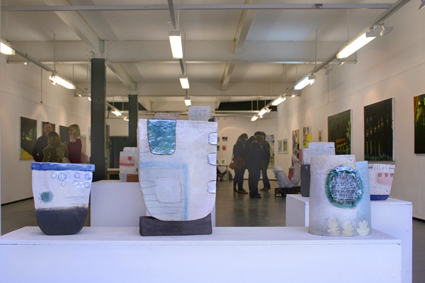
Ceramic Piece By Craig Underhill, (Foreground), With Work By: (L-R), Myself, Andrew Smith & Chris Cowdrill
Ceramic Work By Craig Underhill
Nonetheless,
it was good to spend more time with the work, to chat to Shaun and Andrew again
and get to know Chris a little better.
I appreciated seeing how the work appeared with some daylight
illumination too. Andrew’s paintings,
which had seemed quite muted the previous evening, started to sing next to the
large gallery window as surprising amounts of colour seeped out from their
accumulations of visual incident.
I was drawn to make comparisons with my own paintings’ more overt, on-the-surface garishness.
Paintings By Andrew Smith
My Paintings 'Home 1' (L) And 'Broken 1' (R)
My Painting 'Shut 1'
I like what
Indigo Octagon are trying to do as a collective and am convinced that artists
gathering together to provide their own support mechanisms and shared energy is
a canny strategy in these days of increasing financial and cultural
poverty.I chatted with Chris
about the potential for different projects under the same banner to involve
varying combinations or degrees of involvement from core members whilst drawing
in outside collaborators as appropriate.It works well enough for musicians, (Massive Attack being an obvious
established model), so why not artists?I was encouraged to meet a group for whom the main priority appears to
be the work, with everything else seemingly just about maximizing the chances
of it reaching an engaged audience.In a hollow, P.R. driven culture, where every dream is retailed back to us,
the value of encountering reasonably like-minded people is incalculable.
Paintings By Shaun Morris
Earlier, I
had wended my way slowly to Pershore Street via the seriously dilapidated
industrial back streets of Digbeth.
The streets I traversed are dominated by massive brooding railway arches
which, as Andrew pointed out, lend them a slightly Gothic, or even De
Chirico-esque, quality.During my short walk I encountered numerous good examples of urban
text, decaying surfaces and general entropy.I’m sure I only scratched the surface(s) and intend to
return for more photo-perambulations very soon.
Surfaces And Texts, Digbeth, Birmingham
The day
concluded with a meal and drinks with my friends and a chance to
marvel at the apparent 'last days of the Roman Empire' unfolding on Broad Street.A real find for me was ‘The Yardbird’,
tucked in next to the municipal library.Somewhere between a bar and a club, this intimate venue
revealed itself to have a very happening vibe with lounge décor, an open minded
crowd and excellent Jazz/Funk/Soul/Hip-hop sounds.Full marks go to the proprietors for
pitching the P.A volume perfectly too.It’s good to know my arthritic knees still permit occasional dancing even if my Sunday morning head doesn’t like me drinking!
My last post mentioned how various events in Birmingham have been occupying my time
just lately.Prime amongst these
was the private view for the exhibition, ‘If a Picture Paints a Thousand Words, Why Can’t I Paint’, organised by the Indigo Octagon collective and in which I participated
as a guest artist.Although the
show had been open for a few days, the Friday evening event was an obvious
opportunity to draw as many people as possible through the door and was, in
that and several other respects, a real success.
Being at a
geographical remove, I’d had a relatively little hands-on involvement with the
show’s practical preparations and was unsure exactly what to expect prior to
entering the gallery for the first time.Additionally, I was rather breathless from the rapid race over through
Friday evening M6 traffic, (thank you, Road Gods!), and a hurried hotel
check-in.
In the
event, I was delighted to see how well the exhibition looked and just how much
care, thought and sheer hard work, Shaun Morris and the other guys had put into
the hang.Although generally
familiar with the soft themes underlying the show, and some of the work on
display, I hadn’t anticipated just how well different pieces would relate to each
other across the room.It was
fascinating to observe the subtle correspondences between the differing
preoccupations of the five artists emerge as one moved around the gallery.I think one of the main achievements
has been to allow these connections to be discovered and reflected upon
naturally without too much spoon- feeding or conceptual contrivance.
It’s always
scary to expose one’s work to a public arena and in the context of other
artists’ output.I was relieved to
find I haven’t been fooling myself, and that, out in the World; my paintings
can justify their creation.Of
course, there’s always a list of things one might do differently and certain aspects of the other participants’ work may suggest possible new ways
forward for my own.This is particularly true of Andrew Smith’s engagement with some concerns that I share but across a variety of platforms.Despite my commitment to painting, he
takes greater account of the flux of urban existence, and the relationship
between environment, text and thought processes, than I have managed so
far.His video work, painted
photographs and textual paintings supplied much food for thought.Craig Underhill’s ceramics engage
with the nuances of distressed hard surfaces to which I’m often drawn, whilst
Shaun’s painted motorway nocturnes and Chris Cowdrill’s painstaking, collaged
illustrations tackled those mutable zones at, and just beyond, the margins of
any conurbation.
The Men They Could Hang: (L to R), Craig Underhill, Some Bloke From Leicester, Shaun Morris, Chris Cowdrill, Andrew Smith
Work By Shaun Morris, (Left & Centre) And Andrew Smith, (Right)
Ceramics By Craig Underhill
Many
exhibiting artists will probably admit that private views sometimes alternate
between the slightly intimidating and the dispiritingly vacuous, but this time
round it seemed the large gathering comprised people who’d come for the right
reasons. There was plenty of
genuine interest in the work and lots of positivity and general good humour. I
met many new faces and enjoyed numerous conversations. It was evident
that the I.O. team had worked really hard at getting the word out and it paid
off, with the room remaining full nearly all evening. The exhibition brochure was a stylish art statement in its
own right and the souvenir badges provided a nice touch of affordable ‘merch’.
Shaun & Andrew Perform 'Music For Service Stations'
Box Of Knives
The
exhibition’s mixed media aspect was further enhanced by the inclusion of live
music that turned a private view into a real multi-dimensional event. Although Shaun and Andrew will maintain
their performance of ‘Music For Service Stations’ wasn’t wholly successful, I was
impressed they’d composed a piece specifically for the event at all.They were followed by a committed
performance from local band Box of Knives that went down very well with the
room.
It Was a Mixed Crowd
Although
our numbers were a little reduced through illness, I was pleased to be able to
take a small contingent with me to add to the crowd. As well as thanking the I.O. guys for making it all happen, and everyone who
attended, particular thanks are due to Lorel, Susie, Pauline, Dave and Sid for
helping to make it a great weekend altogether. More of that in my next bulletin…
'Thanks For Coming'
It’s worth
mentioning that the show continues until November 23 so here’s hoping that,
before then, some more folks make it along to the Works Gallery, Jubilee Centre,
130 Pershore Street, Birmingham B5 6ND. Oh, and if you want to know who Harvey Smoke is, - ask Andrew.