Showing posts with label Mark Fisher. Show all posts

Tuesday, 24 January 2017

R.I.P. Mark Fisher


Mark Fisher


It’s dispiriting to be writing another obituary so soon, but seems only fitting to acknowledge (slightly belatedly), the recent passing of Mark Fisher, at the age of 49.  If the thinking of the recently deceased John Berger could be said to have presided over much of the meaningful art criticism and cultural commentary of the late twentieth century, Mark Fisher’s writings and commentaries might be said to have carried on that legacy within the sphere of music and popular culture.

That Fisher’s influence may have been somewhat more niche than Berger’s, is less a reflection on the resonance of his ideas and, in part, more a signifier of how our intellectual life is far more fragmented and thinly spread in the digital age.  However, it is only realistic to accept that the Marxist-derived philosophical positions adopted by both writers now feel even more marginalised by events than in Berger’s heyday.  For all that, many of their underlying assumptions are actually taken for granted (by some of us at least) regardless of prevailing conditions - and Fisher was certainly a significant influence on my own thinking about various aspects of our society and culture in recent years.

In reality, Fisher’s own ideological position seems to have shifted more than a little over the years, and his pop-cultural enthusiasms could be equally unpredictable.  For many years, these were disseminated largely through journalism, for publications such as The Wire, New Statesman and The Guardian, and most notably, via his influential (and consistently edgy) K-Punk blog.  There, one might read insightful, in depth analyses of the work of bands like Joy Division or Roxy Music, but equally, of the cultural significance of Girls Aloud or Rihanna.  His opinions, and the fervor with which they were expressed, were consistently challenging, but there was rarely any doubt that they were considered and came from a refusal to toe any particular party line in a facile manner.


Amongst my own particular favourite posts from K-Punk were his studies of the the music of Burial – an artist whose work has never failed to affect me.  Fisher proved adept at outlining the historical post-Rave, post-digital and alienated-urbanist frameworks framing Burial’s oeuvre, but equally so in highlighting how such zeitgeists feed on subjective, emotional impulses as much as upon cultural theory or formalised aesthetics.


In fact, it seems to me that this was his most important legacy.  The reduction in Fisher’s blogging activity coincided with his establishment as an academic and as the author of the books ‘Capitalist Realism: Is There No Alternative?’ [1.] and ‘Ghosts of My Life: Writings On Depression, Hauntology And Lost Futures’ [2.].  I can recommend both works highly not least for the way that Fisher joins the dots between politics, culture, philosophy and individual and collective psychology.


These days, I tend to the view that the theoretical and political orthodoxies into which we are all coerced, stem from varieties of mental illness or subjective impulse as much as from coherent or objective reason.  Does this not, at least in part, inform the current global rise of blinkered, quasi- fascist populism and the rise of Trump?  Equally, can many of those still adhering to more traditionally left wing world view, honestly claim that they aren’t as much inspired by an instinctive rejection of injustice surrounding us, as by the (often ossified) ideological frameworks built upon them.  The reality is, as ever, that the uncoupling of reason and emotion rarely result in genuine progress – tending rather to trigger yet more suffering (intended or otherwise).

‘Capitalist Realism’ comes from an obviously leftist place, but in those chapters where Fisher proposes possible alternatives to the current ‘reality’ we are sold, he advocates more flexible thinking, adapted to the specific challenges of a new century, over recourse to the codified ideologies of an old one.  Cultivation of critical thinking skills seem vital here, but so too does the expansion in our collective emotional intelligence.


‘Ghosts of My Life’ digs further into the relationship between the cultural and the personal.  It pays close attention to the theoretical underpinnings of the Hauntological impulse within early twenty-first century popular culture and how this reflects the loss of a perceived utopian drive within previous generations.  This sense of our being frozen in capitalist stasis, or of history having been collapsed can be interpreted as a form of societal depression, but equally, as a trigger for ever greater waves of mental illness within the individuals that constitute it, Fisher argued.


In the light of this, the confirmation that Fisher died by his own hand - as the culmination of his own prolonged struggle with depression, is even more upsetting.  This is not least  because, in a period when we appear to be sliding ever deeper into the delusions of global psychosis - we need the kind of reflective, insightful thinking of a commentator like Mark Fisher, more than ever. 


[1.]:  Mark Fisher, 'Capitalist Reaism: Is There No Alternative?', London, Zero Books, 2009

[2.]:  Mark Fisher, 'Ghosts Of My Life: Writings On Depression, Hauntology And Lost Futures', London, Zero Books, 2014


Monday, 11 November 2013

Cynical? Me? - You Would Say That, Wouldn't You?


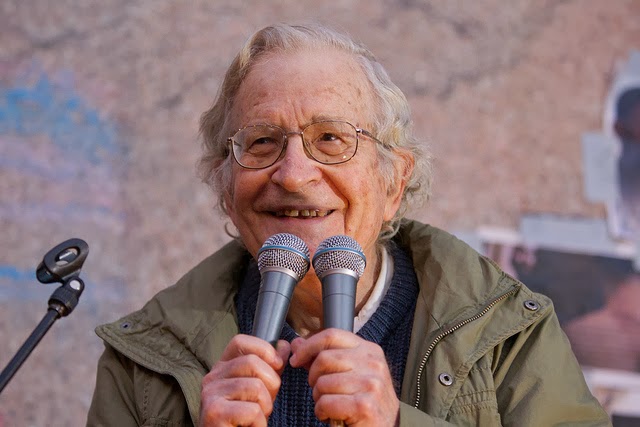
Noam Chomsky Addresses Occupy Boston, Dewey Square, 2011, (Photographer: Unknown)


Not so long ago I had a slightly perplexing day when three different people accused me of cynicism on separate occasions.  Perhaps I was just having a bad day but it did make me reflect on how easy it can be to fall into the habit of world-weary disappointment at the shortcomings of human behavior and thus, to automatically expect the worst.  I guess we all label each other based on superficial impressions so I shouldn’t be surprised if what one hopes is finely honed satire, heartfelt concern or justifiable anger just looks like bleak negativity to others.  In reality, it’s mostly a defence mechanism for the vulnerable, I suspect.  I thought about the issues of optimism versus pessimism and irony versus sincerity again recently in two different contexts, both reminding me that where there’s life, and creative intent, there’s always hope.  This post is about the first.


I’ve just finished reading Noam Chomsky’s little book ‘Occupy’ [1.].  Chomsky’s championing of the Anti-Capitalist Occupy Movement should come as no surprise given his well-established left wing credentials, and the book is a clear attempt both to document the progress of Occupy’s recent organized challenges to the status quo, (in The West at least), and to provide encouragement to those seeking to take its initial idealistic impetus onto the next level of political engagement.  Of course, from one ideological perspective, the cynic’s view of such demands for social or economic change is to dismiss them as just the same old songs from a bunch of naïve urban campers.  Even from those more likely to be sympathetic, it might just seem like something one might hope for in one’s heart is inevitably overruled by the more realistic, if disappointed, head.  One consequence of this may be a general sense of powerlessness in the face of ever-greater degrees of hardship and injustice.  Another may be weary acceptance of that what Mark Fisher has highlighted as the ‘Capitalist Realism’ orthodoxy [2.], (i.e. ‘just the way things are’).  Either way, inertia is the likely result.


Occupy Protesters At Vietnam Memorial, Lower Manhattan, 2012.
Photo: Anthony Lanzilote/New York Daily News


Where I find Chomsky’s book most encouraging is in highlighting that it is in multiple small, anonymous acts of positivity or engagement that real hope for an alternative future may be found and that progress may be incremental and relative rather than necessarily revolutionary or Utopian, (even though they may be the initial impulses).  Using the examples of Feminism, Anti-Vietnam War protest and The Civil Rights Movement he argues that, whilst there are still plenty of causes for complaint, some progress was made.  More importantly still, he insists that it’s through consistent voicing of discontent and ongoing consciousness-raising, that the overall assumptions and agendas of power can be gradually shifted.  No one would pretend Capitalism is about to cave in just yet, at least before it has caused a lot more more harm.  Nonetheless, the fact that many now recognise it is in no way predicated on the greater good of the majority, and indeed the self identification of the '99%', must surely begin to compromise its long-term integrity as a sustainable system.


Howard Zinn, 1922 - 2010


Perhaps, the most moving section of ‘Occupy’, and the crux of its message, is contained in the short chapter memorialising his old friend and noted Civil Rights campaigner Howard Zinn.  It includes the following quotation by Zinn:


“TO BE HOPEFUL in bad times is not just foolishly romantic.  It is based on the fact that human history is a history not only of cruelty, but also of compassion, sacrifice, courage, kindness.

“What we choose to emphasize in this complex history will determine our lives.  If we see only the worst, it destroys our capacity to do something.  If we remember those times and places – and there are so many – where people have behaved magnificently, this gives us the energy to act, and at least the possibility of sending this spinning top of a world in a different direction.

“And if we do act, in however a small way, we don’t have to wait for some grand utopian future.  The future is an infinite succession of presents, and to live now as we think human beings should live, in defiance of all that is bad around us, is itself a marvelous victory” [3.].


Occupy Protester, Zuccotti Park, Manhattan, 2012.  Photographer Unknown


This may all sound like the spent idealism of a previous generation but for those of us with a tendency toward despair with each news bulletin, it is at least some kind of testament of hope.  I also think the idea of living now, in a infinite succession of presents, as we think humans should, could be extended to a range of human activities and certainly to the field of creativity in general.  Regardless of the degree of direct political engagement one might incorporate into one’s artwork, there is some validity in the old idea that any artistic activity is an intrinsically political act.  It is, at source, an attempt to shape a better world, (however personal).  Furthermore, the creative, entertaining and inclusive aspect of many Occupy gestures, demonstrate that the desire to shape the world expressively and the impulse to bring about social, economic or political change are often very closely linked.


[1.]:  Noam Chomsky, ‘Occupy’, London, Penguin Books, 2012.

[2.]:  Mark Fisher, ‘Capitalist Realism:  Is There No Alternative?’,  Ropley, Hants., Zer0 Books, 2012.


[3.]:  Howard Zinn, ‘You Can’t Be Neutral On a Moving Train: A Personal History Of Our Times’, Boston, MA., Beacon Press, 1994.  Quoted in: Noam Chomsky, ‘Occupy’, London, Penguin Books, 2012.