Showing posts with label Theory-Fiction. Show all posts

Monday, 25 July 2022

Negarestanian Diversion 4.2 [S.C. trans_script/trans_late (aug_mented)]


All Images: West & Central Leicester, June 2022


[Augmented, Reconfigured & Translated Audio Transcript]: 

I don't judge the crack-heads, the lovers, or the painters, as immobility is usually associated with the symptoms of memory gap paralysis. In that case, a person cannot access the memory (if the memory gap makes it difficult to access the subject). It is also marked so that it can be accessed from the other side. Can you comment on how to access these memory slots?


The subject and character of the questioned subject is not the soul of the thing (nor of anyone). If this is unreal, and kept in memory until 16.00, memories of Holzer gates and reverse access points are remembered. we all have our vices in this life, trying to break us. Correlations of behavious and patterns of external memory below to the outside.


Animals smuggle and retrieve non-human data in an attempt to remember themselves (including recall of external memory gaps with the function of time spent in space with the whole group). The dentist is in no hurry to sleep in memory. Remembering the world is to bring home the void.


(With thanks to S. Chhana & Anon.)


Sunday, 24 July 2022

Negarestanian Diversion 4.1 [E.M. tran_script/trans_late]


All Images: Central Leicester, June 2022


[Reconfigured/Translated Audio Transcription]:


Usually, the university to remember is related to symptoms of memory hole paralysis. In which case, the subject is unable to access the memory of the memory holes that caused the subject's access problems, because they were specifically designed to be accessed from the other side.


In this sense, the memory gaps are not available to the subject, and are independent (because they are outside the subject and do not concern anyone). If retrieval is unrealistic and useless, in terms of the memory hole, then there is a reverse memory gap at the gate (and access points). Then other access patterns are memories that belong abroad.


Here are channels for transferring and retrieving data from the other side, and making a human  or mental effort to remember what we should not (from the outside too). The memories of memory cats (in a short time) work like a full vessel. None of the creatures whose dreams do not, attack. The holes in our global memory are the way back home.


(With thanks to E. Marshall).


Monday, 18 July 2022

Negarestanian Diversion 4.0: Memory Holes


All Images, West Leicester, June 2022


"The inability to remember is usually associated with the paralytic symptoms of memory holes; in this case the subject is not able to access the memory. If memory holes cause such accessibility problems for the subject, it is because they have been specifically designed for being accessed from the other side. In this sense, memory holes are accessed not for the subject and its integrated self but for that which is exterior to the subject and has no self (no one). If remembering is unrealistic and futile in terms of memory holes, then inversely memory holes are gates and access points; they conduct remembering and other modes of access towards a memory which belongs to the outside." [1.]


"If memory holes are channels for trafficking data and retrieval from the other side, then each human or subjective attempt to recall involves an invocation of, or a stepping into the memories of, an outsider. Memory gaps, with their Space-Time lapses, function as a ()hole complex through which nether entities seep, rush toward our world; memory gaps are the instruments of their homecoming." [2.]


[1.] & [2.]: Reza Negarestani, 'Cyclonopedia', Melbourne, Aus, re.press, 2008.


Saturday, 25 June 2022

Negarestanian Diversion 3: Openness


All Images: West Leicester, June 2022


"In economic openness, affordance does not refer to either the restrictive or restricting affordability of one or multiple systems, but the whole reciprocal horizon in which both the subjective and objective sides of economical openness must survive and undergo a dynamic but economical participation. Affordance does not work on a univocal or a unidirectional line - from the subject of openness to its objective or vice-versa. It is economically collective. Affordance moulds an horizon of economically-secured openness which accommodates both sides as bodies synchronous to each other. Correspondingly, openness is dynamically determined by the survival of both subjective and objective sides as a mutual living process, rather than survival as the evasion of peril. If affordance cannot be subjectively or objectively dismantled, this is because it is established mutually. In regard to its subjective and objective poles, affordance is basically mesophilic, meaning that it always comes in-between. Participations, becomings, lines of tactics and communications must all be based on the meso-sphere of affordance and its survival machineries." [1.]


"To become open or to experience the chemistry of openness is not possible through 'opening yourself' (a desire associated with boundary, capacity and survival economy which covers both you and your environment); but it can be affirmed by entrapping yourself within a strategic alignment with the outside, becoming a lure for its exterior forces. Radical openness can be evoked by becoming more of a target for the outside. In order to be opened by the outside, rather than being economically open to the system's environment, one must seduce the exterior forces of the outside: you can erect yourself as a solid and molar volume, tightening boundaries around yourself, securing your horizon, sealing yourself off from any vulnerability ... immersing yourself deeper into your human hygiene and becoming vigilant against outsiders. Through this excessive paranoia, rigorous closure and survivalist vigilance, one becomes an ideal prey for the radical outside and its forces." [2.]


[1.] & [2.]: Reza Negarestani, 'Cyclonopedia', Melbourne, Aus, re.press, 2008


Wednesday, 22 June 2022

Negarestanian Diversion 2: Hydraglyphic Alphabets


All Images: West Leicester, June 2022


"Beyond an involvement with the flexuous qualities of Hydra (sinuosity, ogee, curvature and curlicue), Hydraglyph emphasizes how the visual shape of consonants deviates from vowels and how such shapes express the nonlinear and barbaric musicality of such consonants, Hydraglyphs are the diagrams of cacophonic and sonic aspects of middle-eastern consonant alphabets, or abjads.


"The term 'snake writing' associated with the excessive curvature of letters, as in Arabic and Pahlavi languages, is more than anything a diagrammatical approach to the sound of these consonants, which is a nonlinear but continuous process of vocalization formed by different intensities, vibrations and forces employed in different phases of vocalization. Hydraglyphs or draconic letters of middle-eastern consonant alphabets are barbaric musical notes in themselves.
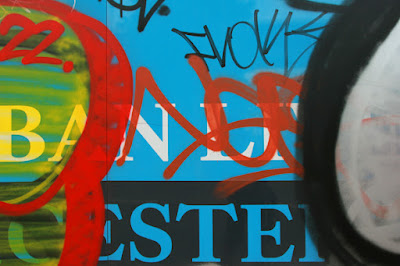


"Close observation of the letters of Pahlavi, Hebrew, Arabic or Samaritan alphabets will reveal that they diagram an exploded view - as in industrial drawings, the view of an object after a controlled explosion in space - of a greater coil (the Mother of all Monsters) or entanglement. To write in these letters is to indulge in dracolatry, a worshipping of ancient serpents. Hydraglyphs, as letters of middle-eastern consonant alphabets, are disentanglements - remaining wreathed and coiled in themselves - of dynamic complexities; they are written and characterized by gates and thresholds.


"The first element of a novice's initiation into middle-eastern calligraphy is to learn to apply different but constant forces and pressures - not in the sense of a constant increase or decrease of forces - to various regions and each part of the letter in flowing manners. Such forces and flows are commonly epitomized as a series of movements including lateral undulation, sidewinding, side-pushing and concertinaing. The application of a new force during the process of writing is usually accompanied by a twisting of the tip of the pen and a deviation from the already-established path into a new twist; the letter is constituted of a thousand gates passing onto each other. Every twist constitutes a temple-pylon to a new region demanding new forces, unforeseen developments, variations and dynamic surprises - Tiamaterialistic miracles of all kinds.


"Greco-Roman letters are shaped by applying nearly constant or invariable forces on different parts; each letter possesses an architectonic coherence between the beginning and the end. Hydraglyphs, however, perpetuate themselves through the ceaseless emergence and subsidence of forces passing through different thresholds. Shape, in this sense, is defined by gradients (antechambers) rather than fixed boundaries (ostium).  The outcome of this fluctuation is a spiralistic configuration or a coiling structure which characterizes middle-eastern alphabets.


"In the majority of such middle-eastern letters, a precise endpoint, a solid death, never occurs: the calligraphic letter is let loose to slide freely as the shape concludes softly by developing a tail at the point that the letter is written.


"But is the tail the end of the monstrosity? Such immersion into a gradient of softness or decay, as opposed to the emphatic death of the Greco-Roman cast and moulded letters, recurs in the vocalization of middle-eastern vowelless alphabets. When the vocalization does not undergo a death or complete termination (the definite end on the lips) as in the Greek and Roman languages, it is fulfilled by a gradual cessation, or to be exact, a softening rather than a stopping. Death in writing and vocalization is followed by impermeability and linearity of vocalization: for middle-eastern alphabets, however, it is decay that chisels its way through death, to ensure the continuation of softness." [1.]


[1.]: Reza Negarestani, 'Cyclonopedia', Melbourne, Aus. re.press, 2008


Negarestanian Diversion 1: Plot Holes/Hidden Writing


All Images: West Leicester, June 2022


"Hidden Writing, whether as apocrypha scripta or steganographia, integrates the utilitarian frenzy of ()hole complex as its functioning principle, inseparable from its convoluted structure. In Hidden Writing structure and function alike are the same as in the dynamism and emergence and formation in porous earth.


"Hidden writing can be described as utilizing every plot hole, all problematics, every suspicious obscurity or repulsive wrongness as a new plot with a tentacled and autonomous mobility. The aftermath of this utilization manifests itself as an act of writing whose effect is to deteriorate the primary unified plot or remobilize the so-called central theme and its authority as a mere armature or primary substance holding things together.


"The central or main plot is reinvented solely in order that it may stealthily host, transport and nurture other plots (which can register themselves as plot holes) by overlapping them with the surface (superficially dynamic plot) or the grounded theme. In terms of such a writing, the main plot is the map or the concentration blueprint of plot holes (the other plots). Every hole is a footprint left by at least one more plot, prowling underneath.


"A plot hole does not operate on behalf of an absence (that of critics' scorn), but registers and conveys the activities of a sub-surface life. Plot holes are psychosomatic indications of at least one more populating itself in the holes it burrows through and digs out. However , the propagation of plot holes in hidden writing is not merely the evidence of actual independent plots beneath and through the visible surface or the so-called main story ('books within a book').


"More importantly, it is the indication of the active inauthenticity and anti-Book distortions that Hidden Writings carry. In addition to being the manifest symptoms of ongoing plots, plot holes originate from pseudonymity, anonymity and deliberate distortions linked to issues of authorship usually associated with Hidden Writings. Shifting voices, veering authorial perspectives, inconsistent punctuations and rhetorical divergences bespeak a crowd at work, one author multiplied into many.


"In fact, mis-authorial problems which are usually associated with Hidden Writings give rise to tendrilled plots as new narratives spreading out from the surface plot in all directions; plots capable of seizing the surface story or the textul structure from the dominant authorial space." [1.]


[1.]: Reza Negarestani, 'Cyclonopedia', Melbourne, Aus., re.press, 2008.