Thursday, 2 April 2015

Concrete 4: Spiralling


Aston, Birmingham, February 2015


Having focussed mainly on painting for the last couple of months, I’ve been finding myself out and about with the video camera again just recently.  I’ve written before about the concrete-related film I’ve been hoping to complete, in collaboration with fellow artist, Andrew Smith, as an accompaniment our two-handed exhibition, ‘Mental Mapping’, in June.  Pleasingly, the project appears to be progressing well, and my most recent filming excursions have been an attempt to fill in some of the gaps in imagery that the script has thrown up.  This post features some still images from a successful day collecting footage in Birmingham, and it provides an opportunity to discuss the project in a little more detail, (now that I have a clearer idea about how it’s unfolding.


Aston, Birmingham, February 2015


When the opportunity to exhibit together arose, in Rugby Art Gallery & Museum’s Floor One Gallery, it was originally assumed that we would split the show roughly 50:50 between works that we have each produced independently.  Andrew and I certainly share a lot of interests, but it’s also the case that there are distinct differences in many of the themes and concerns running through our work, and I suspect, our habitual approaches and preferred creative procedures.


Aston, Birmingham, February 2015


What particularly interested me about Andrew’s work, when we both participated in a group show in Birmingham, in 2012, is his willingness to work across a variety of static and time-based media, and his tendency to work out of a text or, (often intriguingly oblique), concept in ways that wouldn’t naturally occur to me.  Coming originally, from a more literary background initially, it appears to me that the idea, or indeed text, is generally there in his artwork from the start, with visual or physical elements following in whichever way seems most appropriate.  Whilst textual elements have been integral to most of my own work in the last few years, it’s fair to say that my starting point is generally a visual, sensual or emotional response to some place or environment.  Texts or soft concepts, such as they occur in my own work, have generally been lifted verbatim from a certain location, or released as ideas from my own direct experience ‘out there’ with the camera.  Perhaps it’s the case that, if Andrew is often actively seeking, I’m more usually reliant on finding.


Aston, Birmingham, February 2015


The idea of us collaborating directly on a film as part of ‘Mental Mapping’, started to appeal to me as a way for me to work in a new medium, (Andrew has some previous with film making, - I have relatively little), and to do something beyond my own comfort zone generally.  I liked the idea of relinquishing overall control of a project, and of each of us bringing something the other might not have thought of as we passed it back and forth.  With me based in Leicester, and Andrew in Birmingham, (and both holding down day jobs), it was inevitable that this to-ing and fro-ing would become a feature of the project.  So it has proved.  The film also provided a way to incorporate concrete as a theme within the exhibition, without it becoming the main raison d’etre overall.  The huge cement factory at Rugby was always going to be a major influence over my ‘mental map’ of the town we were exhibiting in, and it felt important to acknowledge it, and its wider influence, - however obliquely.


Aston, Birmingham, February 2015


As things stand, we have a hard drive loaded with a lot of footage, collected around the Midlands by myself.  It features a wide variety of concrete and cement-related landscape features, both large and small.  We also have a script for a spoken narration, written by Andrew and reflecting his own, parabolic, often psychological, (and indeed, essentially Surrealist), interpretation of the idea of ‘Mental Mapping’.  We also have a still incomplete film in which the two things are being edited together and sequenced, in ways that I currently have only a general idea about.  It’s fair to say my sense of anticipation over the final product is becoming increasingly palpable, and I’m enjoying the process of enjoying the journey by letting someone else do the driving for a while.  In the meantime, my main task is to get out there again, in an attempt to find those motifs demanded by the script but absent from the original footage.


Aston, Birmingham, February 2015


Thus it was I found myself beside Birmingham’s thundering A38 Aston Expressway in bright sunshine and bitter winds, recording this wonderful spiral pedestrian ramp, the other day.  It seemed to chime with a reference in the script to "spiral stakes" and was something I’d identified earlier as I drove home from my most recent visit to discuss matters with Andrew.  I’ve been dimly aware of it for several years, and, as my car ground to a halt beside it in heavy tea-time traffic, I realised it’s time had come and I now had a specific reason to return and harvest it as an image.  Google Earth and another tank of petrol did the rest a few days later.


Aston, Birmingham, February 2015


The spiral fire escape also pictured here, is another subject I remembered having photographed in passing, some years ago, and for which I now had a specific use.  I had a dim memory of where it was situated, and in the event, it was pretty easy to find by following my nose up Pershore Street towards the foot of the Bullring.  The staircase makes a pretty strong silhouette in its own right, but, viewing it in bright conditions, I now discover how pleasingly it reflects in the adjacent grid of windows to create a pleasingly complex, fragmented double image.  As it turns out, the architecture of Smallbrook Queensway from which it projects, is also a prime example (as is the spiral ramp), of the kind of mid Twentieth Century concrete Modernism with which Birmingham became synonymous.


Central Birmingham, February 2015


Exactly how Andrew will choose to edit any of my latest footage into our film, or which (if any) of my found motifs resonate with him most, waits to be seen.  Either way, it’s been enjoyable to break up my ongoing painting activities for a few hours, and get amongst the concrete again.  The fact that I can now feel the days lengthening and the temperatures slowly rising, is a reminder of just how quickly time flies.  Better crack on.… 


Aston, Birmingham, February 2015


'Mental Mapping', will be at Floor One Gallery, Rugby Art Gallery & Museum, Little Elbrow Street, Rugby, CV21 3BZ, from 8 June - 18 June 2015.


Saturday, 28 March 2015

Richard III & The Greyfriars Project 6: The Cortege


Richard III's Coffin Approaching Bow Bridge (With Car Park Beyond), West Leicester,
March 2015


I’m not normally a big fan of official or royal pageantry, or for the Monarchy in general.  However, it would have been bad manners not to watch Richard III’s remains being borne back into Leicester for the second time, last weekend, (the two events being separated by half a millennium).  The cortege passed only a couple of hundred metres from my own front door, after all.


Bow Bridge (With Distant Dignitaries), West Leicester, March 2015


I’ve taken only a passing interest in the whole palaver over Richard since the discovery of his skeleton, famously - “beneath a Council car park in Leicester” [1.], in 2012.  I was genuinely intrigued at the time, and wrote several posts on the subject of the University of Leicester's Grey Friars Project.  Certainly, it was interesting to watch how what initially felt like a fairly low-profile local event, became a major international news story focused on my own back yard.  However, much of the period since has been taken up with dispiriting and unseemly disputes over whether Richard’s final resting place should be in Leicester or York, (or, possibly, Westminster Abbey); also over the disruption to the city centre caused by the redevelopment of the area around the Cathedral and new Ricardian Visitor Centre [2.]; and even over the austere aesthetics of his newly-designed tomb.


Onlookers And Car Park Signage, West Leicester, March 2015


Richard’s reputation since his brief reign appears to have been almost entirely made up of sub texts.  Five hundred years later, - the major sub text, (even as this much-maligned monarch was being rehabilitated [3.]), was the question over which city would cash in on the tourism bonanza his name might inspire.  For better or worse, Leicester won that contest, (an unusual event in itself), and Mayor Soulsby’s vision of a redeveloped historical portal to the city centre - with the new royal tomb at its heart, is largely complete.  Finally then, it’s time to reinter the bones, - this time with rather more dignity than Richard’s battered corpse enjoyed after his defeat at Bosworth Field; and to get on with re-writing the history books all over again.


Bow Bridge, West Leicester, March 2015


Thus, I strolled round the corner, in gorgeous early Spring sunshine and lengthening shadows, to join a few thousand others who had gathered to watch Richard’s cortege pause at Bow bridge to be officially welcomed back into the city.  The bridge marks the historical boundary between city and county, (as ever, I find myself just beyond the pale), and, as the cast iron plaques on its Victorian masonry attest, holds a particular place in the whole Richard III mythology.


Richard-Related Signage, West Leicester, March 2015


Interestingly, this location seems to attract commemorative plaques and information boards in ever-greater numbers, effectively becoming Information (or Misinformation) Central.  A few feet away is the old, ornate carved legend, suggesting that the discredited king’s body may have been thrown into the water below; the Richard III Society’s small panel - seeking to redress that propaganda slight; and an even more recent information board, dedicated to the bridge and its role in the whole story as it’s now understood.  To all this can be added the local street names, many of which, (including my own address), relate to Richard and the Battle of Bosworth.


Richard-Related Signage, West Leicester, March 2015


Naturally, this links in with my fascination with urban texts, and the multiple, layered meanings and historical interpretations that might be read into our surroundings, in a psychogeographical sense.  In reality, my genuine historical interest in the period, is largely focused: firstly, - on the ways that historical evidence or ‘the facts’ (however sparse), are managed to reflect one current orthodoxy/vested interest or another; and secondly, - on how those stories we tell ourselves become monumentalised in our surroundings.


Photo Opps., Bow Bridge, West Leicester, March 2015

The Florists Will Have Done Well From All Of This.


In the event, the crowds, whilst not immense around Bow Bridge, were deep enough to prevent me obtaining unobstructed views of the coffin and the dignitaries who assembled to greet it [4.].  As it was always likely to though, my interest became somewhat Meta, and shifted rather to the contexts surrounding the processing of the royal remains.  Most of my photos became about the audience themselves [5.], about the jostling for photo opportunities next to the old cast-iron plaque, or just about the other associated signage.

Car Park Signage, West Leicester, March 2015


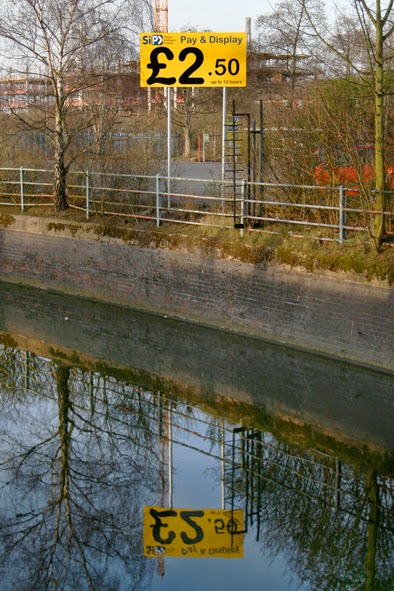
Given the location of King Richard’s rediscovery, it seemed ironic that his coffin should be overlooked by a couple of other workaday car parks as it paused at Bow Bridge.  At least one of these is on the site of a vanished factory building, - itself symbolising the radical shifts in Leicester’s economy over recent decades.  In this context, the Council’s attempts to remodel the city as another hot spot on the A-Level History trail [6.] might make some sense.  Intriguingly, another claims to offer ‘Simple Intelligent Parking’, (that’ll be the day), whilst appealing for more vacant land.  In fact, if their plans pay off, The Council may need all the parking spaces it can get.  Disputes over that issue in the city is, however, a whole other story.


Car Park Signage, West Leicester, March 2015


Perhaps predictably, as the shadows lengthened and the crowds dispersed, all this yellow parking signage, (and some relating to the logistics of King Richard’s ceremonials), eventually became my main subject.  T’was ever thus…


Richard-Related Signage, West Leicester, March 2015


[1.]:  How often have I heard this slightly derisory buzz-phrase repeated in the media over recent months?  It does, of course, play directly to the image, in the general public imagination, of Leicester as a singularly drab, uninspiring kind of town

[2.]:  Let’s face it – many of the denizens of Leicester do love a good moan, given the opportunity.

[3.]:  Of course, we can never really know the true nature of Richard's character, or how much validity there may or may not be in the accusations levelled at him.  For what it's worth, my own hunch is that he was probably just another power junky with a sense of entitlement, living in a period of civil war, (pretty much like the rest of his class, in fact).  He also appears to have been capable of quite enlightened rule during his short reign.  A flawed but multi-faceted personality, perhaps, then, - rather than a pantomime villain.

[4.]:  I’d be lying if I claimed the noble words declaimed over the P.A. by the City Fathers will live long in my memory.  I will, however, always associate the event with scrambling amongst crackling undergrowth (and the occasional abandoned rough sleeper’s camp), to gain a slightly elevated view from the adjacent patches of wooded landscaping.

[5.]:  Amongst the enthusiastic, the quietly respectful, and the just plain curious, was the usual occasional drunk, naysayer or proselytising eccentric.  I’m sure it was much the same the first time round, and to a greater extent.  At least, this time, no one was trying to further disfigure the corpse of a perceived villain.

[6.]:  Stratford, Warwick and Kenilworth Castles, Lady Jane Grey’s Bradgate Park, and indeed, Bosworth Field, are all just up the road.  You can see how this isn’t an altogether bad plan, and how somebody may be trying to join a few dots.


Friday, 13 March 2015

R.I.P. Terry Pratchett


Sir Terry Pratchett, 1948 - 2015


The world of literature, (indeed, the world in general), is rendered a little duller by the passing of author, Sir Terry Pratchett, yesterday.  There’ll be plenty of folk lining up to pay tribute to him, but I’ve had a lot of fun with his books over the years, and it would be churlish not to add a few lines of my own.

Generally bracketed as a Fantasy writer, Pratchett was Britain’s second highest selling author and, certainly, his work is the exact opposite of difficult or obscure ‘great literature’.  In fact, whilst employing the full panoply of wizards, dwarfs, trolls, supernatural characters, etc., the books are actually intelligent parodies of a much-derided genre.  He wasn't adverse to playing with readers' expectations by incorporating a little of the Wizard in his own appearance.  Beyond that, the books operate as satires of our own society, and the foibles of human nature in general.  Most importantly, they’re nearly always just plain funny.  I’ve read many of his most famous ‘Discworld’ novels, usually  when I just wanted some good, honest entertainment, and have never encountered one that wasn’t a proper page-turner.


True Wisdom Is Never Pompous


Behind the humour, and the ample evidence that intelligence and entertainment need not be mutually exclusive, the books indicate an author who was always keen to tilt at those who would drain the joy from life.  He was clearly intolerant of  bigotry, fundamentalism, cruelty, or the hunger for power without responsibility.  Mostly though, his characters tend to be indulgent depictions of complex human fallibility, rather than two-dimensional symbols of good or evil.  Most of them are just trying to cope, (and maybe make a buck on the side, should the opportunity arise).  There’s a suggestion throughout the books that great feats are as likely to be performed through cock-up theory as anything grander, and even predestination might need a bit of patching up to help it along sometimes.


Sir Terry died at the relatively early age of 66, and his later years were famously blighted by his struggle with early onset Alzheimer’s disease.  Nevertheless, he continued to write without any perceptible diminution in his imaginative powers, and was an energetic campaigner for increased research into dementia in general.  He’d also expressed his belief in the right of the terminally ill to choose voluntary euthanasia.  In the event, it’s pleasing to hear he died in comfort, surrounded by family and accompanied by his sleeping cat.


Josh Kirby, Artwork For: Terry Pratchett, 'Mort', 1987


Discworld’s most memorable recurring character may be Death.  Despite his skeletal appearance and inescapability, he’s a surprisingly resigned and empathetic character who proves in ‘Mort’ [1.] that sometimes, even metaphysical personifications need a break from routine and a little, well - fun.  It’s tempting to imagine Death and Sir Terry settling down for an enjoyable chat, as I write.


[1.]:  Terry Pratchett, 'Mort', London, Victor Gollancz, 1987