Showing posts with label Cinema. Show all posts

Saturday, 18 January 2025

R.I.P. David Lynch


David Lynch. Image: Adam Bordow/BW


It's hard to know what to say when someone of David Lynch's cultural stature passes away. Anything even half intelligent one might say about the facts of his career as a director, painter, musician (and transcendental meditation advocate, amongst other things) has already been covered by the time one can even begun to process the information. Others have almost as quickly filled countless megabytes and column-inches with reflections on the possible 'meanings' within the work, and wider significance within the cultural landscape. In the time it took me to get here, I've even read one semi-poetic discussion of the life-long (and life-shortening - as it transpired) smoking habit which almost seemed to define him as much as the work for some.

On reflection, perhaps the whole smoke thing is as good a signifier as any for an artist whose work was so saturated in the ineffable, and so resistant to being pinned down. It also speaks to his approach to life as an endlessly unfolding creative process. Lynch himself spoke of the 'Art Life', describing with relish how each creative gesture would blur seamlessly with his endless chains of coffee and cigarettes - each becoming the next in real time. Ultimately though, that's in danger of becoming yet more romanticised 'myth of the artist' stuff really. It feels like the only meaningful response at this stage is a more personal one, accompanied by some of the man's own unmediated words.


Image: Studio Canal/Les Films Alain Sarde/Asymmetrical Productions/
Babbo Inc/The Picture Factory/Bridgeman

When all else is said and done, Lynch's films and TV work (and let's face it - this is what will be remembered longest) have moved and stimulated me more than pretty much anything else achieved in those media. In my view, no one else has managed to blur the boundaries between moving images and dreams quite like Lynch. The logic at work within them is dream logic. This is why, just like the dreams we experience immediately prior to waking, they seem more vivid, more affecting, more divorced from convention, and more engaging of thought and feeling as sides of the same coin than any other cultural artefact I've encountered. It's why they resist traditional analysis so pleasingly. It's why even Lynch himself didn't always know what might happen - even as a mood or association emerged in real time on set. It's why, for those of us who relish questions and possible interpretations, far more than answers and definitive statements, Lynch is the go-to, par excellence. And I really don't care if he is the kind of film director 'someone like me' would like. I just do.

'Eraserhead', 'Twin Peaks', 'Lost Highway', 'Mulholland Drive' - these are works I can return to repeatedly, and never quite get to the end of. Certain scenes and images will remain indelibly stamped on my memory in perpetuity (I've mentioned more than a few on here before). The concluding credits may be rolling, but my response is slightly different each time, and I'm already anticipating the next time I can fail to '(ex/mans)plain it all away. Each work seems to mean so much, but I really don't want to know exactly what. In the process of not knowing, I may have been horrified, haunted, baffled, or felt like I'm falling in love. I may have gasped, laughed out loud or chuckled inwardly, confronted my own deepest fears, or just gazed longingly at the sheer formal elegance of Lynch's craft. I may have loved and despised humanity in equal measure. I may have gasped at the sheer audacity of it all (on a spectrum from the gleefully cheesy to the truly profound), and even, most surprisingly - meditated without irony on the existence/nature of good and evil). I'm not sure what else I could ask from an art experience, and I thank him for it.

Anyway, enough of me. Lynch really should get the final/not final words...


"If you get an idea that’s thrilling to you, put your attention on it and these other fish will swim into it. It’s like a bait. They’ll hook on to it and you’ll get more ideas. And you just pull them in."

"I don’t know why people expect art to make sense when they accept the fact that life doesn’t make sense."

"Absurdity is what I like most in life, and there’s humor in struggling in ignorance. If you saw a man repeatedly running into a wall until he was a bloody pulp, after a while it would make you laugh because it becomes absurd. But I don’t just find humor in unhappiness – I find it extremely heroic the way people forge on despite the despair they often feel."

"In a way failure is a beautiful thing, because when the dust settles there’s nowhere to go but up, and it’s a freedom. You can’t lose more, but you can gain."

"A film or a painting – each thing is its own sort of language and it’s not right to try to say the same thing in words. The words are not there. The language of film, cinema, is the language it was put into, and the English language – it’s not going to translate. It’s going to lose."

"Certain things are just so beautiful to me, and I don’t know why. Certain things make so much sense, and it’s hard to explain."


All quotes: David Lynch.

Individual sources can be found in: Adrian Horton, 'A life in quotes: David Lynch', London, The Guardian, 17.01.25


Thursday, 7 September 2017

The Failure And Success Of Alberto Giacometti (Stanley Tucci: 'Final Portrait')


Alberto Giacometti, 'Portrait Of James Lord', Oil On Canvas, 1964


There are certain artists I always come back to over the years, regardless of how much, or how little, they influence my own work directly.  The sculptor [1.], Alberto Giacometti is one, so it’s no surprise I found myself at Leicester’s Phoenix media centre the other night, to watch Stanley Tucci’s film, ‘Final Portrait’ [2.].


Actually, it’s been a good year for Giacometti enthusiasts - with Tate Modern also staging themost recent in a series of excellent retrospectives that I’ve attended across the decades [3.].  Whilst I (seemingly alone) have a few reservations about the way the work was displayed in the Tate survey, I have very few about the actual selection.  And I definitely have none at all about the enduring power of those works to move me profoundly – even those with which I have become very familiar through repeat encounters.


'Giacometti' Exhibition, Tate Modern, London, 2017

Alberto Giacometti, 'Bust Of Diego', Plaster, c.1956


It was a thrill to experience once more, the particular variety of perceptual ambiguity exerted by Giacometti’s blade-form portrait busts, the disturbing sense of sexually-charged alienation embodied by ‘Four Figurines On A Stand’, [4.] or the inexplicable power of a tiny head to hold one it’s thrall from the far side of a crowded room.  All that sense of human presence, of energised space around his figures, or of one’s grip on perceived reality slipping away, the harder one stares, should be getting old by now – but it all still moves me every time.


Alberto Giacometti, 'Four Figurines On A Stand', Cast Bronze, 1950-66

'Giacometti' Exhibition, Tate Modern, London, 2017


Clearly, Giacometti’s work and preoccupations have little correspondence with my own current output.  However, as a student, and for many subsequent years of wrestling unsuccessfully with my own hang-ups about drawing, and how to even make art at all, he did seem to represent a kind of mountain I might yearn to climb – but never successfully scale.  The irony is, of course, that he was beset by much the same kind of self-doubt, even whilst operating at an elevation of which I (and most others) might only dream.  In fact, as Tucci’s film serves to reinforce – he really is the No.1 poster boy for a particular form of angst-ridden artistic authenticity.


Ernst Scheidegger, 'Giacometti In His Studio', 1958, (Foundation Ernst Scheidender/
Giacometti Estate


It’s a habit of thought in which it’s hopeless to even dream of producing anything of real value; in which all attempts are doomed to failure; in which the very task one has set oneself is impossible; and yet one that still compels an individual artist to sacrifice their whole life, happiness, and even sanity, in its pursuit.  It manifests itself in works which, however profound their effect on others, mostly feel like disappointments, wrong turnings, or aborted excursions along the way - and in a sense that the struggle is far more significant than any individual artefact thrown-up.


'Giacometti' Exhibition, Tate Modern, London, 2017


All this focus on futility, despair, and other such portentous stuff, clearly ties into what philosophers call Existentialism.  At its most profound, and in the hands of its most sincere exponents (Giacometti, Samuel Becket, Harold Pinter, even Ian Curtis, perhaps), it can cut deeper and more uncompromisingly than most other stuff.  It notably captured a distinct twentieth century zeitgeist, and Giacometti has often been identified as one of the few visual artists to fully engage with the genocidal implications of World War 2, in its immediate aftermath.  If he did so, it was through a stripping-away of everything other bar the essentials of human existence (what it is to simply inhabit this body, in this space).  Of course, all that soul searching can all too easily slip into affectation too (something that, the film suggests, even Giacometti was aware of).  It can become a performance or a form of indulgent self-sabotage.  It can surely become an alibi for failing to complete, or to advance by setting achievable goals.  Indeed, “If I can’t be as good as I want to be, it’s all meaningless – so I won’t do anything at all”, was my own sulky mantra for far too many years - I now realise.


Geoffrey Rush As Giacometti In: Stanley Tucci (Dir.), 'Final Portrait', 2017


‘Final Portrait’, might therefore just have been a vicarious excursion through the entertaining psychosis of yet another obsessive artist.  Certainly, it pulls few punches in examining Giacometti’s legendry eccentricities, and Geoffrey Rush brings an intensity commensurate to that of his subject’s reputation.  We first encounter him as a shuffling, hunched ruin of a man, who proceeds to chain-smoke and hack his way through the remainder of the movie – one minute frozen in despondent immobility – the next, leaping impulsively into an outburst of frustrated anger, or some inexplicable action.


But we’re far from the Hollywood excesses of ‘Lust For Life’ [5.] or ‘The Agony And The Ecstasy’ [6.] here.  This film is actually based on American author, James Lord’s celebrated factual account of sitting for a painting, ‘A Giacometti Portrait’; late in the artist’s own life.  I think he’s generally accepted as a pretty reliable narrator.  Aside from those periodic demonstrations of ‘artistic temperament’ and the bohemian lifestyle choices, the real experience of modeling for Giacometti, it would appear, was one of a baffling endurance test.  As his wife Annette, and heroically stoic brother (and studio technician), Diego attest, the artist really knew how to torture his sitters.


(L.) Armie Hammer As James Lord, And (R.) Geoffrey Rush As Giacometti, In:
Stanley Tucci (Dir.), 'Final Portrait', 2017


Thus, Lord finds himself sequestered in the Spartan, cave–like environs of the Giacometti atelier - a place where the standard rules of time, consideration of a model’s other commitments, and clearly defined deadlines, are all sacrificed to the artist’s obsession.  The insights into Giacometti’s unorthodox domestic arrangements, openly triangular (and emotionally abusive) love life, and totally cavalier disregard for money, actually represent colourful, if disturbing, punctuations, it transpires.  Otherwise, it’s mostly an interminable process of sitting immobile, as the days tick by and the artist goes through his cycles of attempting to really ‘start’ (drawing with the small black brush) and collapsing in despair at the impossibility of his task (obliterating with the large, grey brush).  It might be ‘Waiting For Godot’, by another name.


(L.) Sylvie Testud As Annette, And (R.) Geoffrey Rush As Giacometti, In:
Stanley Tucci (Dir.), 'Final Portrait', 2017


It would be foolish to ignore the fact that, aside from creating a cauldron of existential drama/non-drama, within four walls – the film’s other real strength lies in the power of its five main performances.  Geoffrey Rush himself pulls-out what feels like one of those ‘career-defining’ turns as Giacometti - tempering the forbidding aspects of his subject with moments of genuine vulnerability, and even wry amusement at his own acknowledged character defects.  His achievement is to depict with considerable nuance, his selfish disregard for the feelings of others, and apparent appreciation of the sacrifices and discomfort they endure on his behalf.  We are left with the sense of a fallible but deeply ‘human’ personality (if not exactly a humane one).


Alberto Giacometti, 'Portrait Of Annette', Oil On Canvas, 1964


Alongside him, Armie Hammer depicts the growing exasperation of the initially urbane Lord with aplomb, whilst Tony Shaloub proves eminently convincing as the disengaged, but palpably benign Diego.  Clemence Poesy’s depiction of Giacometti’s paid-for mistress, Caroline, has a certain built-in caricature quality, but is enjoyable nonetheless.  Sylvie Testud, on the other hand, feels immensely relatable as his wife, Annette.  She’s a woman carelessly spurned, and yet heroically aware of her enduring importance as the mainstay of Giacometti’s domestic (and, as we discover - emotional) wellbeing.  It’s a tough role to play with dignity over victimhood – in drama, as in life.


Alberto Giacometti, 'Caroline', Oil On Canvas, 1965


Actually, for me, there’s a sixth member of the cast – namely, the recreation of post-war bohemian Paris.  The surrounding streets and cafés of Montparnasse reek of seductive bohemia, but shun excessive romanticism - preferring a more convincingly gritty squalor  [7.].  The Studio and adjacent courtyard, at Rue Hyppolite Maindron, appear to have been very faithfully reconstructed from various familiar documentary photos.  And while we’re at it - whomever did Mr. Rush’s costume, hair and make-up would definitely get my vote for Oscars.


Henri Cartier-Bresson, 'Portrait Of Alberto Giacometti', 1961


I’m sure many keen moviegoers will have succumbed to the perennial temptation to adopt the demeanor of a favourite character, on emerging into the ‘real world’.  So it may just be that I exited Phoenix with a slight Existentialist’s trudge, or possibly surveyed the car park with a particular weary gaze.  However, the fact is I no longer really identify with all that stuff.  My own creative re-awakening actually came when I consciously gave up fetishising ‘the struggle’, accepting that it’s okay to actually finish things - and even to take pleasure in the process, and in one’s achievement.  If something’s not good enough, these days – that’s just a reason to look forward to making something else.  Certainly, my own work no longer aspires to looking or proceeding anything like Giacometti’s (like that was ever possible!) - and I’m happy to just try to make the kind of art I probably should have been making all along (for better or worse).


Geoffrey Rush As Giacometti In, Stanley Tucci (Dir.),  'Final Portrait' 2017


My  love for Giacometti's oeuvre, and my fascination with the various accounts of his life and times, remain undiminished though.  I no longer want to live and work that way - but I'm glad he did.


Alberto Giacometti, 'Small Man On Plinth', Cast Bronze, c. 1939-45


[1.]:  Giacometti painted a lot for someone primarily thought of as a sculptor.   They must be some of the least 'painterly' canvases ever made however.  Anyway, it's my view that (in terms of his his mature work, at least), pretty much everything he did was actually drawing - regardless of the medium. 

[2.]:  Stanley Tucci (Dir.), 'Final Portrait', UK, Olive Productions, Potboiler Productions, Riverstone Pictures, 2017

[3.]:  'Giacometti', Tate Modern, London, Until 10. 09.17.  (There's still just time, if you're quick).

[4.]:  Famously, Giacometti linked this piece to a memory of viewing four prostitutes in a brothel.  It was an experience, he claimed - in which sexual desire was combined with a sense of the seemingly uncrossable distance in the room, between himself and the women.  Giacometti's psycho-sexual hinterland - and indeed, his sexual politics - were more than somewhat 'complex'.  His four figurines are both remote, and quite literally - on a pedestal.

[5.]:  'Vincente Minelli (With George Cukor) (Dir.), 'Lust For Life', U.S., John Houseman/MGM, 1956).  Kirk Douglas does his best raving madman impression, in Hollywood's depiction of the life of Vincent Van Gogh.

[6.]:  Carol Reed (Dir.), 'The Agony And The Ecstasy', U.S., Carol Reed/C20 Fox, 1965.  A physically implausible Charlton Heston, as Michelangelo, tries to complete the Sistine Chapel ceiling, as Rex Harrison's Pope Julius II looks on in exasperation.

[7.]:  It turns out the best way to recapture the flavour of post-war Montparnasse, is to shoot your film in Stoke Newington.  Who knew?  


Wednesday, 4 March 2015

Stephen Knight: 'Locke'


I finally got round to watching Director, Stephen Knight’s movie, ‘Locke’ [1.], the other day.  I was reminded of the film by Shaun Morris’ blog mention to it, a few weeks back, - recalling that it was one of those that fell through my net when on limited cinematic release in 2014.  For a while I kept forgetting the title too, - in another of those disquieting indications of advancing middle age.  Anyway, whilst buying milk and potatoes in Sainsbury’s recently [2.], - there it was on DVD, and at a price that it would have been rude to ignore.  It turned out to be a right bargain.


Still From: Stephen Knight (Dir.), ' Locke', Shoebox Films/I M Global, 2013/14


Like another recent favourite from last year, Under the Skin’ [3.], ‘Locke’ is a low budget/high impact example of how many of the best film makers are squeezing really interesting results out of pretty economical means these days.  Like that film, it also features a very strong central performance from a relatively mainstream actor, (in this case, Tom Hardy as the eponymous Ivan Locke), working under somewhat experimental conditions.


Still From: Jonathan Glazer (Dir.), 'Under The Skin', Film4/BFI, 2013/14


In ‘UTS’, some of the most intriguing scenes were those in which Scarlett Johansson’s emotionally blank alien prowled the streets of Glasgow in an anonymous white van, as reflected lights and glimpses of the outside world played across the windows of her enclosed cab like a film within a film.  ‘Locke’ takes that to even more symphonic visual extremes; becoming an elegy to the unceasing, hypnotic parade of vehicle lights we’ve all experienced while travelling in cars after dark.  The vaguely Post-Rock atmospherics of Dikon Hinchliffe’s score also contribute admirably to that mesmeric world [4.].  However, whilst Scarlett eventually got to walk about and interact with others, (however haltingly), in an alien landscape beyond her vehicle, Hardy spends the entirety of this film behind the wheel, on a single, solo, motorway drive.  His only interaction with a small cast of additional characters, (and the only way that the plot can therefore advance), is via a constant stream of phone calls, and those few occasions when he talks out loud to himself or to his imagined father.

At this point, a little exposition is probably necessary.  We first encounter Ivan Locke as he gets into his car at a massive construction site in the West Midlands.  He is, we learn, a highly accomplished concrete specialist, respected for his dependability, and a solidity of character matched only by the materials he works with.  As the story gradually unfolds through his numerous phone calls, we also learn he enjoys a stable family life with two adoring sons and a devoted wife.  He commences his journey on the eve of “the largest concrete pour in Europe, outside of the nuclear or military industries”, (a PR phrase he repeats throughout the film with increasing resignation, like a mantra of jeopardy).  He should be on his way home for an enjoyable family evening watching football on TV and an early night.


Still From: Stephen Knight (Dir.), 'Locke', Shoebox Films/I M Global, 2013/14


Instead, Locke sets off to drive to London in order, it transpires, to attend the premature birth of a child he has fathered as the result of an uncharacteristic, brief liaison with an emotionally fragile woman he hardly knows.  This single act, based on his unshakable need to subsequently ‘do the right thing’, stems from a deeply held resentment towards his own absent and unreliable father.  It also triggers a train of events in which the certainties of career and marriage unravel over the phone as he drives on through the night.  Relieved of his official post, he still attempts to fire fights the several crises besetting the preparations for the concrete pour remotely, (via an increasingly panicky subordinate).  Simultaneously, he fields calls from, amongst others, his wife, his sons, his superior, medical staff, and the terrified mother-to-be waiting at the end of his journey.  The film ends as he nears his destination, having, in two hours, seemingly lost everything, “apart from myself and the car I’m in”.

If, as I’ve seen it billed, ‘Locke’ is a thriller, it is purely one of an implied or psychological variety.  Relatively little actually happens on screen, (in terms of action, - loads happens in other respects), yet the events overtaking the subject are life changing and existential in nature.  By limiting the main character’s arena to a few cubic feet of enclosed interior space, events can only be internalised by him, and his psychology be thus laid bare.  I’m tempted to make connections with Joel Schumacher’s thriller, ‘Phone Booth’ [5.], in which a flawed protagonist is forced to confront his own actions behind glass and over the phone, with a sniper who has him pinned down in a telephone kiosk.


Still From: Joel Schumacher (Dir.), 'Phone Booth', Zucher/Netter Productions, 2002


Naturally, the success of a character study such as this hangs on the lead performance.  I know very little about Tom Hardy, other than that his previous work appears to have been in fairly mainstream blockbusters.  It’s all the more impressive then that his work here is so controlled and focused.  His Ivan Locke is a man clearly used to dealing with the world with unflappable logic, and a hitherto unshakable belief that everything can be put right through determination and perseverance.  He is a man, as his wife puts it, whose very footprints turn to stone.  The certainties on which he has attempted to base his life are paralleled by the need to create the most stable concrete foundation possible for the tower that’s being built. 

Certainly, there’s nowhere for Hardy to hide, as his face necessarily fills much of the frame for the vast majority of the film.  He proves adept at conveying the growing sense of exasperation overtaking Locke in admirably subtle ways.  Even when he does let loose, it’s to himself, and he repeatedly tries to reset himself to his rational, softly spoken default state before fielding the next disquieting piece of information.  Even as he is forced to admit he may even be going a little mad, the impression is that this is just another issue that will have to be dealt with.  Some actors might attempt to convey all this with increasing levels of cartoonish derangement but Hardy communicates it mainly through subtle changes in facial tension or vocal intonation, and the occasional momentarily frustrated slump over the steering wheel.  Such anger as may be building within him, appears mostly blanketed by bemused stoicism.


Still From: Stephen Knight (Dir.), 'Locke', Shoebox Films/I M Global, 2013/14


‘Locke’ subjects its protagonist to considerable existential/psychic travail, but it’s striking how this plays out within completely technological contexts.  It’s a distinctly First World fable.  Ivan Locke’s life may be unraveling, but it does so from the comfort of his BMW’s leather upholstery, and via its integrated, hands-free communication system.  It’s a reminder of how even the scariest parts of our lives are often insulated from the outside world or mediated through channels.  The downside is, as so many now find, that he must be constantly available to others, and is required to deal with multiple situations both simultaneously and remotely.  The point he appears most lost, but also, most cut free potentially, is that at which he just lets his phone ring.


Still From: Stephen Knight (Dir.), 'Locke', Shoebox Films/I M Global, 2013/14


Essentially, Locke’s real problem is that, as a consequence of his own actions, everyone now wants a piece of him.  Forced to prioritise, - he’s unable to square the circle of keeping everyone happy, and the price he must pay for abiding by his own code of personal ethics becomes massive indeed.  Only as he starts to doubt his own sanity do we glimpse the cracks in his personality.  His strange personification of “The Concrete”, the suggestions of the hubris often attributed to builders of towers, and the accusations leveled at the father he imagines in the rear-view mirror, all point to that code being as much based on psychological fallibility as on nobility or calm reason.  Perhaps it’s a singularly male tragedy that those destined to suffer most, (himself apart), are those closest to him.

I suppose, given my own current enthusiasms for concrete and driving at night, and a general taste for a little psychology with my drama, it was inevitable I’d be drawn to ‘Locke’.  It stands up as quality gear in its own right though, and I’d recommend it to anyone who doesn’t require every film they see to be populated by superheroes and Hobbits, or to mostly resemble a computer game.  It’s up there with a handful of movies I’ve seen over the last couple of years, all of which manage to be intriguing and pleasingly experimental, without becoming completely elitist in their avant-garde affectations.  Like ‘Under The Skin’, ‘A Field In England’ [6.], and ‘The Double’ [7.], amongst others, it also proves that the most satisfying and thought-provoking cinema is often now made without an extravagant budget or overwhelming digital trickery.


[1.]:  Stephen Knight (Dir.), ‘Locke’, Shoebox Films/IM Global, UK, 2013/14

[2.]:  Should I be concerned by how often routine trips to the supermarket feel worthy of comment on this blog just lately?  Are my horizons too narrow?  Am I spending far too long in these vacuous places?  (Dunno, - Possibly, - Yes).

[3.]:  Jonathan Glazer (Dir.), ‘Under The Skin’, Film 4/BFI, UK, 2013/14

[4.]:  Albeit not quite as experimentally as Mica Levi’s much vaunted ‘Under The skin’ score.

[5.]:  Joel Schumacher (Dir.), ‘Phone Booth’, Zucker/Netter Productions, USA 2002

[6.]:  Ben Wheatley (Dir.), ‘A Field In England’, Rook Films, UK, 2013

[7.]:  Richard Ayoade (Dir.), ‘The Double’, Alcove Entertainment/Film4/BFI, UK, 2013/14


Sunday, 24 August 2014

P-Funk 1: London Perambulations


THE P-WORD:


Like many other folk these days, I drop the word 'psychogeography' with careless abandon.  Indeed this blog is littered with it, as are many others, along with numerous books, articles, films, lectures, seminars, websites, tweets, - and who knows what else?  It's a term (perhaps like 'Hauntology') which describes a recognisable sensibility within certain cultural expressions, but which has inevitably become devalued through its over-application to a increasingly diverse range of artefacts and activities.


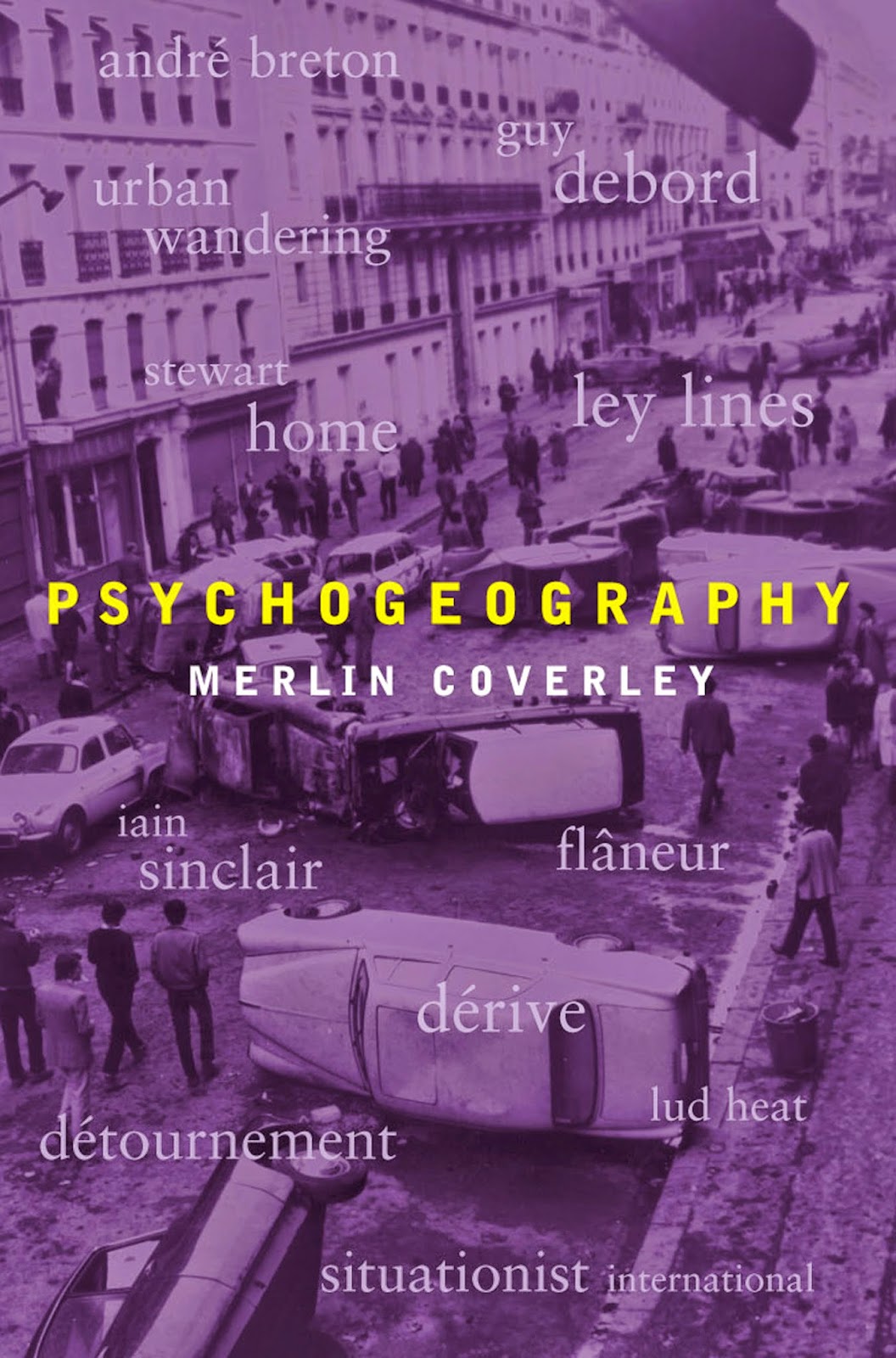
Of course, it's not unusual for such invented, theoretical labels to become adapted to different uses and often disputed over, in the process losing any currency they may have once had through dwindling specificity or changes in intellectual fashion.  I don't want to embark on an extended discussion of the word's multiple applications and provenances here, but would once again refer anyone interested in the Psychogeographic tradition to Merlin Coverley's useful little overview, 'Psychogeography' [1.].  In his introduction, Coverley himself states, 

'Psychogeography'. A term that has become strangely familiar - strange because, despite the frequency of its usage, no one seems quite able to pin down exactly what it means or where it comes from.  The names are all familiar too:  Guy Debord and the Situationists, Iain Sinclair and Peter Ackroyd, Stewart Home and Will Self.  Are they all involved?  And, if so, in what?  Are we talking about a predominantly literary movement or a political strategy, a series of new age ideas or a set of avant-garde practices?  The answer, of course, is that psychogeography is full of all these things, resisting definition through a shifting series of interwoven themes and constantly being reshaped by its practitioners." [2.]


Self-Styled Comic Book Magus, Alan Moore


In the light of this, I was interested to see that Iain Sinclair, a writer who many may see as sitting at the head of the table of literary psychogeography,  now appears to reject the term altogether. This was made plain to me whilst reading the Quietus article, (already referred to in one of my subway-themed posts), in which comic book writer, Alan Moore, discussed his own psychogeographical interests in relation to Sinclair.

"Perhaps understandably, Sinclair has more recently attempted to distance himself from the term psychogeography. In the film, 'The London Perambulator', Sinclair urges that psychogeography had relevance when the Situationist used it as an aggressive way of dealing with the city, and then again when Stewart Home later resurrected it and brought comedic value to it, but eventually became a 'nasty brand name' used to describe almost anything to do with cities or walking. He has instead signed up to Nick Papadimitriou's notion of 'Deep Topography' which brings the tradition back to that of the British naturalist, the wanderer of edges who is not so preoccupied with the concept of his practice." [3.]


Iain Sinclair


To be honest, I'm happy to leave the semantic debate hanging.  Suffice it to say, for my money, 'Deep Topography' is a perfectly pleasing term - if no more or less useful than the term Sinclair is keen to replace.  Instead, the Quietus article led to me consider two other questions.  Firstly, who exactly is Nick Papadimitriou?  Secondly, why did it take me so long to get round to watching 'The London Perambulator'?


PERAMBULATOR:


Nick Papadimitriou.  Still From John Rogers (Dir.), 'The London Perambulator',  2009


'The London Perambulator' is a documentary film, made in 2009 and directed by John Rogers.  It takes as its subject the activities of outsider/Deep Topographer, Nick Papadimitriou, a man who, (even more than any of the other names dropped here), could be labelled a genuine and rather marvellous eccentric.  Certainly, his whole life now seems to be subsumed into an endless cycle of wanderings and detailed explorations of those parts of Middlesex that most people would automatically overlook.  His chosen patch is archetypal Edgeland territory, with all that that implies.  The film includes significant contributions from Iain Sinclair, Will Self, (for both of whom he has worked as a researcher in the past), and, slightly surprisingly, comedian, Russell Brand.  


Comedian (And Self-Styled Revolutionary/Sex Machine/Media Messiah), Russell Brand


Papadimitriou himself clearly had a troubled early life, serving time for burning down his own school as a teenager, and, bizarrely, becoming the subject of a poem by serial killer Dennis Neilsen whilst incarcerated in Wormwood Scrubs.  He has also has a past history of drug abuse, - something he shares with both Self and Brand [4.].  Indeed, I can't help wondering if, for some, all this restless walking and obsessive documentation of seemingly insignificant landscape details might not be a search for deeper engagement with one's existence in a puzzling, fascinating world without narcotics.  Could, all this ceaseless motion and repeated striking out, be a search for a variety of transcendence whilst keeping one step ahead of their vices?  In one of the film's notable scene's, Papadimitiou and Self discuss the diminishing returns of heavy drug use, something that is antithetical to the kind of focus they now seek.  Elsewhere, Sinclair discusses walking as the core psychogeographic activity for its ability to raise consciousness.


Nick Papadimitriou: Reading Between The Lines.  Still From: John Rogers (Dir.),
 'The London Perambulator',  2009


Perhaps Sinclair and Self's disillusionment with the label often attached to them, stems in part from comparing the depth of their own activities and relationship to the landscape with that of  Papadimitriou's.  If they ultimately re-examine their own experiences through the detached filter of literature, there is a sense in which Nick is Deep Topography [5.].  It's one thing to sense physical underground streams and discuss how the engineering of such natural flows into the fabric of the city lends it a multi-layered aspect, (as the film opens), or to exhibit an obsessive interest with the Mogden Water Purification Plant [6.].  However, it is something altogether different to claim, "my ambition is to hold my region in my mind", as he does later, and to imagine his own identity becoming totally subsumed into the very fabric of Middlesex. For all his apparent superficialities, it may be that Russell Brand's slightly daffy air of wonder at encountering someone so singularly at one with his chosen subject, comes closest to pinning down Nick's essence.  Maybe this isn't really a surprise after all.  Brand is known for his quasi-spritual dabblings, and there's definitely something of the ecstatic mystic about some of Papadimitiou's utterances.  He would appear to come from Blakeian tradition more than a Debordian one.


If there is a tragedy at the heart of Nick Papadimitriou's life, it is revealed towards the end of the film where he questions whether it's all been a dispiriting waste of time to have been hanging about in the Edgelands when he could have been working or raising a family.  Ultimately, though, is this not the deal that all artists, (or full-time thinkers), must make to a greater or lesser degree? The other point worth making is that, for all his latent train-spottery  he has seemingly compiled an archive of material on his chosen patch, far deeper and wide-ranging than any other individual or institution could hope to.  If Papadimitriou's real legacy is to demonstrate a more intense and rewarding relationship with our surroundings than most  will ever experience, - well, someone has to do it.  To that end, I'd encourage anyone who's ever wondered what all this wittering about psychogeography (or indeed Deep Topography) is all about, to watch 'The London Perambulator', or its shorter companion piece, 'Inside Deep Library' [7.].


[1.], [2.]:  Merlin Coverley, 'Psychogeography', London, Pocket Essentials, 2006 

[3.]:  John Rogers (Dir.), 'The London Perambulator', London, Vanity Projects, 2009.

[4.]:  I have no knowledge of Sinclair's previous experience in this respect.  He's associated with plenty of counter-cultural figures over the years though, including notorious 'importer' Howard Marks, so I doubt he's a complete naif.

[5.]:  I think I'm talking about degrees of intensity and emotional commitment here.  Papadimitriou is, after all a published author too:
Nick Papadimitriou, 'Scarp, In Search Of London's Outer Limits', London, Sceptre, 2012.

[6.]:  Papademitriou's linkage of The Sewage Works' processing of externalised waste, with the impulse towards psychotherapy, is exactly the kind of thinking many of us lapsing into at any opportunity, (although not quite so passionately expressed, perhaps).  And, this focussing on what Self splendidly calls forgotten "Oxbow Lakes Of Urbanity", is little different from hanging around in Leicester's subway system, after all.

[7.]:  John Rogers (Dir.), 'Inside Deep Library', London, 2007