Showing posts with label Greyfriars Project. Show all posts

Monday, 4 February 2013

Richard III & The Greyfriars Project 5: Confirmation


The skeleton found at Greyfriars, just up the road from where I sit in Leicester, has been officially confirmed as that of Richard III today.  The news is already full of reports about Leicester University's news conference so I won't labour over the specific details here.  However, I did write quite a lot about the Greyfriars archaeological project and how it captured my imagination last year, so it's only appropriate to mark the occasion at least.


Photo:  University Of Leicester

I am genuinely engaged by the historical aspects of all this, in an admittedly dilettante kind of way.  However, of equal interest is how Richard's story, in both life and death, has become such an exemplar of political propaganda, artistic interpretation, news management and public relations.  Never can the 'story' element of the word 'History' have been so significant.


Photo:  University Of Leicester

A quick skim through just a couple of today's newspapers reveals how various disputes still swirl around Richard.  In addition to the old goodie/baddie issue are now added questions, including...

  • The scientific validity of the DNA results announced; How this will all impact on the historical account of the late medieval period;

  • The high profile, populist promotion of the project by Leicester University and Leicester City Council, (and what it reveals about their own funding and regeneration agendas); 

  • The most appropriate site for the skeleton's eventual re-interment;The role of the highly partisan Richard III Society and any resulting compromise of historical objectivity;

  • The involvement of the media generally and how events may have been tailored to suit television and maximise news impact;

  • The conflict between Academic rigour and populist amateurism;

  • The advisability, (and affordability) of Leicester City Council's, (or possibly, Mayor Soulsby's), plans for a Richard III visitor centre.


Photo:  University Of Leicester

Anyway, it's all be very interesting on a numerous levels.  One point that particularly intrigues me is the confirmation that the human remains were actually discovered very early in the dig.  Having visited the site on a subsequent public open day and heard from site supervisor Matthew Morris that chances of finding Richard were pretty slim.  I must conclude that events certainly have been VERY carefully stage-managed and that Mr. Morris is a convincing actor as well as an accomplished archaeologist.


Monday, 24 September 2012

Richard III & The Greyfriars Project 4: The Burial Site


The Newly Filled Trench 3 
The archaeological activity at Greyfriars in Leicester seems to be winding down now after a final round of public access days.  A few days ago I visited the dig once more to view the actual site where human remains were found.  I also called in to Leicester’s lovely old guildhall nearby, to take another look at the small selection of artefacts recovered from the dig.


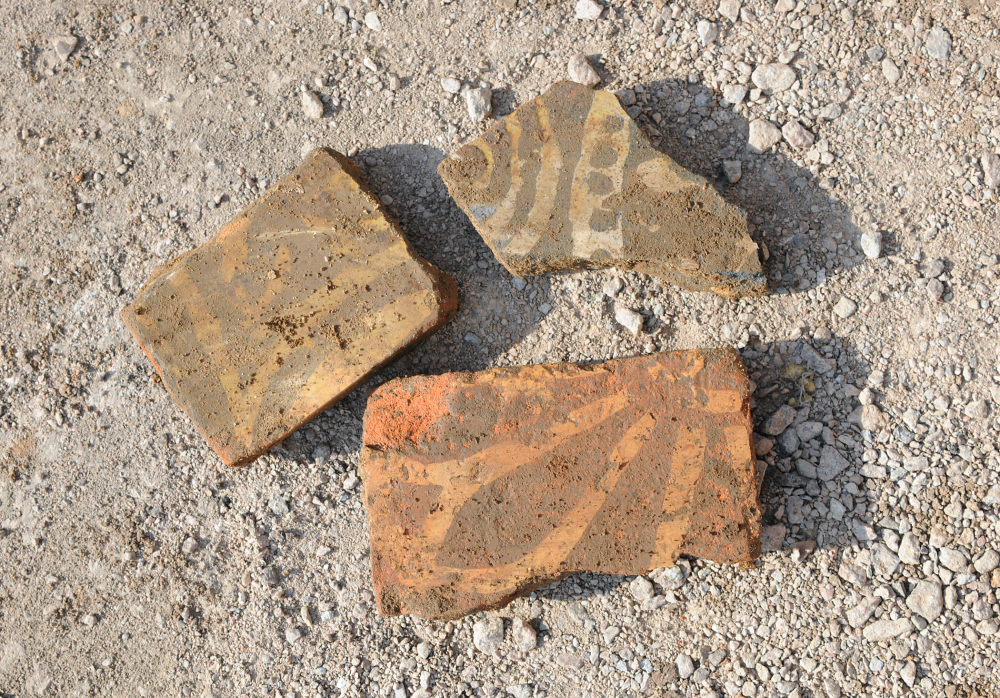
Inlaid Floor Tile From Greyfriars Church
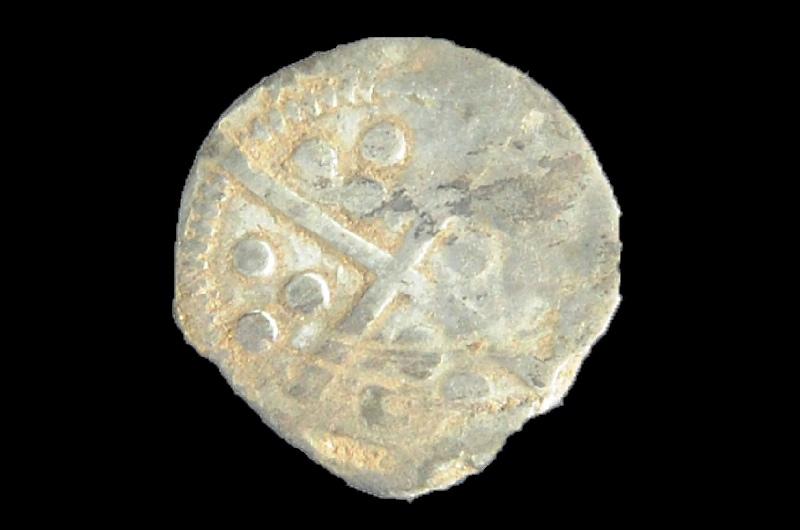
Medieval Silver Penny From The Site
Inlaid Tile Fragments From The Site 
Copper Alloy Letters Possibly From Greyfriars Church Tombs 
Leicester Guildhall

The scope of the project was reduced somewhat as Trench 3, where evidence of Robert Herrick’s 17th Century garden were found, had already been filled in.  It was interesting to see how the other two trenches had been excavated further since my first visit, revealing, amongst other features, sections of possible stone benches from the friary chapter house.  The main features of interest had been simply but effectively labelled this time round and, once again, the guides provided clear information about what we were seeing and interesting insights into how the Greyfriars complex might have been used by its occupants.


Trench Two Now Showing Orientation
Of Cloister Passage Clearly
Remains Of Chapter House In Trench 1 
Remains Of Chapter House In Trench 1
Remains Of Probable Chapter House Bench In Trench 1

Various leaflets and information sheets were also available and included some colourful background about the relocation of Richard’s own bed from Nottingham Castle to Leicester’s Blue Boar Inn prior to the Battle of Bosworth.  Reputedly, it remained there afterwards, subsequently revealing a hoard of golden coins secreted in the base.  I wonder if this is an authenticated account or just more picturesque Ricardian folklore? There's also a suggestion the inn was originally known as The Silver Boar, (Richard's Emblem), and hurriedly renamed after his defeat.


The Burial Site
The Burial Site Adjacent To Victorian Foundations

Of course, the main attraction was the actual site where Richard III’s remains, (if it is indeed him), were found.  It’s striking just how near to later brick foundations the skeleton had lain and just how close it must have come to being destroyed or at least disturbed by their construction.  This was something specifically alluded to during my first visit as a reason why Richard’s discovery was unlikely and makes me speculate again if the archaeologists knew what they had even at that stage.  Either way, it seems the location of the corpse, - centrally within a prominent area of the church choir, certainly points to a high status burial, as might have been accorded a fallen monarch.


Silver Boar Badge Found At Bosworth Field

It’s been a local event of some significance and appears to have captured the imagination of Leicester's citizens and the global media alike in recent weeks.  Hopefully, the results of DNA analysis will put the matter beyond doubt conclusively before the year’s out.  I notice that there has already been some discussion in the local press about what should happen to the remains and even a suggestion of redeveloping the old burnt-out Friars Mills factory as a Richard III museum.  It wasn’t specified who would fund that.

Wednesday, 12 September 2012

Richard III & The Greyfriars Project 3: Human Remains Exhumed


I’ll admit to being fascinated by all the activity around the search for Richard III and the archaeological project at Greyfriars in Leicester.  My apologies to any regular readers of this blog who aren’t as captivated by the subject as I am.  If it’s occupying a lot of my posts - it’s because it’s occupying much of my headspace just now.  Perhaps it’s because it feels like a significant drama is unfolding in real time in my own back yard.

Anyway, this post is a rapid response, (well, as soon as I got home from work), to the latest breaking news.  As reported on the National media early this morning and in an official press conference at 11.00 am, remains of one male and one female human have been found on the site.  The full details can be gleaned from the Greyfriars Project website news updates but it seems that investigations have begun into an adult male skeleton with possible battlefield injuries and evidence of a spinal deformity.  A prolonged period of DNA tests is required before any conclusions will be reached but this is pretty exciting.


Archaeologist Matthew Morris At The Site Of The Burial With...Er, Security.
The Yellow Dot Marks The Skeleton's Position.  (Photo: Reuters/Darren Staples) 

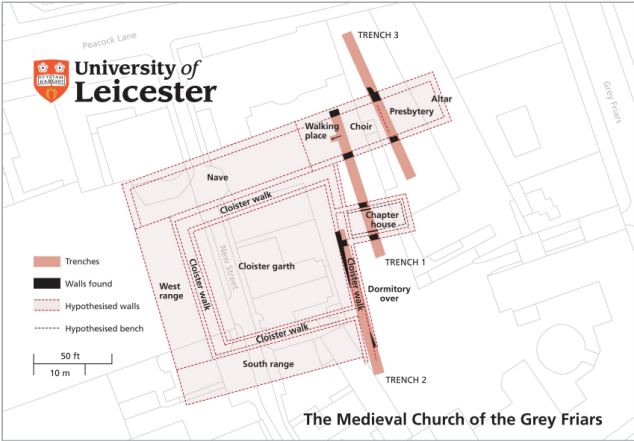
Site Plan.  The Burial Is Shown In Trench 1 Adjacent To The Walking Place


I notice that the team applied for official permission to exhume human remains on Friday August 3Ist.  According to their updates, that’s only at the point that the Friary architecture was starting to emerge.  Perhaps it was simply a case of being prepared ‘just in case’ but I do wonder if the down-playing by team members of any likelihood of finding Richard at the public open day on Saturday, September 8th might have been a little disingenuous.  They could hardly be blamed for not wanting their project obscured by media frenzy but it does suggest they maybe knew more than they were letting on.  I guess one must also bear in mind the discretion and decorum necessary when any human remains are being exhumed.  Either way, it seems that information about Richard is probably still being as carefully managed as it was five centuries ago.


Today's Press Conference Held At Leicester Guildhall

Gripping stuff! 

Sunday, 9 September 2012

Richard III & The Greyfriars Project 2: Public Open Day


I’ve already mentioned the current collaboration between Leicester University archaeologists and The Richard III Society in The Greyfriars Project, currently happening up the road from here.  As their news updates reveal, the project is already considered a success and has been extended for a third week.  They opened the site to the public this weekend so I strolled along to have a look.


I was pleased to see loads of folks there, even if it meant queuing.  The project has obviously captured the local public imagination, - revealing how clever it was to publicise it as a search for King Richard rather than just the Greyfriars Friary.  I was amused to see that the world of ‘merch’ has reached the archaeological fraternity with tee shirts and cheesy white Yorkist roses on sale, albeit with a fairly soft sell.


The archaeologists actually involved in the dig led the well-organised tour and, consequently, their commentary was knowledgeable and our questions received detailed answers.  As well as descriptions of what we were looking at in their trenches, there were interesting insights into the practical realities of carrying out such a dig in the heart of a city.  Whilst they enjoy fortunate free access to a council-owned space, it’s revealing that the only real value of the ‘geo-phys’, (beloved of Tony and The ‘Time Team’ Gang), was in showing the network of hidden drains and cables to be avoided.  In the event, the first trench just went in where it could and, luckily, struck just enough medieval masonry for a picture of the Friary’s ground plan to begin to emerge.


Sections of Corridor Walls In Trench 2

Impressions Of Floor Tiles In Trench 2

Fragment of Cloister Masonry In Trench 2
  
As usual, what to the layperson resembles a few ghost impressions in the earth and the odd architectural fragment provides the experts with a wealth of information.  As things stand, the shape and extent of the Friary Church is appearing with the more recent trenches revealing evidence of the chapter house and main body of the building.  Amongst the artefacts on display were fragments of a gothic window, (possibly from the east end of the Church), decorative tiles, coins of the period but no royal skeletons.


Fragments Of Chapter House Masonry In Trench 1

Window Fragments From East End of Church 

It seemed the prospect of finding Richard was less important to the archaeologists than the knowledge they’re gaining about the Friary itself.  His actual tomb might be located under neighbouring private property or have been destroyed by the excavation of cellars under adjacent  buildings.  The newest trench, in the currently unused plot next to the main site, has revealed evidence of Alderman Robert Herrick’s 17th Century garden where a memorial pillar to Richard once stood.  Most prosaically, he might even lie beneath the Victorian wall now separating the plots.


Trench 3 In Adjacent Plot, Containing Evidence of Herrick's Garden 

Their diffidence might be a defence against anticipated disappointment, evidence of differing agendas amongst the project partners or just of the role of the University's PR dept. in the whole process.  It’s possible that, whatever is added to the knowledge base, Richard III may remain a figure of folklore and imagination and his memory a tool for vested interests.

University Of Leicester

Richard III Society

I walked home from Greyfriars via Highcross Street.  Here once stood the Blue Boar Inn where Richard reputedly spent his last night before the Battle of Bosworth.  Amusingly, a Travelodge now occupies the site but a tidy little pub on the same street commemorates his name.


The Travelodge From Highcross Street

Richard III Stayed Here, (Sort Of)...

But Not Here

Monday, 27 August 2012

Richard III & The Greyfriars Project I


Artist Unknown, 'Richard III'

Leicester is often used to epitomise the boring or unexciting.  Yet, I’m always surprised by how much colourful history lies on, or just below, the surface near my home.  My photos of Leicester’s New Street show a moderately attractive, largely overlooked lane in Leicester’s modest legal quarter.  However, the City Council car park behind those unremarkable green gates, (this is Leicester, after all), is currently the site of a significant archaeological excavation of The Greyfriars Friary that might just uncover the lost remains of Richard III.


The Greyfriars Project is a joint enterprise between Leicester University Archaeological Services and The Richard III Society, - those indefatigable defenders of his reputation.  It draws on the latest evidence about the location of the lost monastic church where Richard’s grave was supposedly situated.  The impressive team assembled includes military, medical and genetic expertise alongside the archaeologists.  The project’s instigation by Philippa Langley, - a screenwriter as well as an R3 Soc. member, and involvement of Channel 4, highlight how History is always as much about accounts as it is about facts.

'Loyalty Binds Me',  Richard's White Boar Emblem

Richard’s defeat to Henry Tudor at Bosworth Field and the ending of the preceding period of civil war is well documented.  I have previously alluded here to local folklore around what happened to his body afterwards and how it relates to persistent controversy over his public profile and the accuracy of the official account.  My own engagement with the subject comes both as a legacy of my school studies and fascination with the physical and textual clues evident in my current neighbourhood.


Sir Lawence Olivier Directs Himself As Richard In The 1955 Film

Ian McKellen plays Richard In The 1995
Film Version, (Dir, Richard Loncraine).

The image of a deformed, megalomaniac murderer of nephews and sexual predator, of popular imagination derives primarily from Shakespeare and a legacy of grotesque stage and screen characterisations of his Richard character.  However much we thrill at this parade of lurching cripples and fascist dictators, our contemporary understanding of propaganda and media manipulation must arouse plenty of cynicism about Shakespeare’s neutrality.  The Tudor dynasty were never so secure in their claim to the throne that they could ignore any chance to discredit Richard’s own worthiness and with it the lingering Plantagenet case.  Shakespeare might not have enjoyed the career he did without propagating the victor’s account so enthusiastically.


Anthony Sher Plays Richard, Royal
Shakespeare Company, 1984

Kevin Spacey On Stage As Richard, Old Vic, 2012

The colourful story of his disinterment from Greyfriars Friary and disposal in the River Soar as unwanted refuse at the time of Monastic Dissolution must be seen in this light, however much locals enjoy believing there’s still a crown buried in the river bed.  If DNA profiling can prove Richard still lies at Greyfriars, that particular legend would be confirmed as historical propaganda.


On my way home from New Street I passed our public statue of Richard, tucked behind the railings of Castle Gardens.  When originally situated more prominently, it was apparently a target for regular vandalism but, since relocation, has been left undisturbed.  It seems that the citizens of Leicester are undecided about him and, for now, his status remains up for grabs.