 |
| All Main Images: Paradise Circus, Central Birmingham, March 2016 |
Well, it’s (relatively) early days yet, but it looks like I’ll be exhibiting again, later in the year. The plan is to do a three-handed show in early September, with my Birmingham-based friends Shaun Morris and AndrewSmith, (both of whose work I’ve showcased regularly on here). The Location will be Artist’s Workhouse in Studley, Warwickshire. We went over to check out the gallery, and meet Artist/Curator Dawn Harris, (and lay a few speculative plans), the other day.


It feels good to have a new, specific target in view, and a reason to put a little more impetus behind my ongoing work. Things have been progressing in a satisfactory, if relatively unhurried manner during the first quarter of the year. Now it’s time to change up another gear, in order to the make the most of this opportunity.


Actually, as I move psychologically from last year’s ‘Mental Mapping’ show, (with Andrew), to this next venture, it feels like the main task is to get into a kind of steady rhythm with all this exhibiting lark. My aspiration is to reach a situation where phases of pure production, and of going public, grow organically out of each other as an ongoing process, (you know, - like a grown-up artist). My instinct is that exhibiting should become a natural part of the whole deal, and one which involves a commensurate level of energy and emotional investment, without leaving one a feeling burnt-out in the aftermath. I’m sure old hands would find this pretty obvious, but I still think of myself as being on a fairly steep section of the learning curve.
 |
| Clues Everywhere: "Where Commerce Meets Culture" |
 |
| And Who Could Resist "The £500m Redevelopment Of Paradise"? |
Anyway, this definitely feels like an exciting next step, and I’m sure I’ll be writing more posts about our show, as the weeks go by. For now, I want to take a slight detour, and mention what happened in Birmingham after my discussions with Shaun and Andrew were complete.

 |
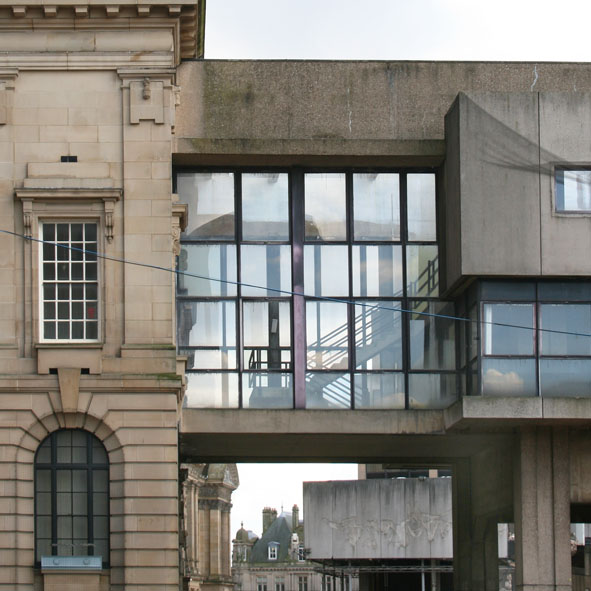
| Behind Those Windows Was The Yardbird Club; A Place Which Really Could Be Paradise On Any Given Night |
With a few hours to spare, and favourable lighting conditions, I headed into the City Centre, to see how the demolition of the old Birmingham Central Library complex, at Paradise Circus, was progressing. I’ve talked about, (and, indeed photographed and filmed) this site, on numerous occasions, and its passing feels more than a little significant. This goes way beyond my personal responses; and the passing of what was either a masterpiece of Brutalist Modernism, or a dismal, neglected eyesore, (or both), seems somehow symbolic of social, philosophical and political change in a much broader context.


 |
| Big - Art Project, Or Big Art - Project? |
Anyway, whatever the pros and cons, the removal of John Madin’s landmark building is inescapable. Indeed, a significant portion of the dramatic edifice is already reduced to a pile of concrete rubble. Actually, my timing felt pretty good, - with the interplay of wrecked sections and those still standing creating plenty of visual drama. However, as is always the case at such sites, the inevitable walled-off exclusion zone, and my lack of a decent long lens meant really good views and compositions were a bit limited. The shots I took tell the story, but aren’t necessarily the best I’ll ever take. My response to this was to get a bit visually ‘meta’, pausing to capture the abundant information graphics, and the abstract delights of the safety fencing, in addition to the main event.
 |
| An As-Yet Untouched Corner Of The Complex |
 |
| And Another. I love The Way They Just Arbitrarily Boshed The (Once) New Into The Old |
It’s hard not to be struck by
the extent of all the PR branding surrounding what we are already being
prompted to think of as ‘Paradise’.
It’ll always be Paradise Circus to me, not least because the cyclical
reinterpretation of what Paradise might actually imply to different
generations, does actually feel like a bit of a circus. Utopia can never be more than a mental
construct, after all. As ever, it’s as
much about the competing meanings, spectacles, and Psychogeographical
resonances, as it is the practical or expedient realities.


For what it’s worth, my immediate reaction to the numerous artist’s impressions dotted around the site, is that what replaces the old concrete Ziggurat may be little more than just another generic glass box, filled with the usual offices and retail outlets. This objection to an ever-encroaching corporate blandness is something many have raised in recent years, but it’s also important to recognise that what you are reading here are equally the observations of a middle-aged bloke, with a weakness for dystopian spectacle, watching the landscape of his early years gradually being erased. Ultimately, the significance, or otherwise, to real people’s lives, of either the old building or what replaces it, is for the people of Birmingham to decide.


In the context of all this,
the most moving moment came as I dropped down into the service yard of the
adjacent Copthorn Hotel, in search of more camera angles. I fell into conversation with one of the
demolition workers, - clearly a local guy, who spoke in a very informed manner
about the old building’s history. It was
clearly an important landmark in his own local mental map, and he expressed
regret that the original architectural vision was compromised by budget
constraints from the very start, - but also, his remorse at participating in
its destruction. He kindly handed me a
fragment of concrete from the rubble as a souvenir, and we parted by
recognising that, if nothing else, it was all keeping him in employment for the
time being. I often talk about my
fascination with the perpetual processes of transformation at work in urban
environments, but this took it all to a far more human level than normal.
Postscript:


Having orbiting the entire
site, and gathered what images I could, I left Birmingham, via Spaghetti Junction, and drove on to Nottingham for a little more social activity. That included watching Ben Wheatley’s newly
released film adaptation of Ballard’s ‘HighRise’ [1.]. This
isn’t the place for a full review, (I enjoyed it), but it’s worth reflecting
that the concerns of ‘High Rise’
chime more than a little with some of the above. My journey even included extended delays on
the M6, caused by a distinctly Ballardian road accident. Once again, things just seemed to join up.


