Tuesday, 27 January 2015

Interzone 2 / Friars Mill Update


Friar's Mill, West Leicester, January 2015


This is a companion piece to my recent ‘Entropic Gates 2’ bulletin.  It draws most of its images and observations from the same chilly, early January stroll, which triggered that one.


Friar's Mill, West Leicester, January 2015


My walk took in part of the district of Leicester near my home, which I’ve sometimes seen described on maps as Blackfriars.  Although long since absorbed into the city, and subsequently into the large St. Nicholas’ parish, it was once a more clearly defined quarter, just outside the city wall and centred upon the Dominican Friary for which it was named.  It’s an area I pass through repeatedly, and one which has appeared in numerous images and posts on this blog in the past, (whether tacitly acknowledged or not).  It definitely features significantly in my own ‘Mental Map’ or ‘Image Of The City’ [1.], and it pinned at one edge by the Northgate Street/Sanvey Gate/Soar Lane junction featured in some of my current ‘Map’ paintings.


'Map 2', Acrylics & Paper Collage On Panel, 60 cm X 60 cm, 2015

I wrote a post entitled ‘Interzone’ some time ago, which detailed some of the qualities of dilapidation, degeneration and neglect that characterise much of the neighbourhood, and the way that layers of Leicester’s economic and industrial history might be read through its streets and buildings.  Any Medieval identity is now negligible, apart from the occasional street name (‘Holy Bones’ being a particular favourite).  In recent times, the prevailing theme has been one of ever-diminishing backwash from a 19th or early to mid 20th century manufacturing heyday.


Friar's Mill, West Leicester, January 2015


Perhaps the most obvious signifier of this is the old redbrick hulk of the Victorian Great Central Railway Station and its adjacent truncated viaduct and guano-encrusted bridge.  The original station building and the arches behind, now house a series of small businesses, mostly of the car fixing/spraying/bashing variety and it’s not unusual to catch the whiff of cellulose on the air as one passes [2.].  More than anything else, these enterprises seem to characterise the ad hoc, peripheral opportunism of much of the zone’s current economic activity.  Visually and tactilely, there’s more than a little of the grungy, ‘Mad Max’ [3.] aesthetic about many of them.  They seem redolent of the urge to make the best of a bad job amidst the relics of Leicester’s (indeed Britain’s) once, much grander commercial heritage.

Whilst the idea of peripheral ‘Edgelands’ [4.] has had much currency in recent years, I am equally engaged by those areas of cities that, whilst they may be quite centrally situated, seem to be lost in space or time between more prosperous or populated quarters.  Often, it feels as though the city is holding its breath in such places, or that time has slowed enough for gravity to reassert itself and for more organic, less driven, processes of transformation to unfold for a while.


Railway Arch, West Leicester, January 2015


I didn’t lurk long enough in the freezing, murky conditions to photograph the arches this time, but I was intrigued by the appearance there of a new business, seemingly of the property management variety.  It seems particularly incongruous in its vaguely aspirational presentation, but may be a significant clue to the changes possibly about to overtake the area.


Railway Arch, West Leicester, January 2015


A more obvious signal of change is the huge construction crane that now dominates the whole area from a long-cleared site a few hundred metres from both the arches, and the graffiti-augmented gates already discussed.  It was to this that my lens was next drawn and, in particular, to its sparse geometry, (ever the formalist), and the way its jib almost disappeared into the rapidly descending mist.


Construction Site, West Leicester, January 2015


A few years back, during the pre-recession boom in property prices, stylish ‘Urban Living’ and the Blairite vision of a CafĂ© Culture Britain, this whole area seemed likely to disappear beneath a welter of glossy new apartment blocks. In the event, only one was actually completed and has stood rather forlornly on its canal side plot, ever since, amidst the surrounding dereliction [5.].  There were also rumours of a planned monster tower of glass on an adjacent site, but that hubristic scheme seemingly evaporated, along with much else from the period.  Instead, what have been built in Western Leicester, in ever-increasing numbers, throughout the entire period, are student accommodation blocks.


Construction Site Crane, West Leicester, January, 2015


Mostly, such edifices have so far proliferated a little to the south, clustering around the massive elliptical tower I wrote about some time back.  More than anything, they seem to symbolise De Montfort University’s [6.] reinvention of itself as a huge property corporation/lifestyle facilitator that does a little educating on the side.  I suppose they also signify the oft-trumpeted shift from a manufacturing economy, to one based on knowledge and services.  I was bemused some time ago to discover that Blackfriars, and indeed, the neighbouring, traditionally working class area that I myself inhabit, were to be absorbed into something now redesignated as the ‘DMU Square Mile’.  Whatever else this might imply, on the ground - the reality would appear to be the onward march of the student apartments.  This is exactly what is now being constructed on the site from which the huge crane rises.


Student Accommodation Block (Under Construction), West Leicester, May 2012


Once upon a time, many students inhabited shabby terraced houses of the type I still live in, and were, if only partially, integrated into a neighbourhood [7.].  There was still, (just), the possibility of some form of bohemian lifestyle, however self-deludingly imagined.  The future would seem to be one in which they gaze over the rooftops from insulated, Wi-Fi-enabled hutches, whilst most of their needs are met and controlled by their academic parent institution.


Friar's Mill, West Leicester, January 2015


Ultimately, as the remaining light reverted to the spirit-sucking grey that only a January afternoon in the Midlands can really achieve, the majority of my photographs concentrated on another site that has appeared here more than once, - namely Friar’s Mill.  As already described, this splendid waterside factory building had stood empty for several years before being gutted by fire in 2012.  Dating from the eighteenth century, and with it’s mellow red brick, attractive proportions, and lantern-topped pitched roof, it was once one of the prime landmarks of Leicester’s industrial and architectural landscape.  In my time in the city, I’ve witnessed it degenerate from a working factory, to a vacant haunt of rough sleepers, Urban Explorers and graffiti artists, and then a roofless, boarded-up shell.


Friar's Mill, West Leicester, January 2015


If, as it now appears, a second wave of attempted gentrification is to wash over this portion of Blackfriars, a new iteration of Friar’s Mill may be at the heart of it.  It is currently enveloped in scaffolding and wrapped like a Christo art project, (the visual impact of which was actually what attracted me back for a closer look).  Signage and idealised illustrations on the perimeter fence suggest that it is about to be both restored and reimagined as a small business centre.  I have no idea how all this will ultimately alter the area as a whole, and Leicester is certainly full of sites where entropy and picturesque neglect still wash up intriguingly against over-optimistic or misplaced attempts to construct a shiny new future [8.].


Friar's Mill, West Leicester, January 2015


Much has been written on the phenomenon of urban gentrification, and how the adoption of an area by artists, ‘creatives’ and other generally funky types often precedes it.  Once the planners, property investors and marketeers notice, it’s usually only a matter of time before the low rents (essential) and organic grunge appeal (desirable) that created the situation, are sacrificed to something far more generic, over-designed and, of course, investable.


Friar's Mill, West Leicester, January 2015


For all that, I can’t really claim that Blackfriars is currently any kind of freewheeling creative cauldron [9.].  There is one small commercial gallery, and a recording studio nearby, but otherwise, the artistic activities in the area may not extend far beyond a few graffiti enthusiasts, and myself wandering around, inexplicably photographing stuff falling apart.  That’s probably why I like it so much really.  It seems likely that the tenor of at least part of the area is likely to change over the next year or two, but to just what extent is hard to say.  I suppose I could mourn the loss of yet another entropic playground, but the more constructive course would probably be to just get on with monitoring the processes of change.  Ultimately, I want my own practice to be about finding imaginative/subversive ways of responding to the shifting situations that actually arise, - not just about trying to preserve my own derelict comfort zones in visual aspic.


Friar's Mill, West Leicester, January 2014


Postscript:

Your eyes don't deceive you; I went back to take a few supplementary photos, under much more favourable illumination, as this post unfolded.


[1.]:  Kevin Lynch, ‘The Image Of The City’, Cambridge MA, MIT Press, 1960.
This book is currently informing some of my own relationship with my urban surroundings, although perhaps not entirely in the ways that the author originally intended.  I’m sure I’ll be referring to it again in the near future.

[2.]:  Another, somewhat incongruous, influence on the general ambience of this area, is the regular sound of gospel singing and enthusiastic preaching from the Pentecostal church that operates from a dilapidated street corner building.

[3.]:  George Miller (Dir.), ‘Mad Max’, Kennedy Miller Productions, Australia, 1979: ‘Mad Max 2: The Road Warrior’, (As Above), 1981:
George Miller & George Ogilvie (Co-Dirs.), Mad Max 3: Beyond The Thunderdome’ (As Above), 1985.

[4.]:  The setting for much of J.G. Ballard’s dystopian vision, and also eulogised in:
Paul Farley & Michael Simmons Roberts, ‘Edgelands: Journeys Into England’s True Wilderness’, London, Jonathan Cape, 2011

[5.]:  It can be seen, complete with its gimmicky, green, waveform roofline, in the background of a couple of these shots.

[6.]:  Formally Leicester Polytechnic.  I am myself an alumnus of both Leicester and Bristol Polytechnics, and always enjoyed the idea of being a Poly student, and of a higher education that might equip one with practical as well as academic skills.  Some would argue that the haste with which all such institutions sought to rebrand themselves as Universities, (with all that implies), is just one of many misguided steps taken by the British education system in recent decades.  Would that a mortar board and hired robes were enough to signify a well-rounded graduate.

[7.]:  Although not always without some friction, it must be admitted.  (Notice I just avoided saying “In my day”).

[8.]:  Leicester’s civic motto, ‘Semper Eadem’, translates to ‘Ever The Same’).  Paradoxically, this seems to be both accurate and inaccurate in equal measure.

[9.]:  In fact, Leicester has made attempts to construct some kind of ‘Cultural Quarter’ elsewhere, in recent years.  Whilst not without its attractions, (Curve Theatre, Phoenix Media Centre, etc.), this feels only partially successful, to date.  Certainly, it is something far more self-consciously imposed from above and lacking any true foundation.  I do question just how much it has really impacted on the lives of most of Leicester’s inhabitants, and the question of what exactly constitutes ‘Culture’ is a whole other essay.  In fairness though, some interesting old buildings have found a new lease of life, and at least one dynamic new one been created, in the process.


Saturday, 17 January 2015

Completed Painting: 'Map 2'


'Map 2', Acrylics & Paper Collage On Panel, 60 cm X 60 cm, 2015


Here is ‘Map 2’, - my second, just-completed painting of 2015.  It’s always the case that everything seems to take a bit longer than one might hope.  However, my current strategy of working on groups of related pieces simultaneously does seem to be paying off in terms of what would be called workflow in the commercial sphere.  It’s certainly a boost to start the year by completing something new every few days.


It’s also useful to be able to just reach for something(s) else already in progress, whenever a particular piece has got a bit stuck or I’m just sick of looking at it for the moment.  Usually, when I return to the original painting, it seems easier to clear the perceived logjam, - if only because I’m looking with a fresh eye/mind.  There’s no doubt the individual paintings are informing each other and solving problems as they come along side by side.  The only real problem I can foresee is the danger of painting the same picture over and over again.  I need to ensure that these pieces keep spinning off each other, in small ways at least, (even if only I can see them).


'Map 1', Acrylics & Paper Collage On Panel, 60 cm X 60 cm, 2015


Like ‘Map 1’, this painting has been consciously produced with June’s ‘Mental Mapping’ exhibition in Rugby in mind, and most of what I wrote about that one also applies here.  The same basic collage/paint approach, (incorporating found advertising posters), was employed, as were multiple references to the specific site where they originated.  In this case, it’s the same junction in Leicester, and the same portion of street map is repeated at the same scale and orientation, (if a little less dominantly painted).  This was achieved using the same manual methods as before.  Were I to include all the legends, icons and other cartographer’s symbols from the actual A-Z map, it would be definitely become necessary to source a higher-tech form of applying these maps, (and hand over cash, no doubt).  However, for now, I rather like the way the basic street plan operates as an abstract, formal element as well as a potential conceptual clue.


Junction Of Northgate St/Sanvey Gate/Soar Lane, West Leicester, January 2015


Opposite the corner where I salvaged the fallen advertising posters incorporated in this piece, is a building now housing a self-storage facility.  These enterprises have become a significant feature of contemporary cities, and represent a kind of re-materialised take on the idea of The Cloud, I suppose.  Clearly, the whole idea of small parcels of vacancy being a rentable commodity has a lot to say about our relationship with living space, the accumulation of physical possessions and the very nature of our economy.  It’s fair to say the compactness of the British Isles, and their increasing population, are ever-present issues here, along with the increasingly punitive cost of real estate, restricted scale of domestic spaces and paucity of coherent public housing policy.  Tangential to this are the obsessive British equation of land with wealth/status, and indeed, the matter of who actually owns, controls and makes money from tracts of both public and private space of all sorts [1.].


Junction Of Northgate St/Sanvey Gate/Soar Lane, West Leicester, January 2015


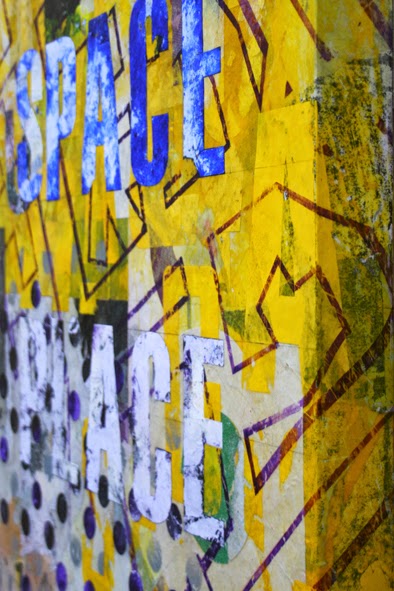
My fascination with the numerous primary yellow interventions scattered throughout our man-made environment is no secret, and my eye was inevitably drawn to that building’s garish yellow & violet livery.  If that is one obvious source of this painting’s chromatic scheme; another is the fact that I was able to collage a section of found violet and yellow UKIP poster material into it.  It felt good to be transmuting their pernicious rhetoric into something a little more constructive. [2.].


As already mentioned, my intention with these pieces is to include elements of text actually found at the source location.  Given all of the above, it was impossible to ignore the name of the self-storage company, (hopefully, without actually infringing any trademarks) [3.].  ‘Space’ and ‘Place’ are both, clearly, key concepts in much of what I do, and feel sufficiently open-ended as terms to allow for numerous potential interpretations.  On reflection, they do slightly fuel my current insecurities about habitually defaulting to the glaringly obvious.  Of late, my oft-stated ambition has been to find some middle ground between the visually/sensually derived stimulus and a modicum of conceptual rigour.  If this is to be taken seriously, I may need to consider slightly more oblique or sophisticated strategies, towards my textual elements at least, in future work.


Anyway, for now, I’m happy to call this one finished.  Actually, it’s one of those all too common pieces that I periodically look at and wonder, “What was I thinking?” then, a few hours later, find plenty of reasonably pleasing things in it.  Perhaps it’s all still just too fresh in my eye/mind to really judge.  I’ll confess to a tiny amount of re-fettling of the ‘Space/Place’ text since photographing the painting, but nothing significant enough to justify a re-shoot.  If anything, it just proved there was little to be achieved by further tinkering, and that it’s just time to get on with finishing the next one.


[1.]:  Although it’s way beyond the scope of this painting, it’s fair to say the whole issue of what exactly constitutes ‘Public Space’ is increasingly open to question these days.

[2.]:  The current depressing swing to the political Right is just another reason to feel baffled by the current state of British society.  I would in no way want to suggest that my own observations about available living space here share any common cause with their UKIP's essentially racist analysis of the situation.

While we’re on the soapbox, and in passing, - as a white, liberal atheist who regularly visits Birmingham, I can clearly state that the recent assessments of the city’s cultural profile by Fox News’ so-called Terrorism ‘Expert’ are some of the most inflammatory and ill-informed nonsense I’ve heard in a long time.  Such opinions deserve all the derision we can muster.


[3.]:  I should point out that I haven’t included the word ‘The’ and, beyond being inspired by a colour scheme common to many such enterprises, have deliberately avoided any serious attempt to co-opt their specific corporate identity.


Tuesday, 13 January 2015

Written City 16: Entropic Gates 2


Soar Lane, West Leicester,  January 2015


Inevitably, the Christmas break flew by with alarming rapidity, and already feels like a distant memory, - after only a few days back in harness.  Having spent much of the two week festive hiatus indoors painting, (when not celebrating/indulging), I drove myself outdoors on the last Sunday to take a turn around a few of my local haunts with the camera.

The freezing temperatures, increasing mist and failing light were something of a disincentive, I’ll admit, but I seized the chance to monitor the changes in a couple of favourite locations, both of which have featured here before.  This post is an update on one of them. 


I now realise that the monitoring of continual change within the urban environment is a key element in my response to the experience of living in a city.  Indeed, it only goes to emphasise the point that to move through any urban environment is to move through time, as much as through space, (physical & mental).  Of course, an embedded ruralist might argue that this statement of the obvious applies even more to any environment where natural/seasonal cycles are most prevalent.  However, I would argue that the sense of transformative change is more concentrated, and monumentalised in cities.  In fact, I suggest it may actually be a somewhat different form of time altogether.

I think there may be considerable difference between both the passage of measurable time as a component of physics, or the regenerative unfolding of biological time, and what might be termed historical time, (which is, I suspect, the form most obviously concentrated in a city).  Whilst they inevitably bleed into one another, one might see any clearly defined concentration of architectural edifices of varying ages, as primarily a series of monuments to itself and the lives lived within it.  Anyway, there are enough (poorly thought out) implications there to fuel an academic thesis, - let alone this supposedly modest post, so let’s just focus on my images of one minor site for now.


Soar Lane, West Leicester, 2011


I’ve walked and cycled past these industrial, steel gates on Leicester’s Soar Lane, thousands of times over the years.  In fact, they only really come into their own when closed, on a Sunday or after hours, as the automotive businesses occupying the compound beyond seem routinely busy [1.].  For many years, the face that the gates presented, in their shut state, was a gorgeous, multi-layered mĂ©lange of heavy corrosion, overlapping graffiti and degrading industrial paint.  It was a veritable elegy to the processes of entropy, and I lost count of how many times I thought, “I really should make something inspired by that”.


The chance came in the winter of 2011-12 when they became a source for one of the panels in my four-part piece ‘Sick 1’.  I’m not convinced that is the most sophisticated example in my back catalogue, but it worked well enough visually within the overall piece.  The combined motifs of corrosion and graffiti also provided an appropriate, (if slightly obvious), accompaniment to the themes of entropy, societal malaise and indeed, security, running through ‘Sick 1’, (which was produced in the wake of 2001’s riots).


'Sick 1', Acrylics, Paper Collage & Mixed Media On 4 Panels,  60 cm X 300 cm (Overall), 2012

'Sick 1 C' Acrylics, Paper Collage & Mixed Media On Panel, 60 cm X 60 cm, 2012


Not that long after I completed ‘Sick 1’, the gates were replaced, or at least heavily refurbished, and I photographed them in in their new, pristine state, complete with their fresh, dark grey paintwork.  I understand the desire of the site’s proprietors to project a slightly slicker, more businesslike image to the world, but it did feel like something was lost in terms of the overall visual texture of a distinctly transitional neighbourhood.


Soar Lane, West Leicester, April 2012

Soar Lane, West Leicester, June 2013


Of course, that situation was never likely to last long and in the intervening months the gates have attracted a new generation of taggers.  Their accumulation has been relatively gradual, but it appears they are just beginning to enter that phase where a sufficient tangle of disparate voices can become a kind of overall, calligraphic hubbub.  Visually, here’s a point at which, purely subjectively, it seems to become about more than mere defilement.

Some might object that what we see here are merely the inept scrawls of a few inept taggers, and that this is a world away from impressive, large-scale graffiti pieces and officially sanctioned (or tolerated) Street Art.  That may be true, but these are at least genuine, organic examples of the visual territorial pissing from which all contemporary graffiti originates.  That impulse is timeless, and in this form, at least has the appeal of a raw expression for which the idea of permission or official sanction is irrelevant.  I also like the way that you can actually see the process of practice and refinement taking place in the case of at least one of these writers.


There’s a long way to go for these particular ‘Written Gates’, until they reach the delightfully organic state that originally captured my attention.  The grey surface coating is still largely doing its job, and the serious corrosion that was once such a feature is yet to seriously take hold.  Indeed, it will be interesting to observe whether a little more routine maintenance, or indeed, the creeping urban regeneration now appearing only metres away, may actually hold entropy at bay this time, - for a little while at least.  The whole area actually feels like it may be poised on the brink of some fairly major changes, but more of that very soon.


[1.]:  They also appear focused more on scrapping and salvage than ‘valeting’, from what I can make out.


Monday, 5 January 2015

Completed Painting: 'Map 1'


'Map 1', Acrylics & Paper Collage On Panel, 60 cm X 60 cm, 2015


It feels good to open 2015 with a newly completed painting.  I’ve had several pieces simultaneously on the go over the last month, and ‘Map 1’ is the first to reach some form of completion.  ‘Completion’ is, of course, a tenacious term when applied to the painting process, - mostly it just feels like the various levels of this image have reached some degree of equilibrium, and that there’s nothing to be gained by fiddling with it any further.

Anyone familiar with my recent work may recognise various customary elements, - not least a heavy reliance on collage techniques, the layering, overlapping and slurring together of different statements, a certain vestigial reliance on geometric compositional formality, (reasonably submerged here), and the inclusion of more or less fragmented textual elements, (pointing towards a variety of soft conceptualism).  However, there are also one or two newer developments in this painting, indicating that it’s the first piece consciously produced for the ‘Mental Mapping’ exhibition that I’m planning with Andrew Smith, in Rugby, this summer.


Having agreed to exhibit together, and been lucky enough to secure a slot at Rugby Art Gallery& Museum’s Floor One Gallery, Andrew and I were faced with the need to come up with an (ideally) interesting title for the show, in order to complete the necessary paperwork.  My initial assumption was that my contribution to the show would largely comprise of pre-existing work, but as soon as the ‘Mental Mapping’ label emerged from our email-assisted brainstorming, it quickly suggested possibilities for new work in my mind.  With approximately six months remaining, I’ve no idea how much completely new stuff I’ll actually be able to include, but I’m determined it should be as much as possible.  For the record, ‘Mental Mapping’ was a phrase of Andrew’s that immediately struck a chord with my own existing preoccupations, but felt ambiguous enough to allow for a number of possible interpretations and to allow each of us to come at things from our own direction.  

Anyway, the obvious connection between this image, and the ‘MM’ theme is the conscious inclusion of an element of cartography, - the map in question being a section of Leicester’s street plan.  I did initially toy with possible higher-tech methods of applying linear maps to a painting.  However, wanting to simply get on without too much expense or complexity, I eventually just resorted to my old scene-painter’s methods, - utilising a combination of photocopying, overhead projection, manual tracing, and a load of masking tape.  The results are, I feel, ‘accurate enough’.


Junction of Northgate St/Sanvey Gate/Soar Lane, Leicester, January 2015


More specifically, the street map includes an actual site from which I have scavenged fallen or torn advertising posters, fragments of which are in turn collaged into the painting itself.  In this case, the hoardings are sited on the crossroads junction of Soar Lane/Sanvey Gate/Northgate Street, (just north west of the city centre), as depicted close to the centre of the composition.


'Consumed 1', Acrylics & Paper Collage On Panel, 100 cm X 100 cm, 2014


This use of torn posters in building up of seemingly dilapidated surfaces has been going on in my work for a while, and I really enjoy the scope it offers for creative serendipity, happy accidents, and found texts and colours.  Equally important are the sly references to photographic reproduction and printing technology implied in the small passages of Ben-Day or Halftone dots that remain visible.  The juxtaposition of consumer-capitalist fantasy/spectacle with the physical realities of entropy, transformation and material fatigue is something I find everywhere in my Urban surroundings.  It remains a regular theme in much of what I do.


Junction Of Northgate St/Sanvey Gate/Soar Lane, Leicester, January 2015


In even broader terms, I suppose that what I do is really just an attempt to unify the idea of material space with that of a ‘Written City’ of signs, messages, labels, clues, texts (and resulting associations), of every sort.  In recent paintings, the textual fragments included in paintings have alluded primarily to my thoughts while passing through these environments.  In this new painting, they relate to actual texts found within the specific site itself.  I intend that these new ‘Map’ paintings should all include some such element of easily decipherable, non-anagramatic quotation.  In fact, I’ve already cheated a little by slightly adapting a found legend here, but I couldn’t resist the ‘Primesight/site’ ambiguity, and the further layer of self-reflexivity it affords.


It’s also my intention that the palette of these ‘Map’ paintings should relate directly to some aspect of the source location.  In this case, The predominance of sky blue is a reference to the customary backing colour of most printed advertising posters, (and it’s frequent emergence as soon as the paper becomes torn), but also to my memory-impression of clear skies above what is essentially an open site surrounded by mostly low-level structures.  After a period of working with fairly subdued, even monochromatic palettes, my current instinct is to reintroduce a little more heightened colour into proceedings.  That certainly seems to be the case with some of the paintings coming along in the wake of this one.

There should be several more ‘Map’ pieces reaching a conclusion fairly soon.  For now, whilst there are (as always), some aspects of this one that please me more than others, it does at least feel like a small evolutionary step on what went before.  Perhaps most importantly, it’s already suggesting possible new ways forward in the coming weeks.