Wednesday, 23 December 2015

Completed Studies (Good Intentions)


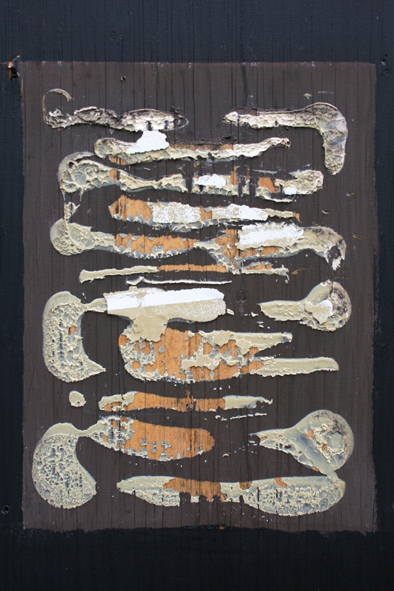
'Untitled', Acrylics, Paper Collage, Adhesive Tape, Ink, Spray Enamel & Pencil On Paper,
30 cm X 30 cm, 2015


This post features four more of my recently produced, small-scale ‘studies’ on paper.  (Are these technically ‘studies’ in the traditional sense? – I’m never quite sure if that’s the correct term for them.  Whatever, - it’ll do for now).

It’s definitely been a slightly disjointed year artistically, broken rather neatly into two halves around June’s ‘Mental Mapping’ exhibition.  If the first half was all about the intensity of producing the ‘MM’ work, and just meeting the deadline generally, the second has, felt like something of a bit of a creative recovery phase, with nothing like the same intensity of output.


'Untitled', Acrylics, Paper Collage, Adhesive Tape, Ink & Spray Enamel On Paper,
30 cm X 30 cm, 2015


That’s not to say I haven’t been engaged during that whole time, what with the commissioned piece produced for my workplace taking up much of the late summer and early autumn.  Nevertheless, things have just felt a little more disparate and less urgent, overall, - certainly in terms of work produced purely for its own sake.  That's partly due to my decision to draw a conscious line under ‘Mental Mapping’, and to move things in a new direction.  It may actually resemble more of an evolution than a revolution, but my thoughts are definitely in a slightly different space.  Unlike that phase of work, I've opted to eschew any clearly defined set of pre-defined parameters, or thematic banner, up until now, and to just let whatever might emerge do so in a more organic manner.  An obvious consequence o has been a certain amount of ‘casting around’, considering options and general reflection, often without too much evidence of overly-urgent action.


'Untitled', Acrylics, Paper Collage, Adhesive Tape, Ink & Spray Enamel On Paper,
13 cm X 13 cm, 2015


Thankfully, as I’ve mentioned previously, I’m much better at accepting this kind of ebb and flow as an intrinsic part of ‘the creative process’ these days.  I no longer aspire to unachievable standards, and can happily accept that if work isn’t in full flow, it doesn’t mean I’ve dried up altogether, or am ‘just no good at it’.  If a dozen of these small works on paper (and a larger archive of related photographs) seem like a relatively modest haul over two or three months, so be it.  Each has actually been fairly intensively worked on, and often went through several earlier stages before reaching their final state.  More importantly, they do seem to point the way forward, both thematically, and in terms of possible working strategies, which was always a large part of their intended function.


'Untitled', Acrylics, Paper Collage, Adhesive Tape, Ink & Spray Enamel On Paper,
30 cm X 30 cm, 2015


Here then, in no particular order, is a list of my current thoughts about them and what may follow.  These seem to be coalescing into a kind of thematic framework that I’m happy to move forward within over coming months, and to include a number of specific intentions as regards more developed work to be attempted in 2016...


Central Nottingham, October 2015


  • As usual, when not sure of my next move, I have trekked into the urban jungle with my camera, in search of resonant imagery, (a few more examples of which I’ve included here).  Whilst open to new stimuli, I find it’s still primarily walls, surfaces and various species of texts that draw my gaze.  I also find that the subjects that really fascinate me just now are the grungier, more eroded, damaged ones.  Texts are of most interest when they fail or break down.


Deritend, Birmingham, May 2013


  • Following my lens intuitively, I have quickly found my images beginning to organise themselves into several identifiable subject categories.  These include: erased or cancelled signage and graffiti; examples of things being painted out or obliterated; cleaner 'ghost patches', and borders of tape residue where posters or signs have disappeared; the squiggles and dots of failed mastic that also once fixed lost signage; white-washed windows in vacant or abandoned buildings; other examples of windows blinded by grilles, screens, boards or barricades; and examples of general erosion, weathering, damage and entropy, (no real surprise, - I've been drawn to many of these things for a long time now). 

  • All of this imagery starts to inform, more or less consciously, the small paper based ‘studies’ of recent weeks.  For the most part, I try to avoid drawing too specifically to any single photo-reference, but allusions to many of the above motifs seem to creep in to what are still nominally abstract statements.  One exception is a particular ‘clean ghost’ patch, which remained before me as I worked on one of the previously highlighted studies.


Central Leicester, November 2015


  • This latter feels like something that could provide the basis for a small series of more resolved paintings, utilising the idea of variation within a repeated symbol, (that has just started, in fact).  I love the idea of such sparse, nuanced formality, and of a subject that is essentially ‘no longer there’.


Lace Market, Nottingham, April 2014


  • Another possible series of closely related pieces might derive from the subject of whited-out windows.  These are a familiar sight, and one that represent a routine form of cancellation.  Despite their ad hoc functionality, each is subtly different from the last, displaying a wide variety of gestural wipes, accidents, clear gaps, hand prints and comedic doodles.  The reflections of the outside world that augment them add an important extra dimension to their nominal blankness, as do the glimpses of interior space beyond, (and the interaction between them).  Would it be rewarding to experiment with pieces actually painted onto glass, or another impermeable substrate, in order to take account of some of this, I wonder?


Central Leicester, October 2015


  • This process of subject categorisation also makes me contemplate the possibility of presenting photographs as final statements in their own right.  Would it be desirable/feasible to produce a series of artist’s photo-book(lets), I wonder?  Ed Ruscha would be an obvious precursor of such a form, although many others have utilised it too.  Possible series might include the afore-mentioned windows, a more general category of ‘absences and cancellations’, or (slightly tangentially), empty, flattened cardboard boxes.


Central Leicester, October 2015


  • That last one is a subject that has fascinated me for a while, and which feels slightly separate and yet somehow related to all this other stuff.  I realise this is because the general themes that seem to over-arch all of this include: absence, vacancy, disappearance, lost voices, messages and meanings, abandonment, loss, emptying out, cancellation, removal and erasure.  Flattened boxes clearly allude to a loss of content, in a rather poignant but deliciously formal way.   Overall, it’s more accurate to say that what really seem important are the clues and allusions to those states, possibly still in process.  I'm not introduced in these ideas as absolutes or in conceptual purity at this stage.  Ragged ghosts, messy vestiges and shreds of vanishing evidence seem key here.


North Leicester, July 2009


North Leicester, November 2015


  • Perhaps it’s appropriate that my current chosen palette appears to be fairly neutral, - verging on monochrome.  Hightened colour feels like something else that is being drained out of my work for the time being.  Could this also be a reaction against the artificial colour that partly characterised my ‘Map’ paintings and (even more so), my recent school commission?  Perhaps sometimes you just need to rest and recalibrate your eyes.


North Leicester, November 2015


  • Could it also be that this chromatic desaturation also reflects a somewhat depressed or alienated mood within much of this imagery?  Rather than simplistically ‘depressed’, perhaps I’d prefer to see in it as a partial reaction to some of the nihilism and pre-apocalyptic gloom that seems to permeate so much of the society and wider world around us just now, (at least as it’s reported).  If there’s a suggestion of fear for one’s own obliteration in there, I’d have to say that starting to pick up the pace of work again, and making these little studies specifically, feels like a profoundly positive, even cheerful act.  I don’t see my art as therapeutic exactly, - but, you know.

  • If that sounds somewhat psycho-personal, more theoretically, it's probably the case that the impulse behind this new phase is a little more more 'Hauntological' than 'Psychogeographic' [1], (as before).   These motifs (and emotions) feel more generalised and less tied to specific locations.  These oft-used but inexactly defined terms are open to interpretation, (this isn't really the place), and there is a considerable overlap between them.  If both deal to some extent with the relationship between situations and past events, there is an important element of Hauntology that seems to dwell on the loss of potential; of futures or utopian aspirations snuffed-out.  It would be foolish to ignore it's Marxist origins, but more generally, it can be seen as an attempt to rationalise disappointment, on various levels, I believe [2].


Central Leicester, October 2015


Central Leicester, October 2015


  • Something else that becomes evident within the small studies is a slight increase of gestural painterliness.  We’re possibly talking fine margins, (and an element of hybridised collage remains within my M.O.), but there is an increased reliance on various, sometimes incompatible, fluid media.  Deliberately, even willfully, careless application methods come somewhat to the fore too, along with a prioritizing of accumulated accidents over more methodical, layered construction of a composition.  We’re probably some distance from ‘your actual’ Expressionism, but this slight freeing-up feels refreshing.


North Leicester, October 2015


  • It's always been my intention that these studies might stand alone as resolved pieces, but could also be recycled as raw material for works in other media.  It’s certainly my intention to scan or photograph them for further digital processing, physical reconfiguration or, ultimately, as the basis for larger-scale paintings or a move into various print media.  It’s hard to predict exactly how this might go, but a process of open-ended exploration, through both new and old media, feels like a definite ambition. This is clearly inspired by the example of Christopher Wool, Jacqueline Humphries, et al, which I absorbed in Tate Modern’s thought-provoking 'Painting After Technology’ display, in May.


Central Leicester, October 2015


  • Oh, - and I aspire to doing some more work with video in the not too distant future too.  There’s always to option to make self-contained video work, but would it be feasible to combine paintings with moving imagery also, I wonder?  I was intrigued by Fiona Banner’s use of projected over printed imagery at her ‘Scroll Down And Keep Scrolling’ exhibition in Birmingham and wonder if it might be possible to project fleeting, sporadic moving elements onto static paintings.  Hmmm…


Central Birmingham, January 2013


If I’m honest, this whole agenda may be as much for my benefit as yours.  It’s essentially a case of me thinking aloud, and could possibly have just remained in a sketchbook, I suppose.  Hopefully, it does more than merely ‘let light in on magic’, and also gives some useful insight into creative thought processes though.  Perhaps there’s also an element of making a public statement I can try to live up to.  Of course, it’s probably all far too ambitious to be wholly achievable, and you wouldn’t want things to be too predictably nailed down or rigidly planned in reality. I’ve tried this before too, with my ‘Belgrave Gate Project’, only to fail to really follow through.  Nevertheless, regardless of how many of these proposals actually see the light of day, or become replaced by completely different ones, it doesn’t hurt to set a few goals and working parameters to be going on with.


Central Leicester, May 2010


As I write, the year is pivoting around the shortest day and we’ll soon be celebrating the New Year.  It feels like the perfect time to be laying plans and (hopefully), gearing up for a renewed surge of creative activity.


[1.]:  Although I've referred to it before, (more than once), for a useful overview of the traditions and conceptual framework of Psychogeography, I still recommend:
Merlin Coverley, 'Psychogeography', Harpenden, Pocket Essentials, 2010

[2.]:  Those keen to know more about the ideas behind Hauntology, specifically within a Pop-cultural and Socio-political context, could do worse than dipping into:
Mark Fisher, 'Ghosts Of My Life: Writings On Depression, Hauntology And Lost Futures', Arlesford, Hants, Zero Books, 2014


Saturday, 19 December 2015

Grrr - Pesky Kids! 1


Well, I suppose this is only the kind of thing you have to expect from time to time, in any school.


RusheyMead Academy, North Leicester, December 2015


I'm always amused at work, when I look out the window and see our students manically pelting around in a maelstrom of bodies with footballs, tennis balls, discarded water bottles, - pretty much anything that can be kicked, (including stones, - as I assume, happened here).  I can still remember having so much energy that you just had to run around in circles the minute you got out of lessons, - but only just.  Unfortunately, it all gets slightly less enjoyable every time another ball smashes against the window I happen to be standing next to.

In fairness, although I can only claim a passing interest, football is pretty big news in Leicester just now.  You can tell the local team are doing well, - one or two of the kids have even swopped in their traditional glory hunter's Man Utd shirts for blue Leicester City ones.


Anyway, kids will always kick balls and windows will always break.  At least it creates a little more material for my hazard tape fixation.


Monday, 14 December 2015

A Little Illumination


Sometimes a moment of ‘Dynamic Quality’ [1.] and an idea one is presented with in a more static or formalised fashion, seem to illuminate each other rather neatly, and with fortuitous coincidence.


The Hockley Arts Club, Hockley, Nottingham, December 2015.  (Photo: Lorel Manders)


The other night, as part of the pre-festive social round, I found myself with a handful of good friends in one of Nottingham’s more happening bars.  ‘The Hockley Arts Club’ is a recent addition to that city’s nightlife and, by all account, very much the place to go, (this month, at least).  If nothing else, that name feels like a considerable stroke of Post-Modernist savvy.

To be honest, being amongst the cool kids was never really paramount in my conception of a good night out, (although being at least on nodding acquaintance with them might have been a secret tangent to my ambitions to attend Art College, all those years ago).  Either way, just being out in convivial company at all, feels like achievement enough these days.


Not sure what happened here, but wine had been taken.  (Photo: Suzie Fletcher).


Over the years, I’ve tended to the view that the best hangouts or ‘scenes’ acquire their resonance through a kind of mysterious, indefinable chemistry, rather than by conscious design or fashion, and that such things are spontaneous, unpredictable and highly subjective, anyway.  Mostly, I was more than happy to just go somewhere new, following the flow of the evening, regardless of the supposed attendant cache.


The Hockley Arts Club, Hockley, Nottingham, December 2015.  (Photo: Lorel Manders).


In the event, I was impressed by the way that, whilst attending to various current ‘Hipster’ tropes, the chosen venue’s designers had managed to create an enjoyable and genuinely comfortable ambience at the same time.  Entertainingly, the overall décor style was distinctly reminiscent of the diluted, mid-Twentieth Century, high street Modernism that characterised my own childhood, and I’d have to compliment whoever was responsible for their stylish deployment of G-Plan furniture, kitsch, chain-store paintings and spider plants - suspended in macramé. (They are a specific historical signifier that takes me right back to where I started).  One particularly impressive aspect of the overall effect was the carefully considered ambient illumination, emanating, in part, from domestic light fittings that might have graced any of the living rooms in which I found myself during the early-to-mid 1970s.


Davis Bowie, 'Young Americans', (Including The Single, 'Fame').


Amongst the unidentified (but perfectly acceptable), Funk and Hip Hop with which we were regaled, was a familiar record that brought home equally my formative years, - namely, David Bowie’s ‘Fame’ [2.].  I don’t actually own any Bowie records these days, but it would be foolish to pretend he wasn’t a significant feature of the Pop-cultural landscape back then, as a shaper of some of the period’s most memorable songs.  His general approach, as rather more of a knowing Bricollagist, than a natural, organic musician, also felt appropriate in the context in which we were currently hearing it.


Even so, as I discussed how cleverly the record’s Cubist Funk elements had been consciously assembled, with my friend Suzie, I couldn’t deny that much of the actual magic just came from hearing it afresh, unexpectedly ‘in the moment’, after years of probably taking much of Bowie’s output relatively for granted.  It is, if you like, the difference between what you know about a record objectively, and how it makes you feel subjectively in a particular situation. (Duh! - that’s the whole point of Pop music, I hear you cry).


I thought about this again the following morning, whilst reading ‘Lila’ [3.], - Robert M. Persig’s sequel to the more famous, (and really rather splendid), ‘Zen And The Art Of Motorcycle Maintenance’ [4.].  These two books constitute a form of pop-philosophical investigation into the idea of ‘Quality’ and are, essentially, Persig’s attempt to constitute some form of Value-based Metaphysics.  Persig sees this as being in opposition to the binary subject/object concepts of ‘Reality’ that have, (in his view), plagued our understanding since classical times.


That might sound a little daunting, were both books not written in a very approachable, quasi-novel form, and if they didn’t also include large elements of personal history, psychological insight and some useful stuff on constructive approaches to practical tasks, such as - indeed, repairing a motorcycle.  Appropriately, each is also an account of a specific journey.  Conversely, it might be easy enough to dismiss Persig’s thinking, (and slightly hokey world view), as just another product of the 60s and 70s counter-culture.  However, it appears that, whilst not exactly on the syllabus of many serious Philosophy courses, neither is it actually derided by many specialists in the field.  There exist quite serious examinations of ‘ZAMM’ by people far more thoroughly versed in the subject than I [5].


Robert Persig, (With His Son, Chris), Aboard The Very Motorcycle.  (Photographer Unknown).


Anyway, this isn’t the place for an in-depth discussion on either work.  Suffice it to say, whilst I certainly won’t be donning saffron robes anytime soon, (or, I suspect, ever), there’s a lot of stuff in ‘ZAMM’ that I find fascinating, philosophically, and it’s a book I’ve turned to repeatedly over the years.  I’m only halfway through ‘Lila’, so can’t comment too meaningfully on it here, although it does appear to develop Persig’s original idea of the Value underpinning his perception of, well - everything, in terms of a distinction between ‘Dynamic’ and ‘Static Quality’. If nothing else, the following passage, (read with a mild hangover the morning after), does seem to relate, in part, to some of my earlier observations re. Bowie’s ‘Fame’…

"...imagine that you walk down a street past, say, a car where someone has the radio on and it plays a tune you've never heard before but which is so good it just stops you in your tracks.  You listen until it's done.  Days later, you remember exactly what the street looked like when you heard that music.  You remember what was in the store window you stood in front of.  You remember what the colours of the cars in the street were, where the clouds were in the sky above the buildings across the street, and it all comes back so vividly you wonder what song they were playing, and so you wait until you hear it again.  If it's that good you'll hear it again because other people will have heard it too and have had the same feelings and that will make it popular.

"One day it comes on the radio again and you get the same feeling again and you catch the name and you rush down the street to the record store and buy it, and can hardly wait until you can get it home and play it.

'You get home.  You play it.  It's really good.  It doesn't quite transform the whole room into something different but it's really good.  You play it again.  Really good.  You play it another time.  Still good, but you're not so sure you want to play it again.  But you play it again.  It's okay but now you definitely don't want to hear it again.  You put it away.

"The next day you play it again, and it's okay, but something is gone.  You still like it, and always will, you say.  You play it again.  Yeah, that's sure a good record.  But you file it away and once in a while play it again for a friend and maybe months or years later bring it out as a memory of something you were once crazy about.

"Now, what has happened?  You can say you've gotten tired of the song but what does that mean?  Has the song lost its quality?  If it has, why do you still say it's a good record?  Either it's good or it's not good.  If it's good, why don't you play it?  If it's not good, why do you tell your friend it's good?

If you think about this question long enough, you will come to see that the same kind of division between Dynamic Quality and static quality that exists in the field of morals also exists in the field of art.  The first good, that made you want to buy the record, was Dynamic Quality.  Dynamic Quality comes as a sort of surprise.  What the record did was weaken for a moment your existing static  patterns in such a way that the Dynamic Quality all round you shone through.  It was free, without static forms.  The second good, the kind that made you want to recommend it to a friend, even when you lost your own enthusiasm  for it, is static quality.  Static Quality is what you normally expect."  [6].

Pleasingly, it seems that the process can work the other way round, and that the Dynamic Quality of a record may be restored given the right conditions.

I'm also led to reflect that, often, the serendipitous connections between apparently unrelated events are more than enough to be going on with, being a form of Dynamic Quality in themselves.


The Hockley Arts Club, Hockley, Nottingham, December 2015.  (Photo: Suzie Fletcher).


Postscript:

It amuses me that everyone else's photos from the evening feature the members of our little party cavorting merrily, and will probably end up on Facebook.  Meanwhile, those I've chosen to illustrate events focus on neon signage and retro light fittings, and may go no further than this.  Images of my own face have been pretty few and far between on here over four years, suggesting my own relationship with internet 'fame' may be ambivalent, to say the least.  


[1.], [3.] & [6.]:  Robert M. Persig, 'Lila: An Enquiry Into Morals', New York, Bantam Publishing, 1991

[2.]:  David Bowie, 'Fame', (D.Bowie / J. Lennon), RCA, 1975.  (It's surprisingly easy to forget that Bowie co-wrote the song with John Lennon, with whom he also shares vocals on the original recording).

[4.]:  Robert M. Persig, 'Zen And The Art Of Motorcycle Maintenance: An Enquiry Into Values', New York, William Morrow & Co., 1974.

[5.]:  Those keen to explore different perspectives on Persig's work and philosophical world view are directed to  http://www.moq.org .


Sunday, 6 December 2015

'A-R-T Triptych' For Rushey Mead Academy: Final Installation


All Images:  'A-R-T Triptych', Acrylic Paints On MDF With Clear Acrylic Sheet,
Rushey Mead Academy, December 2015


I've already discussed this commission, carried out, earlier this year, for the school where I work, at some length.  Consequently, there's not too much more to say about it here, other than, (as promised), here are a few shots of the triptych of panels, as finally installed.


The installation itself was relatively straightforward and I'm pleased with the way they look in their chosen location.  Although the 'one-way-system' around the building dictates no one should normally approach them going up those stairs, real life and teenage behaviour dictate that at least some people are confronted by them head-on each day.

The corridor itself runs past our three Art Dept. rooms, appropriately enough.  As I divide my own working day between there and the Food Technology Dept. immediately below, my own knees are pretty familiar with that staircase too.  Anyway, I like the way the triptych becomes framed by the double doors if one does pass through them that way, and they definitely benefit from all that daylight flooding in from the adjacent window.


If the identically shaped acrylic sheets attached to the front of each panel make them a little harder to photograph, they do accentuate and deepen the colours even further, and made for some interesting reflections as my camera lens was positioned obliquely to their glossy surfaces. They're also justifying themselves in what can be a pretty high-traffic situation, as the odd surface scuff already attests.  I always knew the panels would need to take a fair battering during lesson changes, break times, etc., and replacing the plastic occasionally should prove easier than colour-matching and retouching the actual artwork, in the long-run.


Gratifyingly, the response from staff and students alike has been generally very positive in the few days that the triptych has been in-situ.  Therefore, thanks to all those people who've taken the trouble to big them up.  If anyone actively hates them, they haven't bothered to tell me, - so thanks for that too.


Wednesday, 2 December 2015

Paradise Lost?


Paradise Forum, Central Birmingham, October 2015


As mentioned in a previous post, I recently made one of my regular trips over to Birmingham, partly to take in Fiona Banner’s ‘Scroll Down And Keep Scrolling’ exhibition.  The other reason was to catch up with my recent co-exhibitor, Andrew Smith, for a bit of a chinwag.

That’s something we’d been meaning to do shortly after our ‘Mental Mapping’ exhibition came down in June but, in the event, we’d both been plagued by various ailments, aches, pains and other distractions over summer, meaning it was long overdue.  Although we’ve hooked up on numerous occasions over the last 12 months, it occurred to me that this was the first time we’d been able to just relax over a couple of beers, with no need to take care of practical arrangements or remain conscious of lurking deadlines.  As it turned out, we both spent time with Ms. Banner, before retiring to discuss our thoughts about her work, in addition to a general catch-up and a bit of putting the world to rights.  Very enjoyable it was too.


Paradise Forum, Central Birmingham, October 2015


I’ve always valued having contact with people who aren’t put off when conversation ventures out into slightly deeper waters, and who can discuss Art, Literature, Cinema, Music, etc. from a similar, (if not greater), knowledge base than my own.  Andrew certainly fits into that category and, hopefully, it won’t be the last time we can chew the fat in that way.  It was encouraging to find that we’re both starting to reach out tentatively towards new phases of our respective artwork, so I’ll be interested to see what he’s been working on over the coming months.  I’ve already stated more than once, the whole experience of collaborating on ‘Mental Mapping’ was a very positive one for me, not least our jointly produced video ‘Orfeo’, so who knows? – Maybe we’ll find an opportunity to pool our creative energies again in the future.  ‘Orfeo 2’, anyone? - be like that then!

As it turned out, I probably didn’t venture more than half a mile from my car all day but, as the sinking sun put on a particularly fiery late-afternoon light show, I did take a small detour, returning via Birmingham’s soon-to-be redeveloped Paradise Circus complex.  This is probably one of the most evocative bits of ‘failed’ Utopian Modernism in the country, and one that I’ve returned to with fascination over the last few years.


Central Library Building, Paradise Circus, Central Birmingham, October 2015


I can’t expect everyone to revel in the picturesque squalor of its latter years, as I do, and I’m sure that, for many Brummies, it’s been a perceived blight on the local landscape for some time.  However, many still find something genuinely audacious in the resolute Brutalist design of the original project, and in the idealistic vision such developments represented, (at least in part), in Post-War Britain.  Despite the grime and dereliction that overtook its immediate environs, and apparent compromises over original build quality, the inverted ziggurat of John Madin’s Central Library building remains one of the most striking bits of high Modernist architecture ever realised in Britain.

I’ve written about all this before, both in connection with my own inner-city reveries, and with John Grindrod’s enjoyable survey of the field, ‘Concretopia’ [1.].  I can’t pretend that I don’t feel my age somewhat, as more and more of this supposedly discredited architecture is swept away.  That was the world I was born into, after all, and the social and political assumptions of the age, however outdated, still colour many of my own attitudes in one way or another [2.].  Of course, I have to admit that there may also be more than a little dystopian thrill seeking involved too.  All that self-indulgent, vicarious alienation can be highly enjoyable, at least until one has to live with it practically, on a daily basis, (as I recently discovered not long ago).  Put even more baldly, maybe I’m just a sucker for a good ruin.


Library Of Birmingham, October, 2015


Anyway, Birmingham has newer, glossier theatres and libraries now, just a stone’s throw away, although I note with weary resignation that the new library is already feeling the financial pinch as the Government seeks to remove public funding from anything genuinely worth nurturing.  Younger generations, or those drawn only to the city’s temples of retail commerce, may even feel that such things are an irrelevance altogether, for all I know.


Central Library Building, Central Birmingham, October 2015


Either way, I had fully expected to find demolition work in full swing in Paradise during this visit.  As it turns out, although the extensive barricading and publicity material relating to future plans indicated very imminent movement, it was still possible to walk through Paradise Forum, and even a little way round the side of the complex, in search of a few very last photographs of it in its complete state.

Even more intriguingly, I was invited to contribute to an on-line petition opposing the demolition scheme, even more recently.  However, Wikipedia suggests that any such attempts were in vain, and I suspect that events will have moved on apace the next time I’m over that way.


Paradise Forum, Central Birmingham, October 2015


[1.]:  John Grindrod, 'Concretopia: A Journey Around The Rebuilding Of Post War Britain', Brecon, Old Street Publishing Ltd., 2013

[2.]:  It feels like the more self-consciously future-facing the zeitgeist, the more readily and rapidly it becomes obsolete.  Others, more perceptive than I, have explored this idea of a lost future in some depth; notably Mark Fisher in:  ‘Ghosts Of My Life: Writings On Depression, Hauntology And Lost Futures’, Winchester Hants, Zero Books, 2014.  Vestigial Modernists on the political Left, such as Fisher, suggest that we have replaced utopian futurism with a hypnotised sense of ‘no future’ at all.