Saturday, 22 August 2020

Completed Painting: 'Untitled 4 (Constructed City)'


'Untitled 4 (Constructed City)', Acrylic, Screen Print & Paper Collage on Panel,
60 cm x 60 cm, 2020

These 'Constructed City' paintings are still hardly rapid in their emergence, but at least things are still gradually progressing.  Here's '4' - the latest to be completed since the sorry lock-down saga began, and the second with these slightly larger proportions.  While writing about its predecessor, I intimated that scale definitely felt like a bit of an issue with these images - although I'm still to fully analyse why that might be, to my own satisfaction.  I'm sure that it's partly to do with the relative size of various painterly marks - and perhaps how perceptions alter when a more precisionist manner of working is adopted.  However, I still suspect it has something to do with general confidence too - which isn't necessarily as easily addressed in purely mechanistic terms.


In the latter case, the only real solution I know is to keep working with an open mind - and to take whatever momentum can be extracted from whatever bits of perceived progress do occur.  Dwelling on negatives is clearly futile - that I do know [1.].  Luckily, this painting feels like it may offer more than a little encouragement, in that respect.  My discussion of '3', also covered some of the difficulties I'd had in resolving that particular painting, and the ways in which doing so resulted in a rather different kind of image from that originally intended.  This newest version was hardly without its element of struggle, also.  However, in this case, the difficulties came early on, and mostly involved the establishment of that fragmented silver and white 'ground'.  Once that was resolved, and the process of dividing it with further collaged printed elements, things flowed with an encouraging fluidity.  The result was a painting which (I think) feels much less laboured -  and one which was resolved with a much lighter touch overall.  Surprisingly, for the painting in this little group with the least prior planning, to date - it also feels a bit closer to what I might have been hoping for when I set off up this road.


Ultimately, what I'm really describing is really just what has long been called 'The Creative Process'.  Many might also regard it as stuff that should just remain in the artist's head - rather than being self-indulgently dribbled all over the internet.  No one ever said all this was supposed to be easy - after all, and most creative practitioners will affirm that you have to  hack through a lot of frustrating terrain to get to the good stuff.  Whether or not that really is worthy of public discussion, and whether or not this really is some of 'the good stuff' - I'll leave for others to decide.  Maybe it's just another step along the way - and perhaps, merely some of the better stuff.  But, for now, whatever it is - I'll take it.


[1.]:  Over numerous older posts, I've discussed the various self-defeating mental road blocks I used to habitually erect as impediments to producing work - or to deriving much satisfaction from those things I did complete.  I've also reflected on how much more successfully I've managed to power on through them, in recent years - even when perceived difficulties arise.  Each time I prove that point to myself anew, the old version of events (and the need to rehearse all my old insecurities) feels even less relevant.  'Nuff said. 


Wednesday, 19 August 2020

Look Again 1


All Images: Northwest Leicester, August 2020


Part of the appeal of living in any city, of average size or above, is its ability to keep throwing up new instances of Psychogeographic resonance, even if one has dwelt amongst its streets and buildings for an extended period.  Sometimes this is to do with any dynamic city's tendency towards regeneration or expansion (as epitomised by my numerous construction-related photos of recent months)  The converse of that is, of course the numerous examples of picturesque decay or entropy to be found in many urban environments - particularly where economic decline, faltering investment (or global pandemic) have held sway.  Clearly, I'm no stranger to those either.  Often, it is the state of uneasy tension between those two tendencies - and the surprising juxtapositions it can generate, that supply the real thrills of urban observation.


But there's another, primarily subjective, category of psycho-geo surprise to be relished during routine urban drifts.  It has to do with the re-framing of the familiar or overlooked, and with the ability of a particular landmark or locality that one may have largely ignored, to suddenly reveal itself in anew.  Such (re)discoveries can signify the breaking of old assumptions, and presage the forging of new narratives or conceptual connections.  My last post dealt with the idea of an entirely new edifice suddenly emerging before my lens - as if having hidden in plain sight for weeks, or even months.  The building featured here also stands as an example of something stumbled across, as the result of a slight deviation in an habitual route.  However, what makes it worthy of comment here is the fact that it was here all along - suddenly appearing to take on a new significance, on a particular day, and in particular conditions, for reasons one can only seek to analyse after the event.


Cobden House, should be pretty hard to ignore.  Despite being situated amongst the workaday environs of Leicester's Cobden Street Industrial Estate, it rises impressively above its generally low-level surroundings, and is clearly visible from the busy link road which passes nearby.  It's also typical of the style of degraded post-war commercial Modernism that surely should surely appeal to my tastes on any day of the week.  Exhibiting defiantly monotonous window grids, and long, parallel balconies, the building combines Brutal aesthetics, with an aura of relative dilapidation.  The latter impression is somewhat deceptive - being something that often adheres to such buildings, even when reasonably well maintained (as here).  The now-standard narrative is, of course, one of a long-despised and supposedly 'failed' architectural style, lingering on as a dilapidated monument to a society (and associated economic orthodoxy), whose priorities changed decades ago.  Could many of its exemplars'  inability to age elegantly be a causal factor in this, or merely a result of it - I wonder?  Either way, Cobden House clearly still functions, but now as an expedient shelter for multiple scuffling manufacturing or distribution businesses (in which the city specialises) - but lacking any real sense of unified purpose or real vision.


But, of course, it's the external staircase tower, appended to one end of what would otherwise be a pretty featureless block, that gives the building its real presence(or even, drama).  It's a stylistic flourish not untypical of its era, and suggest that the architect of what must have always been envisaged as a largely functional edifice, was given scope to dream just a little.  It's urgent, ascending diagonals, and mildly futuristic capital speak of a faith in a technological future, and even the implied utopian impulse to create a better, more dynamic society, that now feel like pretty distant memories.  That seductive narrative of the failed utopia, and the future that never was, has been a staple for Hauntologists, wistfully deluded Marxists, and nostalgic Baby Boomers, for quite a while, and I probably fit into at least one of those categories myself.


But such reflections all come after the event of initial recognition (however rapidly).  As I've long reflected, it's that immediate moment of visual/atmospheric impact that really stimulates any  subsequent thought processes involved in my artistic noodlings.  In this case, a simple, unpredicted shortcut during one of my early evening cycle rides - and the choice to turn a certain corner at a particular angle, was enough to create the sense impression sufficient to reframe the building in an entirely new light.  The partial silhouetting of the staircase tower against a pale golden sky, in conjunction with the building's overall mass, and shadowy receding balconies, was sufficient to arrest my progress, and turn a glance into a gaze.  The reality is, I've passed Cobden House a thousand times, and even parked beneath it - while visiting nearby suppliers, as part of my day job.  But this was the first time I've actually pulled out a camera - as if encountering the sight/site for the first time.  That recognition of something ineffable and resonant, within the mundane, and possibly over-familiar, is at the heart of what I'm fumbling to express here.


In this occasion, the only camera available was on my phone.  With slightly shaky hands - and in rapidly fading light, I grabbed what I could (shown in essentially unedited form immediately above) - resolving to return with 'the big camera' to take some 'proper' shots, as soon as possible.  The paradox is, naturally, that you can't recapture a moment - but simply reflect further upon it.  Two days later - on one of the hottest, sun-drenched days of the year, I was certainly able to take more considered, and better composed, focused, or exposed shots.  I was also able to pay greater attention to the building's details, including the masses of boxes stacked against its upper windows (stimulating new narratives about possible current functions), and to the way the coiled razor wire around its perimeter wall create the impression of a fortified citadel.  But the quality of those shots is palpably altered, and as a result - so is their emotional effect.  Ultimately they are more about investigation, than about recognition.  Simple light levels may play a large part - to be sure, as must intention.  But I think there's something far more subjective at play also.  It's about remaining receptive to a certain kind of 'vibe' - often when least expected, or in (supposedly) the least promising circumstances.  It's the inability to adequately analyse that away in objective terms - and yet, to repeatedly experience such small-but-significant revelations within the everyday, which keeps me endlessly circulating through the back streets, housing complexes, and industrial estates of an unglamorous Midlands city, year after year.


Thursday, 30 July 2020

'Constructed City' 17: In Plain Site


All Images: Central Leicester, July 2020


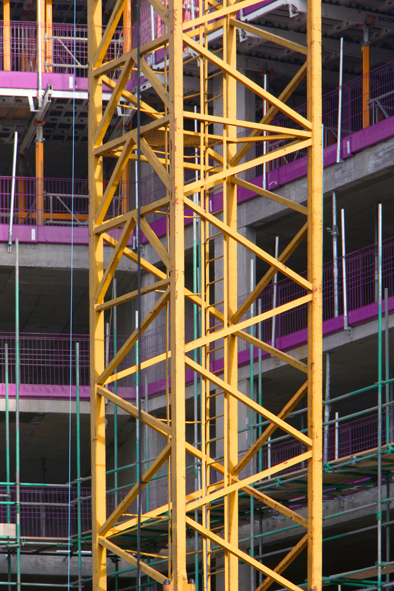
My perambulations around Leicester, to document its major construction sites, have extended ever further over the weeks, as the number of active locations has multiplied.  Strangely though, this one had completely passed me by until now - despite being on one of the city's main arteries - and fairly centrally, to boot.  Midlands sports nostalgists may be interested to know it's on the site of the old Granby Halls - adjacent to the Leicester Tigers rugby stadium.  It's also notable that, for once, the finished building will contain a hotel - and not the usual student hutches. 


Anyway, I suppose it's evidence of how easily one can become entrenched in habits, given that I stumbled across this site during only a slight deviation from my regular route to visit another one, fairly nearby.  The lesson is clear for any self respecting flaneur en velo; the city will always deliver new surprises - as long as one keeps taking left turns.


In its current state, the edifice itself clearly belongs in the same category as those featured in my recent 'Steels' post - but maybe relates to the 'Building With Colour' images too.  Over the months, I've been struck by how each of these sites seems to take on a particular chromatic identity (itself being something which can change dramatically, as the work progresses), and there's no doubt this one is currently 'The Yellow One'.  Long time visitors here will know that 'yellow things' have represented another of my enthusiasms, over the years.  Other than that, it's the customary tale of yet another section of urban sky becoming hatched-in by a complex angular tracery of girders and bare-boned staircases.  Lovely!


Wednesday, 22 July 2020

Pretty, Vacant 5


All Images: West Leicester, June 2020


It seems that the subject matter of most appeal to me, whilst out and about with my camera, currently falls into one of two conflicting modes.  As usual, everything emerges from my immediate surroundings, but I've noticed that it's generally characterised by either a distinct emptying of, or conversely - an ever-denser occupation of, physical space.

The latter is an obvious feature of my on-going 'Constructed City' work, and I've already highlighted how the frenetic urge to build, currently overtaking several key locations around Leicester feels like a conscious filling-in of both the city plan, and the visual panorama.  The building projects that have captivated me so much over recent months, are all large-scale, multi-storied undertakings, and rapidly grow to represent significant and un-ignorable interventions on the visual (and thus, psychic) environment.  Viewed from a distance, (in my case - as approached on two wheels, like as not), they generally betray a distinctly monolithic blocking-in of any vista they occupy.  However, closer inspection generally reveals a situation of overwhelming visual intricacy, complex geometry, and almost limitless abstract appeal.  With these subjects, more is definitely more, and (as I've already discovered) the challenges of translating that in final pieces are not to be underestimated.


But however much those concerns currently dominate my imagination, there is also an countervailing pull back towards the themes of vacancy and absence which characterised my work just a few years ago.  That's what these 'Pretty, Vacant' posts are about.  For all that the local landscape is impacted by multiple, often startling, emerging edifices, it's also host to numerous examples of vacant commercial premises and abandoned real estate.  There is a palpable emptying-out to be detected in numerous locations peppered across the city.


Just a few years (or even months) ago, such motifs  seemed to speak of the economic convulsions of our age, or to anticipate the potentially catastrophic effects of insular politics.  Typically, these would include a decade of post-crash Austerity, and the inevitable B-word.  But, of course, to that list we must now add the implications of our latest pandemic  catastrophe (the C-word - I suppose).  Regardless of how severely we may or may not have been individually affected by recent events, there's a distinct mood of loss stalking the world right now.  Whether through actual loss of life, or through the disappearance of livelihoods, the restriction of economic activity, or the shutting-off of civic and social life - there's a hollowing of what many still fondly think of as 'normality' abroad, right now.  For some, this may represent a perversely welcome opportunity to re-set - perhaps on a global scale.  For others, it may resemble the latest wave of a much greater, gradually unfolding Apocalypse.  For the majority, it might just be another in an endless catalogue of (hopefully) temporary inconveniences - to be endured, and adapted to.


Whatever one's position on all that (for what it's worth, my own shifts between all three - on an almost daily basis) the empty sites I keep stumbling over still feel like a very apposite symbol of our age.  As with several of the examples I've featured in this little series, I have no evidence that this showroom's current state is specifically virus-related.  As a former Triumph motorcycle dealership, it may speak more of fluctuations in that market, to which I'm not privy - not least because another bike merchant also disappeared from the local landscape quite recently.  However my chosen images have never been about capturing specific subjects for documentary reasons alone.  The specifics of the local landscape are an inevitable part of my photographic habit - that's true, but I'd like to think they are quite quickly absorbed into a more subjective process of capturing secondary themes and multiple potential readings.  In that sense, the images here seem to reach out, beyond the simple facts of their situation - perhaps to evoke the recent denuding of our collective day-to-day experience.


As I write, Leicester's particular difficulties continue.  However, there may be a weak sense of renewed hope, elsewhere in Britain - to accompany a reported levelling-off of the daily virus statistics (although why anyone would put much faith in the official statistics - I'm really not sure).  Hopefully, this is not too misguided a hiatus, in what may still prove to be a far longer-lasting situation.  Perhaps all the empty floorspace and blank windows will soon feel less appropriate as topically symbolic motifs.  I certainly can't predict any of that.  Whatever the case, I suspect I would always be visually drawn to such subject matter - regardless of which specific readings might be subsequently attached.  That might be purely for formal/visual reasons - I suppose, or perhaps I'm just a perennial sucker for the bleak and the melancholy.  In this instance, it occurs to me that one might just as easily meditate on the paradoxical thrill of the 'everyday', or the strange resonance of contemporary non-spaces (motorway services and airports being other closely-related examples, perhaps).  The essential resonance of the location would remain undiminished - I believe.  Meanings fluctuate, just as do commercial lettings, commercial use and public health.  And window reflections and beautifully cast shadows do too, of course.  

Such morphing and layering of possible readings is the real thrill of a Psychogeographic relationship with one's own environment, and will always be most heightened in the hive of a city - or so it seems to me.  Only time will tell which may feel most appropriate in this one, over the coming months.


Friday, 17 July 2020

Completed Painting: 'Untitled 3 (Constructed City)'


'Untitled 3 (Constructed City)', Acrylic, Screen Print & Paper Collage on Panel,
60 cm x 60 cm, 2020


Greetings from Plague Town!  I can't pretend Leicester's exceptional status, as the only British city to remain in strict(ish) pandemic lock-down, has impacted my own life too distressingly.  However, there is a palpable sense of frustration (and indeed, mounting anger) abroad, over the reckless behaviour and mismanagement that may have brought our local situation about.  Whatever the rights and wrongs of all that (as ever - I suspect the blame lies at several doors), It's frustrating to remain in a state of relative limbo, particularly as the rest of the country gropes its way towards something resembling rehabilitation.  Sadly, I doubt we'll be the only place to encounter such difficulties, before this whole sorry saga is over.  One can only hope something useful will have been learned from the mistakes made here (ha!) - not that the thought of being a test-bed for calamity is exactly comforting.


Anyway, as I say, my own existence remains relatively uncompromised - on a day-to-day basis, at least.  I had been going into work for a few days a week, over the last month, despite the fact that our school remained closed to the majority of students.  And there was some satisfaction to be gleaned from breaking the week up - and in regaining a partial sense of purpose in the outside world.  But that's once more on hold, given that, regardless of the lock-down conditions, we're now officially (if somewhat laughably) in the Summer holidays.  It feels fairly futile to try to predict exactly what awaits us in the 2020-21 academic year (besides more complications and uncertainty - no doubt), so for now, I'm a completely free agent, with only myself to answer to.  I really can't complain.  There are plenty of folk out there who'd give their eye teeth to be in this situation (and still getting paid).  And the answer - as ever, is pretty straightforward; just get on with some artwork.

So, in that spirit, here's the latest of my 'Constructed City' paintings to reach completion.  I've already described my slightly tentative entry into this particular phase of work, as reflected in the limited dimensions of the two panels previously completed.  This one is a little bigger (although still far from large), and represents an attempt to take some momentum from completing the two tiddlers.  Perhaps it's all in my head - but scale really seems to be an issue with these paintings.  I've yet to fully analyse exactly why, but it's clearly something to do with the size of individual marks and zones of colour as a composition becomes more complex.  Even at this modest scale, the simple act of doubling the dimensions of the panel's sides from 30 cm to 60cm, seemed to raise a whole new set of issues.


In fact, the basic composition was initially pretty close to both '1' and '2', making this new one much more of an evolutionary step than a radical leap.  And the theme of veiled geometry, which had already emerged, was deliberately carried over here too.  However, in this case, it became apparent that the simple expedient of dragging a translucent field of paint across a portion of the nearly-completed painting wasn't going to work quite so well.  And so the piece entered a somewhat extended phase of formal subdivision and over-painting of that central passage, before anything even vaguely resembling a satisfactory conclusion was reached.

In passing, it's also worth noting that this one includes an extension of the collage techniques already built into its predecessors.  As well as sections of some of my 'CC' screen prints, I was able to recycle some of the associated (and normally sacrificial) proofs - with a wash of indian ink applied over them.  That might seem a small thing perhaps, but it's always pleasing to devise a new method of covering some ground.  In this case, it's also justification of my belief that nothing is ever wasted.  Those proofs were originally laid onto notoriously unstable newsprint, so it'll be interesting to see how the painting ages. 


Anyway, if the final result is far more complex than originally intended, it' also represents a far more concerted process of problem-solving.  If I'm honest, I'm probably still not totally happy with the painting as a whole.  However, it does feels like some resolution was achieved - and that any unanswered questions are now best left for the next attempt.  And, actually, with hindsight, such pieces often prove to have been the most useful in any body of work.  Opening a whole new can of pictorial worms, even within a limited arena, is always more instructive, in the long term, than merely repeating what one already knows.

Onward...


Wednesday, 15 July 2020

'Constructed City' 16: Building With Colour


Main Images: West, North West, and South Leicester, May - June 2020


As I observed last time, my ever-expanding archive of construction-related photographs is inevitably categorising itself into various recurrent themes.  Here's a little bundle focusing on the often startling colours of a modern construction site.


Frank Auerbach, 'Oxford Building Site II', Oil on Canvas, 1960

Frank Auerbach, 'Shell Building Site', Oil on Board, 1959


Once upon a time, construction sites, or 'building sites' - as they were traditionally known, were places of drab, earth colours.  The materials used were almost wholly organic, or of mineral origin, and often (in Britain, at least) appeared to inhabit a world of churned earth - top-dressed with congealing slurries of cement or plaster and littered with debris.  The main concession to gaiety was that drab, pink primer (or possibly, its dull aluminium counterpart) often used on wooden frames, or perhaps, the begrimed, primary yellow of a back-hoe excavator.  Building work seemed almost to be a process of solidifying and shaping the same primary mud from which each new edifice was raised.  In my imagination, it's a world evoked by the early post-war construction site paintings of Frank Auerbach, whose extreme impastos of mangled paint seemed ideally suited to such subject matter
[1.].


The contemporary construction exists in a very different chromatic context.  It's usually one  characterised by far lighter tones, and a wide palette of, often highly saturated, synthetic colours.  The edges (and thus, the point of juncture between contrasting colours) all seem somehow sharper now, too.  In part, this is a reflection of the far wider range of artificial materials now employed, as well as the methods of their assembly.  A degree of traditional brick-laying, timber joinery, cement-pouring or surface-coating may still occur - to be sure.  But they now reside  within an overall process more akin to assembling a kit of pre-exiting parts [2.].  Many components of any new building - be they extruded, laminated, vacuum formed, or otherwise pre-fabricated (possibly even 3D printed nowadays - who knows?), arrive on site resplendent in a surprisingly vivid spectrum of self-coloured hues, metallic or translucent surface wrappings, and manufacturer's liveries.

Thus, a building in progress may now exhibit tangerines, lime greens, cerulean blues, sugar pinks and glittering silver - all juxtaposed within a few square metres.  Pipework, cabling, insulation materials, and plastics of all sorts, can be a particularly rich source of such materials - as typified by the pretty lilac hue prevalent in many of these shots.


Another important participant in all this is the temporary infrastructure of construction.  Safety barriers, barricades and access equipment all come in an ever more strident palette of primaries and saturated secondaries - un-ignorability clearly being one of their key functions.  Heavy plant, and the enormous lifting equipment towering over any large site, exhibit ever more brilliant colours these days, and, of course, the neon yellows and oranges of Hi-Vis workwear long overtook the wardrobes of construction workers, as safe practice and a general concern for well-being, overtook their industry.


In bright sunlight, a busy construction site is a far more garish environment than the urban landscape surrounding it.  For the reality is that many of these brighter hues disappear from the site as a building reaches its conclusion.  Insulation layers vanish behind more tastefully integrated final surface dressings.  The site is progressively denuded of brightly-painted kit, as it is readied for its unveiling.  In some cases, that final reveal may itself involve the removal of another layer of coloured wrapping.  New occupants will eventually arrive to inhabit the completed edifice, by which time the cavalcade of colour has transferred to a new location.


[1.]:  It should be acknowledged that, at the time those pieces were produced, Auerbach was limiting his palette for reasons of economy as well as aesthetics.  That quantity of paint doesn't come cheap across the entire colour chart, after all.

[2.]:  That distinction between 'building' and 'construction' seems particularly apposite, in this context.