Showing posts with label Coventry. Show all posts

Thursday, 24 June 2021

Sunday, 20 June 2021

Archi-Techno Excursion 001.3-exp: (Central Coventry, April 2021)


All Images: Digital Photo-Manipulation, June 2021


An evolving series of fairly rough-and-ready digital experiments - using source imagery collected on my spontaneous photo-derive around Coventry, a few weeks ago (as mentioned in recent posts).  In each case, Photoshop has been allowed to make at least as many decisions as I have myself (far more, in actuality).


Saturday, 22 May 2021

Archi-Techno Excursion 001.1 (Central Coventry, April 2021)


All Outdoor Images: Central Coventry, April 2021


It's normally the case that my art distills itself, in a fairly gradual manner, from some specific stimulus, out there in the physical world.  However abstracted, formalised or theme-laden things may become, the starting point is nearly always something recognised (and photographed) in the urban environment.  But, these images represent a kind of reverse-engineering of that process - relating to my recent, paper-based 'Techno Studies'.


'Techno Study 001', Mixed Media on Paper, 300 mm x 300 mm, 2021


'Techno Study 003', Mixed Media on Paper, 300 mm x 300 mm, 2021


As mentioned elsewhere, the primary trigger for those little improvisations was audio in nature - reflecting my relatively deep-dive into some of the more rigorous strands of Techno music, over  the last couple of months.  They continue to appear, largely intuitively, with no specific subject attached.  However, on reflection, there definitely appears to be an emergent architectonic quality to the imagery too.  Most of the studies do actually incorporate certain fragments of recycled, architectural imagery from unrelated printing ventures (nothing is ever wasted).  Therefore, whilst these have been primarily grabbed for formal reasons, a vestigial reference to the physical environment is probably inevitable.


Thinking about that, and also, in passing, about Owen Hatherley's books, 'Militant Modernism' [1.], and 'A Guide To The New Ruins Of Great Britain' [2.], I started to hanker after some immersion in slightly less familiar, hard-edged urban geometries than those I regularly encounter.  The most easily-achieved solution was to grab my camera and zoom up the M69 for an impromptu stroll around the glories of central Coventry, on a pleasingly clement Saturday afternoon in late April.


Hatherley, along with numerous other commentators (John Grindrod being an obvious candidate [3.]), often wax nostalgic about the rapidly disappearing Modernist environment of Britain's Post-War/Pre Thatcher years.  Indeed, Hatherley himself makes no attempt to disguise his own socio-political bias in mourning the lost opportunities of the period, and is often entertainingly scathing about the newer replacement buildings which increasingly dominate many British cities.


Whilst he may not dwell on Coventry specifically, it's impossible not to recognise that the city was, in many ways, an archetype of mid-century experimental redevelopment - having been heavily bombed by the Luftwaffe during World War II.  As in so many other places, the often neglected, or all-too-glibly despised buildings of the period are rapidly being demolished or remodelled (usually code for being painted or cheaply clad) - regardless of whether they fit the category of good, bad, or indifferent.  As ever, it seems the British prove themselves more than adept at chucking out the baby with the bathwater, culturally speaking.  It would certainly seem to be Hatherley's contention that what often replaces them is generally blander, more dispiritingly expedient, or quite simply -  philosophically/economically pernicious.


I can't pretend I don't share at least some of his prejudices - be they ideological or aesthetic.  I'm far more likely to be found savouring the bleak ambience of some dank multi-storey car park, or photographing the grubby interstices of a stubbornly lingering Brutalist 'masterpiece', as contemplating arcadian landscapes.  And my shelves hold just as many examples of more or less left-leaning literature and nominally Hauntological music as the next disillusioned 50-something, white male.  Every new pile of reinforced concrete rubble, and freshly cordoned-off 'development opportunity', skirted around in some Midlands city, can be all-too-easily read as yet another triumph of market Capitalism over yesterday's vague attempts at Social Democracy - I find.


And yet, I'm equally aware that nostalgia can also be a pretty self-defeating trap for the unwary  the ageing, or the politically bereft).  All that hankering after lost futures and failed Utopias can certainly be a pretty seductive alternative to actually engaging with the future (be it societal or personal) in any more constructive manner.  Melancholy or despondency can become pretty comfortable refuges.  Let's face it, a relish for some eroding facade or generally entropic locus, is an unmistakable trope in my own work - just as it is in that of many others.  And I occasionally wonder if we might not be enjoying all that dystopian collapse a bit more than is necessarily healthy.  Owen Hatherley might use the term 'Ruins' to disparage a paucity of Promethean vision or economic sustainability in contemporary architecture, but let's not pretend that the decay of many of the edifices he might champion doesn't often make for a thrillingly catastrophic spectacle all of its own.  We must also recognise (however reluctantly) that many folks may genuinely prefer the superficially shiny, homogenised and new, over some forbidding monument to rueful decline, where matters of architectural taste, or preferred lifestyle, are concerned. 


Any good (Post) Marxist will tell you Capitalism contains the seeds of its own destruction.  However true (or desirable) that might seem - surely the ideologies of the Left also contain more than enough potentially fatal flaws of their own.  If, (as history surely demonstrates), it is the fate of all Revolutions to implode, or all Utopias to disappoint - must not a palpable and perpetual sense of loss not actually become the inevitable default?  Might a sense of 'failure' not become just as much of a delectable addiction, as all that hankering after unsupportable 'success' ? (I'm not sure anyone really believes in 'progress' any more - do they?)  Could it be that the futuristic thrill that once attached itself to Coventry's more daring Post-War buildings, during my family's occasional visits in my 1970s childhood, has been replaced by a different (if no less delusional) one - now that they await re-cladding or total erasure, like  the decaying relics of some recently-departed alien civilisation?


Ultimately, I'm not sure if my current run of modest little studies (or the relative spontaneity with which they have so far emerged) can really support the weight of so much cod-philosophising.  An unrelenting 4-4 beat and a few concrete facades can only get you so far - surely?  So perhaps it's much simpler to just focus on the aesthetics instead.  Whatever strands of thought may (or may not) have been spooling through my brain as I limped around Cov. - there can be no doubt that the images I harvested do reflect my perennial enthusiasm for formal geometry and compositional rigour in their own right.  And clearly, not everything glimpsed here is strictly 'of the period'.  The crisp new lineaments of a re-modelled tower block can supply just as many potentially imitable repeating grids as some crumbling old concrete fortress - it should be noted.  On the day, that (along with the Surgeon album I played loudly on the drive home [4]) was probably more than enough to be going on with.


[1.]:  Owen Hatherley, 'Militant Modernism', Ropely, Hants, Zero Books, 2008.

[2.]:  Owen Hatherley, 'A Guide To The New Ruins of Great Britain', London & New York, Verso, 2010

[3.]:  John Grindrod, 'Concretopia: A Journey Around The Rebuilding of Postwar Britain' London, Old Street Publishing, 2013.

[4.]:  Surgeon, 'Basictonalvocabulary', Tresor, 1997.  Re-released, as part of the box-set: Surgeon, 'Tresor 1997-99', Tresor, 2015. 


Sunday, 9 May 2021

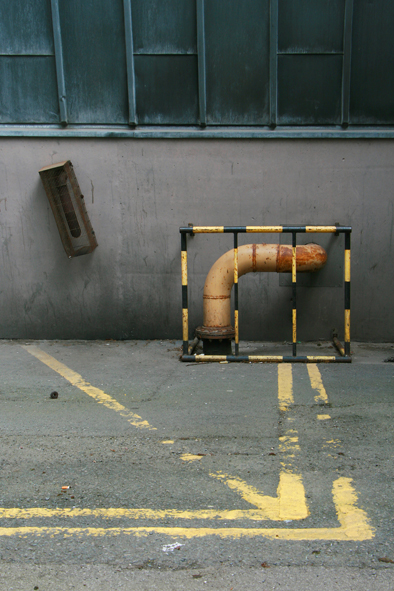
Significant Yellow Item: #2021.Y010


Significant Yellow Item: 2021.Y010, Central Coventry, May 2021


Here, a small section of the city's biology is left exposed, twisting through ninety, and ninety again.  Tender vulnerability is cordoned within a guardian wasp-geometry - drawing only attention.  An exclusion zone extends on the diagonal.  Diverse angularity dominates throughout.


Transcending small debris, and the creep of oxides, the defining edges remain crisp here.  A remarkable calm prevails behind the scenes.  Soft light seeps from the reverse of a disregarded future.  The elephant-memory will not prevail.


This is a detail to cut-out and keep.  I might linger for a considerable term here - welcome seclusion within a small fold of time. 


Tuesday, 30 December 2014

…And The Day After


Washingborough, Lincolnshire, December 2014


We had a little fall of snow on Boxing Day evening this year.  It was a few hours too late to allow for much sentimentalising over white Christmases, and didn’t hang around very long, - at least where I was.  Nonetheless, this being Britain, a few centimetres of the white stuff quickly became inflated in the media imagination into a major weather event.  There were numerous weather and travel warnings, shading into implications of infrastructure breakdown and societal collapse.  Apologies to anyone who may have experienced the odd closed road or cancelled bus service, or who may have lost control on a slippery road, but really I’m baffled by how easily we get ourselves into a national tizzy about so little in this country.  Like most Brits, I retain a race-fascination with the weather, but this affected mild helplessness is something else again.


Washingborough, Lincolnshire, December 2014


Anyway, it was pretty enough for a few hours on 27 December, and I'm always intrigued by how a fall of snow can affect the quality of illumination and general appearance of the most familiar surroundings.  Finding myself at my parental home, just outside Lincoln, I took a couple of shots of melting snow in the placid housing estate where my Mother and Stepfather live.  I won’t pretend this is normally the most stimulating environment, (visually or otherwise), but after its dusting of snow, I was immediately reminded of George Shaw’s lovely painting of a similar situation, ‘Scenes From The Passion: The First Day Of The Year’.


George Shaw, ‘Scenes From The Passion: The First Day Of The Year’, Humbrol Enamel
On Board, 2003.


I’ve outlined my enthusiasm for Shaw’s work before, and always respond to his ability to mine a rich vein of melancholy visual poetry within the mundane surroundings of his childhood home in Coventry’s Tile Hill.  I don’t have the same emotional memory-connection with my Mother’s current home, so this time it was really a case of reality taking on greater resonance through the imitation of Art.


Ermine Estate, Lincoln, (Photographer Unknown)


Coincidentally, I'd earlier taken a little car journey of reminiscence around Lincoln’s Ermine Estate, on the city’s northern fringes.  The Ermine is a post-war housing development with a certain nostalgic resonance for me, being a place I, and my friends would often wander around aimlessly during our Secondary School lunch breaks.  We were searching for some undefined excitement beyond the school gates I suppose, but never really found it.  Strangely though, for all its suburban blandness, the estate always had a sense of slightly alien potential in my mind, - a frisson of stimulating unease.  Perhaps, I should undertake my own visual exploration of that peripheral territory of the imagination some day.


Wednesday, 6 August 2014

Time Tunnels 1


I often mention my fascination the processes of decline, regeneration and transformation that exert themselves on the fabric of any city.  Despite the best intentions of politicians, planners and developers, no living city is ever the finished article.  The laws of politics, economics or physics, and not least the unpredictable vagaries of human nature, dictate an organic situation in which shifting circumstances bring renewal to one section of a city, just as another undergoes a period of decay.  It’s this tension between clear intention and apparent randomness that fascinates me most about urban life.


It interests me greatly how, as one passes through different, (often adjacent), iterations of a city, it’s possible to interpret something of the competing assumptions that have shaped it.  I’m thinking here less about mere architectural style and more about the way that changing attitudes or philosophies (on a societal level), influence the sculpting of physical spaces - in turn dictating the way that life is lived and perceptions influenced within them.  That last part, (about perceptions), is, naturally, of particular interest to me.  One aspect of this I’ve noticed is the apparent ‘flattening out’ of hitherto multi-layered physical environments which seems to be a current trend in urban (re)development.


Despite a childhood spent amongst the picturesque historical surroundings of Lincoln, the wider Britain into which I was born was that of the Post War consensus and the supposed utopianism of the planned Modernist environment.  With the Luftwaffe having already made a pretty good start in many places, the desire to remodel large areas of Britain’s towns and cities in accordance with newer, (post Bauhaus/Le Corbusier) experimental attitudes was pretty urgent in the years between 1945 and my birth in 1962.  It was still the prevailing trend, (if noticeably running out of steam), up to the end of the 1970s, when a very different, market-driven zeitgeist really kicked in.


As a child, I remember the slightly futuristic impressions gained from our occasional family visits to more major towns.  These included Sheffield, with its immense Park Hill housing rampart and dramatic ‘Hole In The Road’, where shoppers passed below the circulating traffic; or Coventry, with its dramatic new Cathedral and somewhat space-age conjunction of intertwining ring roads and unapologetically angular architecture.  The separation of different activities into multi-layered strands was characteristic of all this, (of which the underpasses and pedestrian subways that particularly fascinate me just now are key signifiers).  It’s still illustrated by numerous vestigial portions of the Midlands towns I still haunt, such as Leicester’s inner ring road flyovers, and numerous portions of Birmingham’s city centre [1.].  Further glimpses can still be seen around Nottingham’s Boadmarsh  Shopping Centre [2].


I thought about all this again recently, as I filled a few spare minutes taking these photographs around Birmingham’s Five Ways junction.  As in so many similar locations, the plan here was to separate pedestrians from traffic by directing them beneath, through subway tunnels, here connected by a central, sunken realm at the heart of the massive roundabout.  It typifies that attitude of strict control toward separate modes of transport and activity, and resulting heavily designed and engineered solutions, that prevailed in the Modernist vision of town planning.  Like so many such solutions, it is intrinsically logical and certainly utilitarian, but perhaps compromised in terms of its assumptions about technological ‘progress’ and, more interestingly perhaps, human psychology or behaviour patterns.


As in so many such locations, it’s the physical dilapidation and clear neglect evident at Five Ways, which testify to the changing posture of our society toward both them and the theoretical frameworks they symbolise.  The fact that in recent years I have personally witnessed the filling-in and leveling out of at least two pedestrian subway systems, and the total removal of one of the city’s landmark flyovers, suggests that a very different attitude to the interaction of traffic, pedestrians and the urban environment currently holds sway.  Certainly, it appears that, to a greater extent, things are being brought back together on the same level, in a manner that seems less about imposing a variety of ‘freedom’ through idealistic prescription, and more about encouraging people to navigate their environment in slightly more opportunistic ways.


I guess I could be drawn ever deeper into discussion of how all this reflects current ideas about how cities are used by people, attempts to regulate the assumed primacy of car transport, or indeed, the economic and political drivers which control all aspects of our everyday life.  However, as usual, I fall back into focusing more on the sites that capture my imagination as evocative situations in their own right.  All of the above certainly informs my response to such places, but also reflects the way a designer might think.  I am an Artist, and I do believe there is a distinction in the two ways of thinking.  Mine is, ultimately, a subjective response to the world as I find it, more than an attempt to shape it according to any particular set of precepts.


Those theories, associations and socio-historical insights are of great potential interest to me, but always remain secondary to my subjective experience of any meaningful situation.  I can’t pretend I’m not drawn to the strange, squalid glamour of subways and urban road systems with a kind of vaguely deviant thrill, far more than any desire to analyse how the environment might be ‘improved’, [3.].  Thus, I’m prone to hanging around such places with my camera, before they’re all leveled or filled in, to the bafflement of passers-by who might prefer not to use them at all [4.].  That essentially poetic sensibility is perhaps reflected by the fact that, as usual, at Five Ways, my lens was increasingly drawn into close-up contemplation of details and poetic surfaces, in preference to the overall layout or wider topography.


All Images:  Five Ways, Birmingham, August 2014


Since taking these shots in Brum, I’ve collated a load more, taken in a couple of favourite subterranean locations in Leicester.  Therefore, I’ll continue this meditation on subways in a subsequent post in the near future.


[1.]:  Not to mention its peripheral ‘Spaghetti Junction’ motorway intersection.

[2.]:  Another childhood destination.  These trips were often about my Mother’s search for shopping experiences not available in Lincoln.  Coventry was, however, a search for a kind of modern culture fix in the new cathedral, our own being resolutely and spectacularly Medieval.

[3.]:  I’ll admit it, - I’m as susceptible to a bit of ‘ruin porn’ as the next Psychogeographer.

[4.]:  Interestingly, while photographing and filming beneath Leicester’s recently demolished Belgrave Flyover, I had many conversations with passers-by bemoaning its imminent removal.  This may be in part due to the locals’ renowned resistance to change, but some spoke with genuine affection towards it as a neighbourhood landmark.


Saturday, 15 March 2014

Grayson Perry: 'The Vanity Of Small Differences' And 'New Art West Midlands' At BMAG


Grayson Perry, 'The Annunciation Of The Virgin Deal', Digital Tapestry, 2012, (Detail).


I seem to be pretty much living in art galleries at the moment, so it was no surprise to find myself walking into Birmingham Museum & Art Gallery yet again, the other day.  This time I even got paid, as I was accompanying a group of GCSE students, from the school where I work, on their trip to view the exhibition, ‘Photorealism: Fifty Years of Hyperrealistic Painting’.  I’d already spent some time with that show, (and reported on it here, at some length), so stationed myself near the nearest main exit as ‘back stop’, for the first part of the visit.  However, once the students emerged to explore the rest of the building, I got the chance to take in a couple of other attractions at the same time.


Grayson Perry:  ‘The Vanity Of Small Differences’.


Grayson Perry, 'The Adoration Of The Cage Fighters', Digital Tapestry, 2012


Many people in Britain will have seen Perry’s entertaining TV programmes about the mores of taste within the British class system [1.].  If the subject seems like an easy target, it should be remembered that class-consciousness still casts a massive shadow over British life, and Perry deals with the matter entertainingly but without condescension, generally.  He is indeed a regular and amiable presence in the British media, and I’ve already discussed his delivery of the '2013 BBC Reith Lectures'. It might be easy to dismiss him as a Media luvvy, but he is, above all, a working artist with a recognisable sociological agenda, as well as an obvious mission to communicate.  His cheerful, public embrace of a somewhat unusual brand of transvestism, (even by normal cross-dressing standards), is both psychologically revealing, and evidence that his fascination with the intricacies of social display goes beyond the merely voyeuristic.


Grayson Perry Dresses Up For A Night Out With The Girls In Sunderland.


This show provided an opportunity to view the six large-scale tapestries that Perry designed as the culmination of his project, alongside the TV shows and evidence of the research and development phases that support it all.  The three broadcasts each dealt with one of the traditional class divisions within British society, Working, (a label possibly now in need of reinterpretation), Middle, and Upper, (be it old aristocracy or new money,), but that model is, as Perry points out, too rigid and simplistic a way to view the matter in reality.  Instead, taking Hogarth’s 'Rake’s Progress’ as his inspiration, (and transforming the original protagonist, Tom, into his own Tim Rakewell), he depicts our hero’s progress through the competing tribes and shifting strata of British society and the complex distinctions and contradictions that characterise them.


Grayson Perry, 'The Agony In The Car Park', Digital Tapestry, 2012, (Detail Below).


Perry posits Tim as a bright, Working Class lad from Sunderland who, through diligence, education and aspiration, achieves success and wealth as a software tycoon.  He eventually acquires the trappings of a quasi-aristocratic lifestyle but ultimately crashes his Ferrarri, to die in a street in the homogenised, media-fixated, (and supposedly classless?) landscape we all increasingly inhabit.  If the six finished pieces could be said to fit nominally into the three basic social groupings, they also demonstrate how it is through their overlaps, and the subtle nuances within each, that the true story of contemporary social taste and expectations lie.  This is most fully appreciated whenever aspiration is given free rein or some degree of social mobility is achieved.  Borrowed from Freud [2.], ‘The Vanity Of Small Differences’ proves an apt title indeed.


Grayson Perry, 'Expulsion From Number 8 Eden Close', Digital Tapestry, 2012

Grayson Perry, 'The Annunciation Of The Virgin Deal', Digital Tapestry, 2012


There is far too much content in the six tapestries to start listing their subject matter in detail.  However, I would mention the messianic Social Club singer; complete with crucifix-like shipyard crane, meat raffle and car park boy racers, from ‘The Agony In The Car Park’, as particularly memorable.  Its sense of guileless sentimentality and tribal communality suggest that traditional Working Class ties are as deeply rooted and proudly felt as any.  I’m also rather taken with the setting for Tim’s demise in ‘♯ Lamentation’, with its petrol station, McDonalds and retail park.  It seems ironic that having climbed so high, Tim should be brought back to earth amongst the signifiers of Global Capitalism, (paradoxically, a great leveler of taste, - even as it magnifies inequality).  To close one’s eyes for the last time on such sights seems almost too cruel.


Grayson Perry, 'The Annunciation Of The Virgin Deal', Digital Tapestry, 2012, (Detail).


I think it’s fair to say that the various elements of the project, including the research phase, (or ‘Taste Safari’), the broadcasts, and the finished tapestries themselves, all play an equally important role in the overall project, demonstrating the importance of working across various platforms for many artists today.  It might also be argued that the different stages involved actually reflect the content rather cleverly.  TV is still often regarded as passive entertainment to distract the lower classes.  Research and study, (including an extensive process of drawing), might represent the process of achievement and betterment through learning and hard work.  The Tapestry is itself a traditional status symbol of the Wealthy, once being immensely expensive and labour intensive to produce, but also redolent of the elegant decay with which we might associate old aristocracy.


Grayson Perry, 'The Working Class At Bay', Digital Tapestry, 2012, (Detail Below).


Perry’s use of modern CAD/CAM techniques to realise his final pieces adds another interesting layer of context, both in further investigating the relationship between traditional craft and contemporary art, prevalent in all his work, and in symbolising how digital technology has become a significant driver of 21st Century social mobility, and transmitter of social mores.  Whilst still not cheap to produce, most of the labour and time in a digital tapestry is now spent preparing the digital files, with all that implies about artisanal status.


Grayson Perry, ‘♯ Lamentation’, Digital Tapestry, 2012


I’m impressed by the way Perry pulled off his complex compositions, packed with wonderfully observed details and clues.  If some of these seem stereotypical at first glance, it should be remembered that he observed everything first hand, during his research trips to Sunderland, Kent and The Cotswolds.  Are such clichés, clichés for a reason, or just inherently self-perpetuating?  I can also appreciate the way he has incorporated various art historical and quasi-religious visual quotations from Renaissance paintings into his composite images.  Perry wryly points out that this is a deeply Middle Class thing to do, whilst illuminating how the construction of a class-based taste identity is as much an act of faith as the religious frameworks within which all social assumptions once operated.


Grayson Perry, '‘♯ Lamentation’, Digital Tapestry, 2012, (Detail).


The concerns and modes of Grayson Perry’s work are a world away from my own, and his ‘not-really-naïve’, cartoonish, figurative style and narrative approach are unlike anything I have attempted myself, or am ever likely to.  Nonetheless, I do find his work both engaging and thought provoking.  Above all, there’s a lot of fun to be had from viewing our tribal eccentricities in his tapestries, just as there was in viewing his TV shows.

Grayson Perry, 'The Vanity Of Small Differences', continues until 11 May 2014 at: Birmingham Museum & Art Gallery, Chamberlain Square, Birmingham, B3 3DH.


‘New Art West Midlands.’


‘New Art West Midlands’ is a group show of work by a selection of recent graduates from Birmingham City, Coventry, Staffordshire, Wolverhampton and Worcester Universities.  It is actually part of a programme of exhibitions spread around a number of regional galleries, and it would take quite an effort to get round the whole thing, I suspect.  I may try to visit more of it at some point but, for now, had to be satisfied with a brief scan of the work on show at BMAG.  Such shows are inevitably a mixed bag and I didn’t have time to really find out what was going on with a lot of the work in depth.  However, two artists did stand out as being of real interest at first glance.  Both are painters, which says something about the power of immediate visual arrest characteristic of the medium, I suppose.


Santhanha Nguyen:  Nguyen is a skateboarder who uses her chosen means of transport to explore abandoned or out-of-bounds urban spaces.  Her painting ‘13’ (2012), appears rather traditional in its loose(ish) handling, veils of fluid oil paint and earthy palette; which is actually refreshing as an alternative to the predictable post-punk or wild style tropes usually associated with that scene.  It depicts the abandoned top deck of a multi-story car park, closed under H&S regulations (!) after becoming a favourite suicide venue.


Santhanha Nguyen, '13', Acrylic On Board, 2012


To be honest, much of the interest in the piece may lay in that knowledge, but Nguyen does convey something of the detached desolation of the location, predominantly by building her composition around a wide expanse of nothing very much.  She claims Casper David Freidrich as an influence, but I was also reminded of George Shaw’s ‘Back Of The Club 2’ (2001), which also dares to focus its attention on bleak architecture and a tract of empty tarmac.


George Shaw, 'Back Of The Club 2', Humbrol Enamel On Panel, 2001


Nguyen’s art practice, and her involvement with skateboarding, clearly overlaps with the concerns of other subcultures such as Urban Exploration and Parcour.  All attempt in some way to redefine our relationship with urban spaces and to interrogate the systems of power and access control applying to them.  I am also reminded of the recent dispute between the skateboarders of London’s South Bank cultural complex, and the architects and planners keen to clean up the organic, unofficial aspects of its terrain in favour of yet more bland ‘retail opportunities’.

James Birkin:  The influence of George Shaw seems even more overt in the painting of James Birkin.  He also derives subject matter from apparently mundane locations in Coventry, and I was immediately drawn to his depictions of the city’s disused ‘Mustard’ nightclub.  In ‘Seating Booth’, ‘Office’ and ‘First Floor’, (all 2013), he employs a slightly naïve brand of Photorealism to depict the desolation, and squalor of the club’s abandoned interior spaces, focusing particularly on the tawdry décor, superficial damage, and the accumulations of detritus that lend the place a Marie-Celestine quality.


James Birkin, 'Office', Acrylic On Canvas, 2013


Birkin works from flash photography and does manage to evoke the strange, artificial objectivity of such illumination in his paintings.  There’s something affecting about the shabby incongruity of such nocturnal leisure zones viewed under functional white light, and his chosen method pushes this even further.  In fact, paradoxically, the apparent prioritisation of factual investigation over subjectivity, creates a particular set of atmospherics all of its own.


James Birkin, 'Seating Booth', Acrylic On Panel, 2013


These slightly wonky attempts to faithfully describe the subjects’ complex detail reminded me of Shaw’s own faltering early attempts to master Photorealist methods.  I wonder if this is a conscious strategy or simply indicates a young painter still striving to refine his chosen style, and also, if it would be going too far to see signs of a nascent ‘Coventry School’ emerging in Shaw’s wake?  I had paused to view one of the latter’s refined mature works, just the previous day, at Cov’s Herbert Gallery, and noticed the garish exterior of ‘Mustard’ on returning to the car.  That, and the presence of the ‘Photorealism’ show, downstairs at BMAG, makes me reflect that, often, the more you see, the more things connect up.

'New Art West Midlands' continues until 18 May 2014 at: Birmingham Museum & Art Gallery, Chamberlain Square, Birmingham, B3 3DH.  Also at other regional galleries, (dates vary).


[1.]:  Grayson Perry, ‘All In The Best Possible Taste’, Channel 4 Television.  Three Episodes.  First Broadcast: 05 June, 12 June, 19 June 2012.

[2.]:  “The phenomenon that it is precisely communities with adjoining territories, and related to each other in other ways as well, who are engaged in constant feuds and ridiculing each other.”  From:  Sigmund Freud, ‘Freud Library Vol.12: Civilisation Society And Religion, Group Psychology, Civilisation & Its Discontents, And Other Works’, London, Penguin, 1987.