Wednesday, 9 October 2013

Bradley Garrett: "Explore Everything' / Terminological Amendment


As I’ve routinely outlined, much of the source material from my artwork, (both visually and conceptually), comes from my wanderings around various cities with a camera.  It’s an ongoing activity that I try, perhaps rather grandly, to ally with the respective spirits of Psychogeography, Flâneurism or The Situationist Dérive.  In reality, it may be no more than the routine search for environmental/contextual stimulus that could be expected of any artist, but I hope there are certain attitudes of mind brought to my excursions that ally them, at least partially, with those theoretical traditions.

Whether carried out on foot, by bike or car, or indeed any other available transport means, I’ve been in the habit of referring to all this as ‘Urban Exploration’.  However, last month I read an article, leading in turn to a little further online research, which makes me think I should adopt a different term for my activities.


Robert Macfarlane's Own Hero Shot.  Photo: Bradley Garrett


The article, written by Robert Macfarlane for The Guardian [1.], was essentially a promo for a recently published book by American hipster academic and urban adventurer, Bradley Garrett.  Garrett’s book, ‘Explore Everything: Placehacking The City’ [2.], is the culmination of his own PhD studies and participation in what others were calling Urban Exploration long before I ever adopted the label.  In this context, we’re talking about those intrepid, adrenalised trespassers who mount planned incursions into abandoned industrial ruins, drainage and transport systems, construction sites, disused military installations and any secret place where access or free passage are restricted.  I was well aware of the phenomenon, but hadn’t appreciated just how widespread, (indeed global), an activity it had become.  In the article, Macfarlane even goes beyond the normal scope of a book reviewer by allowing Garrett and his associates to conduct him in a little underground expedition of his own.


Photo: Bradley Garrett


There’s a fairly obvious extreme or street sports aspect to all this and not a little of the high-fiving and whooping rad-dudery that often characterise those worlds, (although it’s clearly not an entirely male culture).  Many ‘Urbex’ trespasses take place in filthy, dark, dangerous and physically demanding locations and the macho skills of spelunking, climbing, orienteering and sprinting, (to evade security), can all be called upon.  Experience, research and careful pre-planning are essential.  Injury and possible long-term ill health are obvious risks and there have been occasional deaths. 

However, behind the hardcore bravado are a number of intriguing theoretical or psychological impulses behind these attempts to hack or subvert the highly prescribed/proscribed urban environments most of us now inhabit.  There is an implied testing of how much freedom of movement remains to the average citizen and also of the tricky issues around private and official control of once public spaces.  ‘Urbexers’ pose an overt challenge to the boundaries between legal and civil trespass and the (often unexplained) presumption of secrecy that pertains to so many sites.  For some, clear political agendas run through the subculture as a whole.  They may seek to uncover the possible (or imagined) conspiracies of silence, exploitation or sinister activity attached to certain sites or illuminate, (quite literally), how marginalised populations are forced to live rough or actually underground in a city’s hidden zones.  Elsewhere, they may simply claim the right to access a panoramic view or vantage point that has been annexed for profit, (it costs £25.00 to view London from ‘The Shard’s’ summit).


Photo: Bradley Garrett


For others, the motivation appears more involved with a very human desire to simply explore the hidden rather than any specific political impulse.  They take a delight in peeling back the multiple layers of urban geography to discover what lies beneath, (or indeed above), and seek out a vertical as well as horizontal reading of the built environment.  This reflects a desire to understand the physical systems and infrastructure that make a city function, (underground railways, drainage, etc.), but inevitably leads also into reading the chronological strata that constitute it, (wartime remnants, industrial archeology, abandonment, earlier incarnations, past lives, etc.).  Wherever the emphasis is placed, I think there is an unmistakable Psychogeographical impulse behind the phenomenon of Urban Exploration.


Photo: Bradley Garrett


There’s an essentially benign anarchy to it all too, coupled with a refreshing impulse to intrude non-destructively.  The general attitude is one of simply occupying and witnessing a site for the sake of simply being there.  In contrast to those who seek to alter, damage or ‘decorate’ forbidden locations, most Urbexers are content to simply ‘be’ in a place then document their discoveries in photographs and videos.  Where a gesture has been required, hanging a removable banner or posting visual evidence and ‘hero shots’ on web forums have generally been sufficient.  This process of routine visual chronicling and a delight in the physical appearance of generally overlooked or transitional places is of obvious relevance to my own creative habits.


Photo: Bradley Garrett


A major, inescapable connection is the theoretical legacy of The Situationist International. Desires to short-circuit the prescribed street plan, to experience the city with immediacy and subjectivity, or to sample experiences beyond the mere surface of things, are essentially Situationist in nature.  This is true, be they political or artistic statements or just strategies to experience one’s surroundings more fully.  Urban Exploration takes its place, alongside Graffiti and Street Art, Happenings, Pop-up or Flash Mob gestures, and the tented encampments of the Occupy movement, as they ripple out from Paris, 1968 and the wider Debordian moment.  Above all, it is an explicit attempt to access a grittier, more vivid reality, however grimy or hazardous, behind the slick corporate facades and hypnotic, pixelated imagery of the Capitalist Spectacle.


Bradley Garrett: Underground Academic


Although his primary focus appears to have shifted, Bradley Garrett himself has been an enthusiastic participant in Urban Exploration.  He was particularly associated with the London Consolidation Crew, - infamous for visiting every one of the London Tube network’s disused ‘Ghost Stations’, and for their climb to the top of the unfinished ‘Shard’ tower.  ‘Explore Everything’ is his account of those years and the exploits and ultimate demise in the face of legal action, of the LCC.  If he exhibits a typically American self-confidence and bushy-tailed desire to make each year more memorable than the last, (which could get a little tiring, I fear), he also brings a serious academic intent to the subject as his websites demonstrate.  Whilst the www.placehacking.co.uk site is now archived, www.bradleygarrett.com remains fully active and covers the whole field of his studies as a Geographer and Ethnographer, as well as accounts from the Urbex front line.  Both sites are full of his vivid photography, insightful writing and links to impressive video work.  Particularly recommended among the latter are, ‘Crack The Surface:Episode I’ and ‘Episode II’ and ‘Urban Explorers: Quests For Myth, MysteryAnd Meaning’.  Whilst the first two showcase many of the scene’s prime movers and shakers in action, the latter provides fascinating reflections on it from various academic viewpoints.

Even in my prime, I never had the physical prowess or reckless courage demonstrated by Garrett and his contemporaries and remain essentially risk-averse where physical jeopardy or legal action are concerned.  Nevertheless, in my own cowardly way, I fully understand the curiosity that can lead one to poke the camera lens where it may not always be welcome in search of alternative readings of a city.  I’m fascinated by these bulletins from travellers into regions I might not dare enter myself but really don’t think I can continue to apply the term ‘Urban Exploration’ to my own more sedate, (but hopefully, creatively valid), excursions.  Perhaps, from now on, ‘Urban Observation’ or perhaps ‘Urban Documentation’ will have to do instead.


Postscript:

From reading Bradley Garrett's own blogging, I know he is, (slightly ironically), very protective of his own intellectual property.  I hope he'll accept my appropriation of his images here in the spirit it is meant, (as a celebration of his work) rather than any kind of money making rip-off.


Tuesday, 8 October 2013

Lighting Up Time


These  images complete the story told in my last post, and the one before that.


They were taken at the end of the day as the light faded.


We went in search of a misplaced Utopia...


...and found ourselves in Paradise...


...as travellers raced towards the mouth of Hell.


Monday, 7 October 2013

Biblio-Tech: The Library Of Birmingham


Library Of Birmingham, September 2013


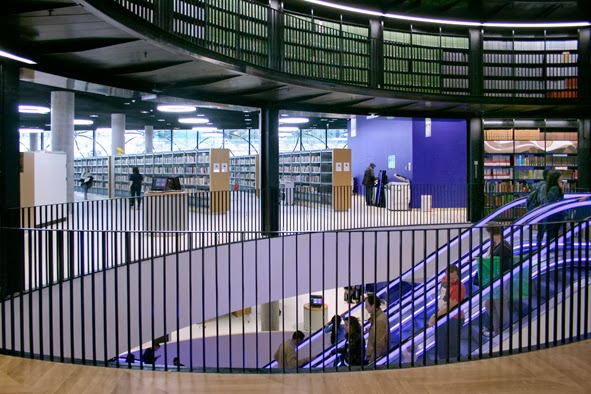
Having already written about the most recent two-wheeled foray along the canal towpaths of Birmingham, this post covers what happened when we got back into town and, in particular, some impressions of the spectacular new Library Of Birmingham.  Designed by architects, Mecanoo and engineers, Buro Happold, the library has been shaping up as a major landmark for some time [1.] but it was still a revelation to see it completed, in it’s own space, and free of the builder’s clutter of its construction phase.  Dave, my cycling companion, had already visited the building once and described its impressive internal spaces and upper terraces with their views over the city.


Library Of Birmingham, September 2013


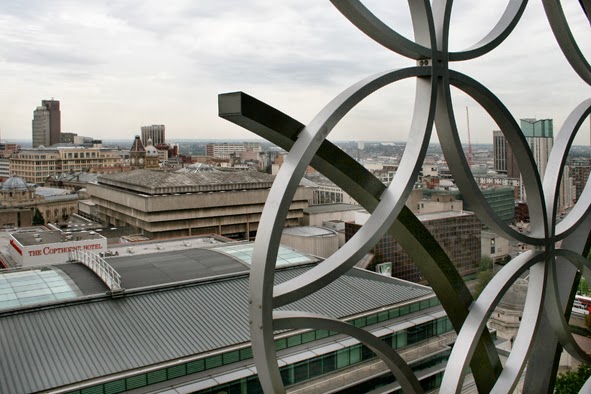
However, the first impression, on approaching the building, is of its dramatic exterior, comprising a massing of simple monumental forms, enveloped in a complex lattice of interlocking metal rings.  As with the Nottingham Contemporary gallery, this decorative detail is a conscious reference to the city’s industrial traditions, (in this case, of metalworking and jewelry manufacture).  Like that building, the library also features significant areas of the gold-coloured cladding that seems so popular with the architects of such projects these days.  Neither building is exactly elegant but both are striking and make a clear statement of cultural and civic intent.


Library Of Birmingham, September 2013


In Birmingham’s case this is on a grand scale and it cheers me that something as woefully undervalued these days as a library, has received such a self confident treatment.  I suppose one could cavil at such an extravagant and official  ‘top-down’ gesture, or accuse the library of merely contributing to the overall stock of cultural spectacle.  Nevertheless, situated so close to the temples of consumerism and capital in Birmingham city centre and the anesthetic weekend Babylon of Broad Street, this is at least a place anyone could go to find out for free what all this talk of ‘Spectacle’ is all about in the first place.


Library Of Birmingham, September 2013


I’m also sure many naysayers will criticise Birmingham’s civic leaders for spending public funds so lavishly on something as supposedly outmoded as a public library.  These are probably the same people who are happy to see ever greater amounts of public provision slip away into the hands of private interests or who would have us all sofa-bound, staring mutely into tiny screens, whilst tidbits of infotainment are drip-fed to us by what amount to online global advertising companies.  Instead, whilst there will no shortage of digital portals in the new library, there are opportunities to access information and resources in various ways, (including the National Film Archive).  This is a two way street in terms of its own online presence.


Library Of Birmingham, September 2013


The physical space looks large, (and hopefully flexible), enough to accomodate changing future usage, and includes a café, children’s play area, gallery and performance facillities.  This is far from a traditional book depository and much more of a people’s palace of enlightenment.  Beyond its obvious functions, it’s a place one might drop into for a coffee or an impromptu meeting, to read, get on with some work or just hang out at the heart of Brum’s ‘cultural offer’.  Of course, much will hinge on whether the council can maintain at least some of its local library provision alongside the new flagship, but if the people of Birmingham can’t make good use of all that, we might as well just give up on this country altogether.


Library Of Birmingham, September 2013


Once inside the building, the visitor’s eye is drawn to a cavernous entrance space and the procession of blue neon-lit escalators that ascend the building.  Riding these affords some truly dynamic viewpoints and we both got busy with our cameras on the return to ground level.  I was also very impressed with the rotunda shaped areas that recall the old Reading Room of The British Museum and other august repositories of knowledge.  These cylindrical spaces piercing different levels are a recurring motif throughout the complex, echoing the external rings and alluded to by the drum structure that surmounts the entire building.


Views From Library Of Birmingham, September 2013


I won’t pretend the building is a total success.  The main powered revolving entrance is plain confusing and keeps stopping as soon as it is pushed; surely architects and engineers should have worked this out with reference to human behavior by now?  Having only just opened, the whole building was thronged with curious visitors and the narrowness of various doorways, pinch points and internal gangways was very noticeable.  I was also underwhelmed by the dismal, narrow staircase that leads to the uppermost floors, (for those not content to queue for the inadequate lifts).  This just felt like the money had run out (quite possible, I suppose).  In fairness, many spaces should feel freer once the initial crowds thin out and the library settles into its more normal routine.


Views From Library Of Birmingham, September 2013


One thing certainly worth visiting for is the view.  The architects have included two elevated exterior spaces, (the uppermost being designated ‘The Secret Garden’), offering panoramic views over the city on all sides.  In an age when access to such vantage points is becoming increasingly restricted and/or monetised, that’s of considerable significance and adds a whole other dimension to the library.  It may seem a small thing but I believe that offering citizens (and tax payers) the chance to gaze down on their city for free, and thus gain new perspectives on their own lives, is exactly what one might expect of an enlightened public institution.  I guess I’m biased but the ability to view the world from different angles and without let or hindrance, feels like a right and not a privilege to me.


View From Library Of Birmingham, September 2013


We spent some time taking in the views, pointing our cameras over the parapet, and discussing where we’d been earlier in the day and where future expeditions might take us.  Of particular visual interest to me were a nearby multi-story car park, with its patterns of markings and parked cars, and the tangle of ducting and services on the roof of the adjacent Rep Theatre.  Another nearby landmark is the ugly monumental structure housing Birmingham’s previous Central Library.  This is slated for demolition and perhaps, more than any other building, epitomises Brum’s old reputation as a post-war concrete jungle.  On our way, we had viewed the fascinating display of photos [2.] documenting both its construction in the 70s and the burnt-out Victorian institution it in turn replaced.  Despite its grim dystopian aspect and tawdry, fast food-tainted arcade, I have a perverse affection for this road-spanning edifice and we ended our day taking photos around the back of there as the light faded.


View From Library Of Birmingham:  The Old Library, September 2013

View From Library Of Birmingham:  Birmingham Rep, September 2013


More of that another time…


[1.]:  Construction started in January 2010.

[2.]:  These exhibitions of photography in outdoor public spaces are something that Birmingham is rather good at.


Friday, 4 October 2013

Navigation 2: Cycle Ride From Gas Street Basin To The A38 At Edgebaston


Birmingham, September 2013


In a quest for further visual and mental stimulation on Birmingham’s canal banks, my friend Dave and I set off to cycle another stretch of that city’s waterways network the other day.  We started at Gas Street Basin, which is an excellent example of a once prime industrial/infrastructural site having being designated as ‘heritage’ and re-dedicated to the demands of the leisure, hospitality and cultural industries in the 21st century.  A mere step away from Birmingham’s main cultural attractions and baser entertainment hot spots on Broad Street, it feels hemmed in by city centre towers and flashy, over-designed facades.  The basin itself offers waterside drinking and dining and numerous opportunities for water trips and narrow-boat ‘experiences’ of various kinds.  The renovated barges themselves, moored up in rows, resemble the quaintest of time machines stranded in a bizarre, schizophrenic future their builders could never have imagined.


Birmingham, September 2013


Rather than seeking out photo opportunities here, we merely focused on pushing our bikes through the strolling Saturday afternoon crowds and waterside drinkers before finally mounting up to head southwest along the Worcester & Birmingham Canal.  In retrospect, I wonder if this was an opportunity missed.  The experience of such places is very different in tone from those absorbed on our previous trip, when our ride had placed us right on the bleeding edge of the remains of traditional workaday Birmingham or else observing its physical transformation in progress. However, it’s easy to rely too heavily on prior expectations and maybe I should be making greater attempts to account for the weird hyper-reality of such recently developed urban quarters as well as the more visually ragged and nuanced sources on which I generally rely.  I’m not really sure how but finding out could be interesting.  Indeed, a deeper visual interrogation of such locations might actually assuage some of the alienation I habitually feel in the face of their apparent vacuity.  If this is to be increasingly the new ‘reality’ then better to explore its true Ballardian nature than merely slide over its surfaces.


Birmingham, September 2013

Birmingham University Station, September, 2013

Birmingham University Station, September 2013


This mismatch between our expectations and the actual experience became a theme of the whole ride.  As we headed out through Edgbaston and towards Birmingham University, we found ourselves in a world of verdant suburbia, joggers, the middle class voices of strolling freshers and a Uni. canoe club social.  Even the parallel electrified railway, - something that would normally draw my lens, seemed too immersed in lush foliage to really provide a subject I could respond too.  We found ourselves working hard to latch onto what fragments of graffiti we could, although there was something genuinely interesting about the conjunction of spray paint and contemporary brushed metal on the supports of the new University Station footbridge.  This was accented by the aesthetic paradox of a traditional cast metal bridge number plaque applied to its sleek cladding.

We came to the conclusion that, whilst perfectly pleasant for a modest ride, this stretch of canal was just too polite and lacked enough genuine edge to really excite us visually.  I do, however, wonder if it might provide a different experience in winter.  The structural qualities of the railway might appear starker then, and the overall visual experience become more tonal and subject to contrasts, rather than just green.  It interests me that, just as I found myself short of an adequate response to the redevelopment at the start of our ride, so I struggled equally to get a handle on this terrain too.  I find no shortage of stimulation in those areas that fit the criteria of 'Edgelands' but am yet to adequately assimilate what might be termed 'Complacent Suburbia'.


A38, Birmingham, September 2013

The Search For Sanity Goes On: A38, Birmingham, September 2013

A38, Birmingham, September 2013

A38, Birmingham, September 2013


We aborted our outbound progress at the point where the canal passes over the A38 on a high aquaduct, alongside the railway on its parallel bridge.  Here, I indulged my enthusiasm for those locations where comparative forms of transport infrastructure meet, and to capture still shots and some video footage of trains crossing the bridge as motor vehicles circulated hypnotically on the roundabout junction below.  This was the first outing for my new video camera.  (Dave had already shot some footage through the windscreen on the Motorway journey from Leicester and, whilst it’s early days, the results look encouraging).

The civil engineering here has an intriguing banality, with clearly defined edges and supremely characterless routes, and  It felt like we had finally discovered something resembling a genuine sense of place.  We gazed down on uncannily smooth tarmac, crisp road markings and four incongruous pedestrians crossing the carriageway like visitors to an alien planet.  We also commented on the strange illusory sensation that it might be possible to stroll across the calm surface of the canal behind us in its shallow, concrete trough.  I sometimes wonder if this fascination with the mundane must just look like an artistic affectation, yet the bizarre resonance of  such places is something that manifests itself instantaneously, long before I've had time to analyse a situation.


Feeling slightly underwhelmed but content to have been in the saddle, we headed back into Town. Subsequent viewings of Google Maps suggest there might be scope to extend this ride at least as far as Bourneville, (for views of ‘Chocolate City’), on another day.  Instead, we took the opportunity to visit Birmingham’s impressive new public library, although not before I'd paused to record the wild calligraphy of corrosion on two nearby skips.


Birmingham, September 2013

Birmingham, September 2013