Showing posts with label Bradley Garrett. Show all posts

Sunday, 2 March 2014

Down The Peninsula 2: 'Greater Love Hath No Man'


Levant Mine Ruins, Pendeen, Cornwall, February 2014


During my recent short break in West Cornwall, the most visually dramatic evidence of the region’s changing economic fortunes came at Pendeen, on the coast  to the north of Land's End, where I spent an afternoon wandering amongst the remains of the old Geevor and Levant copper and tin mines.  Pendeen was the first Cornish destination I experienced, being the site of an annual field trip for first year Fine Art students at Bristol Polytechnic.  After all these years, I still respond to the lack of quaintness or pretention that befit its identity as an ex-mining village and typify this stretch of rugged coast in general.


Geevor Mine, Pendeen, Cornwall, February 2014


Levant Mine Ruins, Pendeen, Cornwall, February 2014


For me, this site is best approached via Lower Boscaswell, where one passes through a somewhat bleak housing estate, (built for the post-war workforce at Geevor, I guess).  Beyond this, and an intervening field, lies the Coast Path and a wrecked landscape of broken filter beds, ruined buildings and scree slopes, all teetering above perilous cliffs.  The waves at Levant Zawn seem angry in any weather, and somehow redefine the term ‘precarious’.


Levant Mine Ruins, Pendeen, Cornwall, February 2014


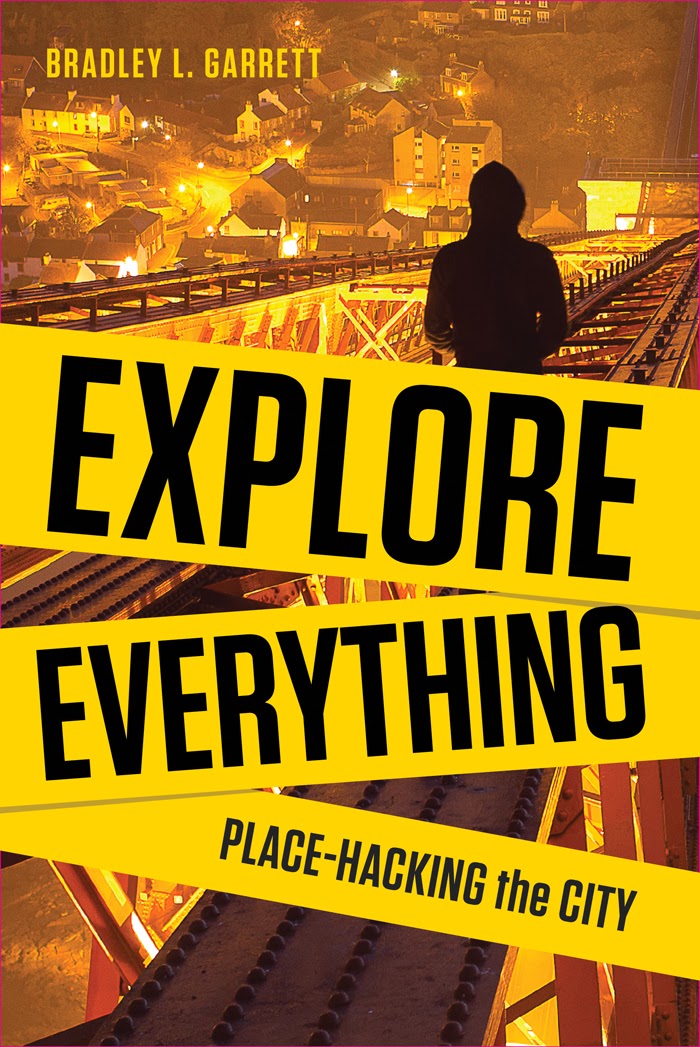
Approached from this direction, it’s a little while before one comes across the first information plaque revealing that, predictably, you’ve actually strayed into another industrial heritage visitor attraction.  Of course, this only really speaks of Cornwall’s changing economy and current reliance on the tourist Pound/Euro and, thankfully, much of the outdoor site has been left relatively untouched to slip into fascinating dereliction.  Staring at isolated, patches of exposed Victorian floor tiles and fragmented industrial architecture, I found myself fantasising about Andrei Tarkowski’s film ‘Stalker’, [1.], and reflecting again on the whole issue of ‘Ruin Porn’ alluded to in Bradley Garrett’s book, ‘Explore Everything’ [2.].


Levant Mine Ruins, Pendeen, Cornwall, February 2014


Despite that, it was impossible to resist the call of the picturesque, and to indulge myself in the effects of reflected sunlight on standing water and the totemic qualities of dramatic concrete columns.  I even succumbed to the archetypal Cornish motif of the little Victorian engine house on the road back to Pendeen, (where a National Trust plaque is the real giveaway).  Sue me, - sometimes the clichés are just too tempting.


Levant Mine Ruins, Pendeen, Cornwall, February 2014


Ironically, a sense of perspective on all this was actually afforded at the main site, via interpretation plaques detailing the famous Levant mining disaster of 1919 and the harsh conditions endured by the workforce, (including women and children), at the height of the mine’s prosperity.  They are a reminder that, beyond all artistic affectations and the perpetual search for a resonant image, real lives were lost, or else lived out in hard labour, in places like this.


Levant Mine Ruins, Pendeen, Cornwall, February 2014


Back in Mousehole lies further evidence of the hardships inherent in this marginal landscape.  The loss of 16 lives, being those aboard the stricken freighter, ‘MV Union Star’, and the 8-man local volunteer crew of the Penlee lifeboat, ‘Solomon Brown’, in hurricane conditions on 19 December 1981, is well documented, and was a pivotal moment in the village’s history.  Coincidentally, my own first Cornish stay mentioned above, was only a few months later.  Whilst I didn’t visit the actual village then, I do remember the slightly stunned atmosphere that still pervaded the whole area at the time.  One of the lost lifeboat crew, Charles Greenhaugh, was also landlord of the harbourside Ship Inn, which now carries a memorial plaque, with the memorable phrase “Greater love hath no man”.  There are more, typically modest memorials up the road at the now empty boathouse from which ‘Solomon Brown’ launched that night into truly foul weather.


Charles Greenhaugh's Memorial Plaque, Ship Inn, Mousehole, Cornwall


Memorials To Those Lost In The Penlee Lifeboat Disaster, Penlee Point
Lifeboat Station, Cornwall

Boat Slip, Penlee Point Lifeboat Station, Cornwall, February 2014


Though not always one for tales of conventional heroism, I never fail to be turned over by accounts of the bravery and sheer, bloody-minded refusal to back down in the face of impossible conditions, demonstrated by Coxswain, Travelyan Richards and his crew.  They went willingly where no one else could in an attempt to save lives, and ultimately to their own deaths.  Their last message was the matter of fact observation, “We’ve got four off”, at which point they went back for the remaining four crew members.  In the words of Helicopter Pilot, Ltn. Cdr. Smith, USN,

“The greatest act of courage that I have ever seen, and am ever likely to see, was the penultimate courage and dedication shown by the Penlee [crew] when it manoeuvred back alongside the casualty in over 60 ft breakers and rescuing four people shortly after the Penlee had been bashed on top of the casualty’s hatch covers.  They were truly the bravest eight men I’ve ever seen who were also totally dedicated to upholding the highest standards of the RNLI.” [3.].


The crew of 'Solomon Brown', Unidentified News Report, 1981

Wreckage Of 'MV Union Star', Near Lamorna Cove, Cornwall

Penlee Point Lifeboat Station, Cornwall. February 2014


The last few remaining, and generally elderly, true locals in Mousehole can sometimes have a reputation for seeming brusque or resentful.  If that is in part due to seeing a once-viable community fragment before an influx of occasional visitors (guilty) and property price-inflating second-homers, - perhaps it’s understandable.  Indeed, the Penlee tragedy could even be seen as one of the last times there was anything like an extensive native community capable of cohering around such an event.  I do know that, if you were in real trouble, you’d want people like their lost contemporaries to come looking for you.


RNLI lifeboats are still crewed by volunteers  and depend on charitable donations.  Think on...


[1.]:  Andrei Tarkovski (Dir.), 'Stalker', 1979, Mosfilm Studio.

[2.]:  Bradley L Garrett, 'Explore Everything: Place Hacking The City', London, Verso.

[3.]:  Quoted in:  Nicholas Leach, 'Cornwall's Lifeboat Heritage',  Chacewater, Twelveheads Press, 2000.


Friday, 14 February 2014

Bradley Garrett: 'Explore Everything' (Explored)


A while back, I wrote a post about the phenomenon of Urban Exploration and, in particular, the work of Bradley Manning, whose book, ‘Explore Everything: Place Hacking The City’ [1.] had just been published.  I obtained a copy over Christmas and, having just finished reading it, can report that it is an entertaining, informative and thought provoking read.


American by birth, Garrett is an Anthropologist and Oxford Academic whose engaging writing style and exuberant, participatory approach to his subject matter contradict the stereotypes of such occupations more than a little.  ‘Explore Everything’ is an account of the two years he spent as a member of The London Consolidation Crew, the British Urban Explorers who became infamous for scaling ‘The Shard’ tower before its completion and for visiting every one of London’s disused ghost tube stations.

Indeed, as Garrett acknowledges, some of the publicity adhering to the LCC and their extensively reported acts of creative trespass, may be in part due to his own presence within the group.  Furthermore, far from being merely ‘The Scribe Of The Tribe’ [2.], his efforts to understand and explain the motivations behind their exploits may have helped to spur them on to ever more intrepid heights, (and depths).  The ways in which Anthropological researchers may inadvertently affect their subjects is clearly something Garrett has contemplated at some length.


Upside Down, Beneath London.  Photo: Bradley Garrett


Much of the book’s immediate appeal lies in its account of a journey into the city’s obscure, forbidden underbelly, and the intrepid, illegal (in civil law), and often plain dangerous expeditions that constituted it.  There’s plenty of macho bravado around the UrbEx scene, just as with Parcour, guerrilla Street Art and other contemporary subcultures, and Garrett certainly entertains us with accounts of ascents of massive windswept cranes and high buildings, rope descents into tunnels and drains, and games of midnight cat & mouse with security guards. 


Beneath London.  Photo: Bradley Garrett


His beautiful, long exposure photos are spectacular and often steeped in vertigo and/or claustrophobia.  They also serve as testament to the achievements of his crew, being visual trophies in essence, but some time is also spent considering the aesthetics of such photos, and what they imply about the motivations behind Urban Exploration.  He is particularly interesting on the subject of ‘Ruin Porn’ and the area of entropy-chic generally, (something that is making me reflect long and hard on my own practice).


Beneath London.  Photo: Bradley Garrett


Indeed, the book expands its scope in several directions to question both the wider philosophy and politics of UrbEx and Garrett, quite logically, makes connections with the Situationist tradition, and with the wider issues of public access versus private interests, and contemporary ‘Security’ agendas, without pushing any specific dogma.  I note with interest that he also references Robert Smithson, an artist who interests me greatly and about who I've written before here.  Garrett takes full account of the psychology of exploration and it's interesting to discover how easily the conscious historical, geographical, documentary or political agendas he may have started out with, gave way to a purer quest for ever more stimulating experiences and the thrill of reaching somewhere secret in the moment.

Garrett is also pretty frank about the hypocrisies, conflicting viewpoints and internal politics running through the scene; something he and his compatriots were to eventually fall foul of.  As these, and the long arm of the London Transport Police, and The State’s post 07:07/pre-Royal Wedding & Olympics paranoia finally caught up with them, the LCC inevitably started to fragment.  Garrett ends his book with tales of their final expeditions abroad, (partly to escape the heat and publicity at home), and with reflections on those dispossessed communities forced to make a life underground, for instance in the storm drains of Las Vegas.  He also ponders the future of Urban Exploration and the prospects for those who will continue to pierce the increasingly impermeable official surfaces of our modern cities.


Beneath London.  Photo: Dan Salisbury


Rather than venturing into deeper analysis of ‘Explore Everything’, I’ll simply recommend it to anyone who, like myself, finds themselves fascinated by the idea of ‘The City’ or, indeed, all those just in search of an interesting read generally.  In conclusion, here’s a passage from the book that particularly stuck in my mind,

“In the practice of urban exploration, it is not the philosopher or the scientist who interpret spaces but the often uninformed wanderer searching for knowledge as it presents itself.  If, as Dsankt [3.] tells me, we ‘do it because we want to do it, not out of a grand sense of preservation’, what then can we learn from taking the unguided tour, where the important historical attributes of a place are overwhelmed by the sensory, emotional, affective experience of simply being there?” [4.].


Beneath London.  Photo:  Marc Explo


I’m too old and too cowardly to climb crane gantries or spelunk the sewers, and unlikely to transgress beyond the mildest bits of benign trespass.  Nonetheless, that “sensory, emotional, affective experience of simply being there”, makes complete sense to me.  It’s one of the reasons I remain an artist.


In addition to ‘Explore Everything’, plenty of interesting additional material, (Including videos and loads of high quality photography), relating to Urban Exploration, can be found at:


[1.], [2.] & [4.]:  Bradley L. Garrett, ‘Explore Everything: Place-Hacking The City’, London, Verso, 2013.

[3.]:  The Frenchman, Dsankt is one of the world’s best-known Urban Explorers.


Wednesday, 9 October 2013

Bradley Garrett: "Explore Everything' / Terminological Amendment


As I’ve routinely outlined, much of the source material from my artwork, (both visually and conceptually), comes from my wanderings around various cities with a camera.  It’s an ongoing activity that I try, perhaps rather grandly, to ally with the respective spirits of Psychogeography, Flâneurism or The Situationist Dérive.  In reality, it may be no more than the routine search for environmental/contextual stimulus that could be expected of any artist, but I hope there are certain attitudes of mind brought to my excursions that ally them, at least partially, with those theoretical traditions.

Whether carried out on foot, by bike or car, or indeed any other available transport means, I’ve been in the habit of referring to all this as ‘Urban Exploration’.  However, last month I read an article, leading in turn to a little further online research, which makes me think I should adopt a different term for my activities.


Robert Macfarlane's Own Hero Shot.  Photo: Bradley Garrett


The article, written by Robert Macfarlane for The Guardian [1.], was essentially a promo for a recently published book by American hipster academic and urban adventurer, Bradley Garrett.  Garrett’s book, ‘Explore Everything: Placehacking The City’ [2.], is the culmination of his own PhD studies and participation in what others were calling Urban Exploration long before I ever adopted the label.  In this context, we’re talking about those intrepid, adrenalised trespassers who mount planned incursions into abandoned industrial ruins, drainage and transport systems, construction sites, disused military installations and any secret place where access or free passage are restricted.  I was well aware of the phenomenon, but hadn’t appreciated just how widespread, (indeed global), an activity it had become.  In the article, Macfarlane even goes beyond the normal scope of a book reviewer by allowing Garrett and his associates to conduct him in a little underground expedition of his own.


Photo: Bradley Garrett


There’s a fairly obvious extreme or street sports aspect to all this and not a little of the high-fiving and whooping rad-dudery that often characterise those worlds, (although it’s clearly not an entirely male culture).  Many ‘Urbex’ trespasses take place in filthy, dark, dangerous and physically demanding locations and the macho skills of spelunking, climbing, orienteering and sprinting, (to evade security), can all be called upon.  Experience, research and careful pre-planning are essential.  Injury and possible long-term ill health are obvious risks and there have been occasional deaths. 

However, behind the hardcore bravado are a number of intriguing theoretical or psychological impulses behind these attempts to hack or subvert the highly prescribed/proscribed urban environments most of us now inhabit.  There is an implied testing of how much freedom of movement remains to the average citizen and also of the tricky issues around private and official control of once public spaces.  ‘Urbexers’ pose an overt challenge to the boundaries between legal and civil trespass and the (often unexplained) presumption of secrecy that pertains to so many sites.  For some, clear political agendas run through the subculture as a whole.  They may seek to uncover the possible (or imagined) conspiracies of silence, exploitation or sinister activity attached to certain sites or illuminate, (quite literally), how marginalised populations are forced to live rough or actually underground in a city’s hidden zones.  Elsewhere, they may simply claim the right to access a panoramic view or vantage point that has been annexed for profit, (it costs £25.00 to view London from ‘The Shard’s’ summit).


Photo: Bradley Garrett


For others, the motivation appears more involved with a very human desire to simply explore the hidden rather than any specific political impulse.  They take a delight in peeling back the multiple layers of urban geography to discover what lies beneath, (or indeed above), and seek out a vertical as well as horizontal reading of the built environment.  This reflects a desire to understand the physical systems and infrastructure that make a city function, (underground railways, drainage, etc.), but inevitably leads also into reading the chronological strata that constitute it, (wartime remnants, industrial archeology, abandonment, earlier incarnations, past lives, etc.).  Wherever the emphasis is placed, I think there is an unmistakable Psychogeographical impulse behind the phenomenon of Urban Exploration.


Photo: Bradley Garrett


There’s an essentially benign anarchy to it all too, coupled with a refreshing impulse to intrude non-destructively.  The general attitude is one of simply occupying and witnessing a site for the sake of simply being there.  In contrast to those who seek to alter, damage or ‘decorate’ forbidden locations, most Urbexers are content to simply ‘be’ in a place then document their discoveries in photographs and videos.  Where a gesture has been required, hanging a removable banner or posting visual evidence and ‘hero shots’ on web forums have generally been sufficient.  This process of routine visual chronicling and a delight in the physical appearance of generally overlooked or transitional places is of obvious relevance to my own creative habits.


Photo: Bradley Garrett


A major, inescapable connection is the theoretical legacy of The Situationist International. Desires to short-circuit the prescribed street plan, to experience the city with immediacy and subjectivity, or to sample experiences beyond the mere surface of things, are essentially Situationist in nature.  This is true, be they political or artistic statements or just strategies to experience one’s surroundings more fully.  Urban Exploration takes its place, alongside Graffiti and Street Art, Happenings, Pop-up or Flash Mob gestures, and the tented encampments of the Occupy movement, as they ripple out from Paris, 1968 and the wider Debordian moment.  Above all, it is an explicit attempt to access a grittier, more vivid reality, however grimy or hazardous, behind the slick corporate facades and hypnotic, pixelated imagery of the Capitalist Spectacle.


Bradley Garrett: Underground Academic


Although his primary focus appears to have shifted, Bradley Garrett himself has been an enthusiastic participant in Urban Exploration.  He was particularly associated with the London Consolidation Crew, - infamous for visiting every one of the London Tube network’s disused ‘Ghost Stations’, and for their climb to the top of the unfinished ‘Shard’ tower.  ‘Explore Everything’ is his account of those years and the exploits and ultimate demise in the face of legal action, of the LCC.  If he exhibits a typically American self-confidence and bushy-tailed desire to make each year more memorable than the last, (which could get a little tiring, I fear), he also brings a serious academic intent to the subject as his websites demonstrate.  Whilst the www.placehacking.co.uk site is now archived, www.bradleygarrett.com remains fully active and covers the whole field of his studies as a Geographer and Ethnographer, as well as accounts from the Urbex front line.  Both sites are full of his vivid photography, insightful writing and links to impressive video work.  Particularly recommended among the latter are, ‘Crack The Surface:Episode I’ and ‘Episode II’ and ‘Urban Explorers: Quests For Myth, MysteryAnd Meaning’.  Whilst the first two showcase many of the scene’s prime movers and shakers in action, the latter provides fascinating reflections on it from various academic viewpoints.

Even in my prime, I never had the physical prowess or reckless courage demonstrated by Garrett and his contemporaries and remain essentially risk-averse where physical jeopardy or legal action are concerned.  Nevertheless, in my own cowardly way, I fully understand the curiosity that can lead one to poke the camera lens where it may not always be welcome in search of alternative readings of a city.  I’m fascinated by these bulletins from travellers into regions I might not dare enter myself but really don’t think I can continue to apply the term ‘Urban Exploration’ to my own more sedate, (but hopefully, creatively valid), excursions.  Perhaps, from now on, ‘Urban Observation’ or perhaps ‘Urban Documentation’ will have to do instead.


Postscript:

From reading Bradley Garrett's own blogging, I know he is, (slightly ironically), very protective of his own intellectual property.  I hope he'll accept my appropriation of his images here in the spirit it is meant, (as a celebration of his work) rather than any kind of money making rip-off.