Showing posts with label Urban Documentation. Show all posts

Sunday, 29 May 2022

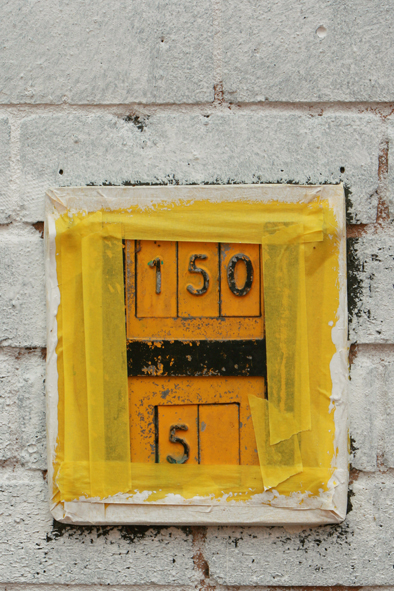
Significant Yellow Items: #2022.Y014 & #2022.Y015


All Yellow Gates Images: West Leicester, February 2022


As a child, I always had a somewhat troubled relationship with numbers. I laboured over maths lessons, and sometimes wonder if I was actually suffering from a mild case of dyscalculia. For a while, around 5 years-old, I even introduced a number called 'Twenteen' (between 19 and 20), when counting. That caused definite problems, as you can imagine. However, I have since come to adore the poetry of the concept - and often speculate on how one might write twenteen numerically (suggestions welcomed).


As an adult, I have contented myself with the fact that, some basic arithmetic and a small  facility with fractions and percentages, the ability to measure, and a moderate grasp on geometry, are about all I've really needed to get by. As I always suspected, simultaneous and quadratic equations appear to have had next to no bearing on my experience. This isn't to downgrade anyone who lives for numbers, but maybe just a recognition that we all speak slightly different languages - and that a quality-orientated world view is just as valid as a quantitative one.


All Hydrant Plaque Images: West Leicester, April 2022


One aspect of my numerical interactions which does remain intriguing, is a prevailing tendency to associate specific numbers with certain chromatic values. For me, 5 has always been situated somewhere within the yellow to yellow-orange spectrum. Apparently, that remains the case.  


Tuesday, 21 July 2015

Belgrave Gate 15: Time To Rethink?


Here's a subject that has appeared on here more than once before.  After all though, one important function of this blog appears to be to chronicle the gradual (and not so gradual), processes of change within my urban surroundings.  I've always loved the juxtaposition of inherent blankness and surface nuance in this ad hoc facade, but this latest incarnation is particularly enjoyable.


I find it almost impossible not to read that newly revealed section as an implied window (onto what - exactly?), although it is, of course merely the result of a couple of panels having been removed. I love the process of entropy that suggests, whilst preferring not to think too hard about what might have happened if they actually fell.  That pavement below is a pretty busty pedestrian thoroughfare at most times of the day.  I am also struck by the way the edges of several of the upper boards are warping and curling with age.


Clearly, the Council's ongoing battle to negate the boards functioning as an informal bulletin board continues.  As you can see, the ragged edge between the grey and dismal brown sections, and the merest hints of past text re-emerging through the torn brown surface are currently in a rather pleasing state of balance.


Finding myself down on Belgrave Road to photograph the building yet again made me think again about my 'Belgrave Gate Project' and how it became stalled some time back as my attention turned to what eventually became the phase of work featured in the recent 'Mental Mapping' exhibition.  In fact, this boarded building is one of the first landmarks that caused me to pause for thought in that part of town in the first place.  I've not given up on the 'BGP' altogether though, and the original premise of a Psychogeographically informed investigation into different facets of a given district is as applicable to my work as it ever was.  I'm still just as much engaged with the idea of doing so through a variety of media as I was when I first engaged with the project.  In fact, some of those intentions actually percolated through the 'Mental Mapping' work in slightly less open-ended ways and perhaps that is the crux of the matter.


All Images:  Belgrave Road, North Leicester, June 2015


Taking some of what I learned from the work produced in the last year, it may be that there is scope to reassess some of the perimeters of the 'Belgrave Gate Project', and to redraw them in a slightly tighter, more focused manner for future consideration.  There are a lot of things up in the air just now, as I take a little time out from my own work to recharge my creative batteries.  As the various possibilities start to coalesce into something more definite, in the fullness of the time, it will be interesting to see if I find myself haunting that particular quarter of Leicester with my cameras on a regular basis, all over again.


Saturday, 3 May 2014

Somewhat Abstracted


Charred Boards, Narrow Marsh, Nottingham, April 2014


A few posts back, I mentioned how spending any significant amount of time in an art exhibition can sometimes influence my perception of the world after leaving the gallery.  In the case of my recent visit to ‘Somewhat Abstract’ at NottinghamContemporary, (already discussed at some length), a similar process took place but this time, in reverse.  On my way to the gallery, and with time and Spring weather on my side, I spent a while exploring the surrounding area with my camera with the intention of concentrating on the walls, surfaces, and material fabric of the city in as abstract way as possible.


Charred Boards, Narrow Marsh, Nottingham, April 2014


There was a specific research agenda behind this, (and it’s hardly new territory for me, after all), but also, the general sense that, if ‘Abstract’ was to be a theme for the day, I might as well get into that mindset from the get-go.  In the event, I spent over an hour happily strolling around the dilapidated grandeur of the Lace Market area to the North of The Contemporary, and the more workaday territory immediately to the South -between the foot of the sandstone cliff that the gallery surmounts, and the Railway Station beyond.


Both: Narrow Marsh, Nottingham, April 2014

Rear Service Entrance, Nottingham Contemporary, April 2014


Although adjacent, these zones differ greatly in both atmosphere and physical attributes and there’s quite a contrast between the worlds of above and below.  The Lace Market, once being the seat of one of the craft trades on which Nottingham’s prosperity was most famously built, is a maze of interconnecting streets lined with imposing and often ornate Victorian buildings.  In recent years it has adapted itself to the needs of young creative types or those in search of stylish inner-city living, and the identity of the area now takes its identity equally from its historic setting (and dilapidation that still prevails in places), and the incidents of slick design and gentrification now punctuating it.


Both: Narrow Marsh, Nottingham, April 2014


The tract below is even more obviously in a state of transition.  The elevated tramline running towards its terminus next to the railway station, which is itself currently in the throws of major redevelopment, bisects it.  Indeed, this whole area is a nexus of transport routes, with a major road in and out of the city centre and a canal cut both running through it.  Regular readers will recognise this as exactly the kind of location I’m routinely drawn to.


Both: Narrow Marsh, Nottingham, April 2014


Immediately to the west of the new tramway lies the bulky, faded Modernism of the Broadmarsh Shopping Centre, Bus Station and Car Park complex, with various entrances resembling the mouths of a somewhat forbidding bunker.  To the east sits an enclave of mid-twentieth century housing that always intrigues me in its inconguity.  Laid out, I assume, as a public housing estate, and punctuated by a network of secluded pedestrian cut-throughs, it feels like a surprisingly calm oasis of tightly packed gardens and something of a time capsule in a rapidly changing scene. 


Both: Lace Market, Nottingham, April 2014


In the shadow of the tramline lie the last vestiges of the old Narrow Marsh slum area and the ruins of a disused railway line that once ran through it.  This includes a couple of streets of abandoned, dilapidated commercial buildings, (some showing evidence of arson), which provided some of the richest pickings for my camera.  These seem to teeter on the very edge of events now, as lapping up against them is a recently cleared area, clearly awaiting development and denoting the regenerative processes overtaking this whole district.  I never tire of such locales where one can sense the last gasps of a previous situation, just prior to it being sloughed off like dead cells from a city’s larger organism.


All: Lace Market, Nottingham, April 2014

Narrow Marsh, Nottingham, April 2014


As was my intention, they tread a line between formal abstraction and the recognisable world, whilst remaining fairly 'straight in terms of exposure and focusing'.  They also contain less than usual of the textual content that habitually fascinates me.  I suppose one could argue that relatively little of my geographical description above is specifically discernible from them.  However, I never tire of the multiple ways that history, and changing events or usages, can leave evidence of itself on the surfaces of a city’s physical fabric.  The passage of thousands of lives and the activities carried out within them, are all to there to be read, along with the wider processes of entropy, material decay and socio-economic fluctuations, if one looks hard enough.


Prunella Clough, 'Samples', Oil On Canvas, 1997


It was a delight to enter the ‘Somewhat Abstract’ show a few minutes later and find many of these thoughts magnified and distilled by the work on show.  They were there most obviously in the paintings of Prunella Clough and cast reliefs of Karin Ruggaber, with their strong suggestions of weathered masonry and urban environments.  More obliquely, they were also there in Mark Lewis’s filmed meditation on the lost Utopianism of an outmoded vision of architecture and city planning, or indeed, in Wolfgang Tillmans’ investigation of just how photography might transform itself into a medium capable of conveying the abstract.


Narrow Marsh, Nottingham, April 2014


On reflection, I wonder if photography might, paradoxically, be one of the more interesting ways to explore the oft-stated idea of abstraction/representation as two sides of the same coin.  It can, of course never be abstract in the strictest sense, but like the exhibition itself, may offer plenty of scope to explore the points at which the recognisable begins a transformation into something other.  It also occurs to me that, despite my recent ham-fisted attempts to expand my 'range' by incorporating representational motifs within certain paintings, it's really in some variety of formal abstraction that I feel most at home.


Lace Market, Nottingham, April 2014


Somewhat Abstract: Selections From The Arts Council Collection', continues until 29 June at Nottingham Contemporary, Weekday Cross, Nottingham, NG1 2GB.


Tuesday, 22 October 2013

'Reporting Back' From Brum: Hurvin Anderson & Nina Könnemann At Ikon.


Hurvin Anderson, 'Country Club: Chicken Wire', 2008 & 'Untitled (Livingstone Road)', 2000


Approximately a year ago, around the time I participated in the ‘If A Picture Paints A Thousand Words…’ group exhibition, it felt like Birmingham was becoming a focus for some of my more interesting experiences and activities.  I hadn’t visited the city properly for several years and was interested to be exploring it once more and sampling the various attractions, cultural and otherwise, that it offers.  Attempts to revisit shortly after for photographic expeditions were stymied by a combination of foul weather and increasing difficulties with my dodgy old legs.  However, as 2013 has progressed, (and partly thanks to my physiotherapist), I’ve been able to head west increasingly, taking in exhibitions, numerous sites of photographic or psychogeographic interest and commencing a methodical exploration of Brum’s transport infrastructure in the process, (as detailed in various posts).


Ikon Gallery, Birmingham, October 2013


I found myself there yet again with friends the other weekend and, although Birmingham is only a stone’s throw from our own towns, we decided to make an indulgent weekend of it, treating ourselves to hotel rooms, extravagant breakfasts and the chance to escape the humdrum routine for a couple of days.  Many folk make Brum the butt of dismissive humour but it offers much to the visitor, and is still Britain’s second city in my view.  It’s much easier to negotiate (and afford), than London, is far more welcoming, and has a lot less ‘side’ generally.  It may not be elegant or quaint but isn’t without grandeur and actually provides a wide variety of moods and visual experiences that engage me far more than traditional notions of ‘beauty’ or extravagance anyway.


Despite the bleak weather, we spent a couple of very enjoyable days just hanging out and off duty.  The real highlight for me was a visit to the Ikon Gallery to view Hurvin Anderson’s exhibition of paintings entitled ‘Reporting Back’.  I had a hunch this would be a good one but in the event, it exceeded all expectations; taking its place on a short roster of really impressive shows I’ve seen in recent months.  Having viewed it on the Saturday, I returned the following morning to reflect further on the paintings.


Hurvin Anderson, 'Northern Range', 2010 & 'Lower Lake', 2005


Anderson’s origins lie in Birmingham’s Jamaican community, (he is British by birth), although he has acquired an international reputation as a painter since leaving the Royal College of Art in 1998.  He refutes further the wearisome notion that painting is dead, (still being peddled in some quarters), and also the convention that Black art must be clichéd, pigeonholed or superficially ‘right on’.  His work shows a powerful commitment to, and facility with, the medium of paint, but played out with due reference to the context of photographic and appropriated imagery in which we all now float.  Whilst rooted in the tradition, Anderson’s painting feels completely relevant to now.


Hurvin Anderson, 'Untitled (Red Flags)', & 'Miss Sylvia', Both 2004

Peter Doig, 'Pelican', Oil On Canvas, 2004


I now realise that the art that captivates me most always carries an initial visual/ expressive punch, followed by a slower burn of reflection on the possible themes or theoretical frameworks within it.  I want my mind to be stimulated but never to the exclusion of my senses being seduced.  It’s why I remain wedded to painting, (or some hybrid of it), and why I responded to this exhibition immediately I walked through the door.  The most obvious impression was of the similarities between Anderson’s painting and that of Peter Doig.  Both have a remarkable facility with paint and employ abstract inventiveness within an essentially representational framework, playing freely with the formal elements of picture making.  There is also an original take on the idea of the tropical in both artists’ work.  Anderson is more solemn and rather less theatrical in his approach however, and presents a vision that is very much his own.  My good friend Suzie quite rightly saw correspondences with Hockney and Hopper, whilst I was also reminded of Michael Andrews (a perennial favourite) and the Euston Road tradition in general.  One might even draw some comparisons with Ewan Uglow.    However, Anderson never fetishises the nailing down of an objectivised image in the way that Uglow and the followers of Coldstream did.  ‘A Painter’s Painter’ is a hackneyed label to apply to any artist, and yet…


Hurvin Anderson, 'Miss Sylvia' & 'Imperial', Both 2004

Michael Andrews, 'Good And Bad At Games', Screen Print & Oil On Canvas, 1964-68


The Artist draws fully upon the Afro Caribbean experience, but does so in ways that manage to be particular and personal but also universally human.  Finding subject matter in both his native Birmingham and The West Indies, he repeatedly explores his sense of displacement and disquiet at never quite belonging in a particular place.  This must surely be a powerful theme for any diaspora, and not least for one with a shared memory of the multiple displacements of slavery, colonialism, independence and subsequent migration to these shores.  Yet, as a middle class white man, I gained just as much emotionally and intellectually from these works and they reflect a kind of melancholy loss, alienation or recourse to memory that is easily translatable into any culture.  They may speak eloquently of ‘Black Experience’, (which is not for me to judge), but encapsulate wider Human experience too.  As we viewed the paintings, we decided they reflect the thoughts and feelings of an individual above all, and that there is nothing as limiting or uncreative as a standard account for any culture.


Hurvin Anderson, 'Untitled (Red Flags)', 2004, 'Northern Range',  2010 & 'Lower Lake', 2005


The locations Anderson depicts are repeatedly imbued with disappointment or melancholy and of access denied or promise unfulfilled.  It is achieved most overtly in his use of visual barriers, parallel to the picture plane, through which various scenes are viewed.  These include fences, gates and decorative security screens, (typical of the West Indies), and play both strong pictorial and powerful psychological roles.  Elsewhere, it is evoked more obliquely through images that subvert the illusions of tropical or colonial paradises and Victorian Utopianism, or depict figures rendered anonymous within a newfound context.  The latter category includes blank faced ‘portraits’ of his sister and nephew, wrapped against the cold in their Canadian home, having undergone (we assume) yet further displacement.


Hurvin Anderson, 'Peter's IV (Pioneer)', 'Peter's II', & 'Peter's III", All 2007


One of the upstairs galleries at Ikon was dedicated to several of Anderson’s ‘Peter’s’ series of canvases, with which he essentially made his name.  Sharing the same basic format, but sitting at different points on the figuration/abstraction continuum, they are a powerful exploration of the psychologically significant location of the Afro Caribbean barbershop (of an implied back-room variety it seems here).  With or without a figure in the chair, these paintings are primarily about a specific arena for thoughts, feelings and memories and somewhere that a marginalized community might enjoy a coming together in safe surroundings.  They seem imbued with the stories and conversations that have unfolded within the space, whilst being formally and pictorially inventive as visual images.


Hurvin Anderson, 'Peter's: Sitters II', 2009 & 'Peter's IV (Pioneer)', 2007


At the risk of yet another industrial length post, mention should also be made of German artist, Nina Könnemann’s delightful video piece ‘Bann’ playing in the Ikon’s Tower Room.  It comprises candid glimpses of smartly dressed smokers grabbing a crafty fag in various corners, doorways and dingy alcoves within the City of London.  Whilst some are shown in the open, others reveal their surreptitious presence only through puffs of smoke, disembodied hands, (complete with cigarettes), reflections or just the discarded butts that remain after their passing.


Nina Könnemann, 'Bann', Video, 2012


Könnemann captures the fluctuating subculture that exists all around us at any hour since the widespread indoor smoking ban took effect and the importance of those snatched private, if damaging, moments in relieving the pressure of modern urban life.  It is poetic, ritualistic and not without humour, (for instance one subject’s double take on spotting her camera or the gloomy woman furtively chaining a second tab in the shadows).  It is also an atmospheric elegy to the grey and geometric corporate world of concrete, marble, steel and glass that these City workers inhabit.  Their rhythmic exhalations of smoke just seem to add to the tarnished silvery miasma in which they exist.


Nina Könnemann, 'Bann', Video, 2012


Leaving Ikon via its well stocked bookshop, I picked up a copy of the ‘Reporting Back’ catalogue as well as books on the work of Beat Streuli and Christiane Baumgartner.  The last two are both artists who caught my eye in the ‘Metropolis: Reflections On The Modern City’ exhibition at Birmingham’s Gas Hall earlier in the year.  It just went to emphasise that many of my most inspiring and enjoyable experiences over the last year have occurred in Brummagem.


Apologies; I Fear I Have Committed A 'Selfie'.


Hurvin Anderson’s exhibition, ‘Reporting Back’, and Nina Könnemann’s video, ‘Bann’, continue at Ikon Gallery, Oozells Square, Brindley Place, Birmingham, B1 2HS, until 10 November 2013.  Both are highly recommended.