Tuesday, 24 September 2019

Pop Classics: Robert Indiana & Roy Lichtenstein At Tate Modern


Robert Indiana, Sculptures, Tate Modern, London, July 2019


A slightly concerning slump in my general energy levels, and an attendant apathy regarding social media upkeep (remember when we didn't have to bother with all this striving for attention?), make this my first post of the month.  Only a Doctor might ultimately reveal if my physical lethargy represents anything more sinister than the creeping passage of middle age, and I guess it's ultimately up to me to decide about what I can and can't really be bothered with, digitally.  But, for now, let's persevere, and keep the pot at least simmering with a slight return to my last trip to London, in July.  In particular, this post relates to the pleasurable hour I spent with Tate Modern's current Pop Art display.  


Robert Indiana, Sculptures, Tate Modern, London, July 2019


I definitely enjoy the way the Tate constantly reshuffles and recontextualises its permanent or loaned collections - not least because it makes each repeat visit a potentially stimulating new experience.  Sometimes this leads one to discover something completely new, but this time it was also an opportunity to revisit some perennial favourites in a new configuration.  I remain a sucker for a bit of Pop, and am often surprised to discover how, in the case of the best examples at least, the genre's self-proclaimed superficialities haven't faded, anywhere near as rapidly as one might expect, over the years.  Some of this stuff is certainly very familiar, and has been rendered pretty ubiquitous through repeated mass-media regurgitation, but there is something quite appropriate about that, after all.  In reality,  I still find much of it can still raise a smile, when encountered at first hand.  


Robert Indiana, Sculptures, Tate Modern, London, July 2019


This time round, it was intriguing to witness how the Tate had juxtaposed certain American 'classics' with much less well-known, stylistically sympathetic examples from the other side of the Iron Curtain.  There's clearly plenty to consider regarding the apparent critique of Pop's embrace of Capitalist aesthetics, from opposing sides of the Twentieth Century's ideological divide, and perhaps that's something this post might have been about.  Instead, it's really about how I was more self-indulgently distracted by two of my old Pop favourites - and by certain correspondences between their work, and my own.

I've long been a fan of Robert Indiana - not least for the elegant, emblematic qualities of his work, and the elegance with which he incorporated textual elements into his visual statements.  This is all very familiar from his crisp two-dimensional works, but it's also there in his frequent forays into sculpture.  Best known of those are the welded steel 'Love' monuments which still crop up in various international cities, and have continued to proliferate in a variety of media and formats, over the decades.  But, here at Tate, I was delighted to discover a cluster of his slightly less familiar, herm-like totems, occupying the centre of a large room. 


'Sentinel' Sculptures, 'Visions Of A Free-Floating Island', Surface Gallery, Nottingham,
September 2018


I've always loved these, not least for their formal clarity, but perhaps most of all - for their distinctly human qualities.  It's difficult not to regard them as standing figures, I feel - and also not to notice their formal similarity to certain, far more ancient statues.  I'm also prompted to marvel at how Indiana was able to adapt the glib, monosyllabic invocations of commercial signage or labelling, to further suggest, something intrinsically human (either physically or emotionally).  Like all the best Pop Art, they allow scope for philosophical meditation, whilst retaining a formal accessibility.  Most importantly - they are distinctly witty.

And, of course, it's now impossible not to admit that they were clearly in my mind (either consciously or otherwise) as I was constructing my 'Sentinel' sculptures last year.  The scale, format, and resulting figurative characteristics of those, make the connection pretty obvious - as do my similar attempts to apply apposite textual excerpts to a sculptural format.  Also, they seem to be equally 'of the street' in their use of low grade, found materials.  There's even a submission to the somewhat corny, in at least one or two of the 'Sentinels' - although I certainly don't claim to have got away with that, with anything like the knowing cool of Robert Indiana.


'Sentinel 5', Salvaged Cardboard Boxes, MDF, Adhesive Tape & Paper Collage & Acrylics,
 2018

'Sentinel 2' Salvaged Cardboard Boxes, MDF, Adhesive Tape, Paper Collage & Acrylics,
2018


Anyway, when not revelling in Indiana's statues, or struggling to find clear camera angles in what was a very popular gallery space - I was equally pleased to revisit two works by Roy Lichtenstein, hanging on the wall beyond.  As icons of Pop go, they don't get much more archetypal or over-familiar than Lichtenstein's 'Whaam!'.  In many respects, it could be said to encapsulate everything that's most resonant about American Pop Art.  Relish for the immediacy and mass-appeal of commercially motivated imagery - tick.  Exploration of the visual and formal tropes of mechanically reproduction - tick.  Dialogue between 'high' and 'low' art and the translation of imagery between certain media typical of them - tick.  Juxtaposition of the candy-coated blandishments of consumption-driven affluence, and the darker aspects of actual history - tick.  Exploitation of the potential of key imagery to both insulate the viewer from uncomfortable reality, and simultaneously open-up avenues of internal philosophical debate - tick.  Perhaps never were existential inconveniences (i.e: war and human slaughter), rendered quite so superficially cheery in a piece of gallery art.  And, perhaps most impressively, given its perennial recycling and possible slight fading of pigments - it still feels almost as crisp, fresh and provoking, as it must have in 1963.


Roy Lichtenstein, 'Whaam!', Acrylic & Oil on Canvas, 1963


Three years later, Lichtenstein made his own excursion into the third dimension, in the adjacent wall-mounted relief, 'Wall Explosion II'.  By extracting the already frozen and formalised emblem of the explosion, from 'Whaam!', and then rendering it in welded steel, he further pursued the idea of the instantaneous moment made tangible (or consumable - even).  Again, there's something both eloquent and undeniably 'Pop' (almost literally so) about the translation of a moment of destruction into a reproducible, and thus - marketable, commodity.  And his use of perforated mesh to allude to the ben-day dots of halftone reproduction, or even the stencils he might himself use to emulate them in paint, is just too damn clever for words.  Those are the same halftone dots I've tried to suggest or even collage into more than one of my own works, in recent years - but never in quite such a sophisticatedly oblique manner as Lichtenstein did here - sadly.


Roy Lichtenstein, 'Wall Explosion II', Enamel on Steel, 1965


Monday, 26 August 2019

Finally, Some Good News...


Both Images:  West Leicester, August 2019


I'm choosing to take this as a small grain of comfort.  Let's hope it might suggest an element of alternative insight, beyond a slightly desperate exhortation to make a late application for further education.


Now, perhaps we all need to wake up, stop embracing our extinction, and start striving for a future that might actually be worth studying for...


Monday, 19 August 2019

Life In The Cone Zone


All Images: West Leicester, August 2019


I'm always rather drawn to those ad-hoc mazes of barricades and cones thrown up by alterations to a city's infrastructure.  The chunky plastics, urgent colours, and emblematic direction signage, all allude to our safety neuroses - and to the complex knots we tie ourselves up in, as we pursue some elusive sense of 'improvement'.  All city dwellers must inevitably spend increasing portions of our lives blundering about amongst them, it seems.  We have chosen to dwell, after all, in an realm of perpetual flux - where the present must be shored up against the future, lest we overwhelm our environment altogether.  If only we could remain patient, and tolerate a few more delays - perhaps a perfect solution might finally be arrived at.    


This particular example has been in situ for many months now, and I pass through it regularly, on four wheels or two.  Consequently, I've had ample time to idly peruse its complexities, and implications.  As a potential subject - you might almost say, it's got my name all over it...


Saturday, 10 August 2019

Galleries Of Light


Tate Modern, London, July 2019


Visits to art galleries can still tend, by their very nature, to be an internalised type of experience.  Art works may (and increasingly do) function out here in the world, in a variety of contexts - both official and unofficial, but the default venue for much visual art still remains the gallery, of whatever variety - with all the associations that may imply.


David Zwirner Gallery, London, July 2019


Despite a growing imperative for galleries and museums to justify themselves in terms of some defined educational function or community outreach, (the sociological implications of which open up entire debates of their own), there is still a sense in which such spaces may act as crucibles of purely self-fulfilling, internal reflection.  Regardless of the agenda of an individual artist, curator or institution, 'Fine Art' (whatever the hell that now means) retains the function to act as a condenser of the viewer's individual thoughts and fantasies.  As long as that still applies, it seems desirable there should remain the possibility of a few 'neutral' spaces, shorn of any function other than to act as a venue for such unprescribed enlightenment.

Of course, I understand that any commercial gallery space has a very obvious economic function beyond the purely reflective, or that the transformation of many subsidised galleries into something identifying as 'arts labs' or educational outposts, implies a greater degree of participatory activation.  But even in these places, it's often still possible to sidestep a particular establishment's primary agenda, and just 'be' with artworks, if only as a peripheral activity.  For many this will sound elitist, socially unjustifiable, or just plain self indulgent.  I'm certainly not dismissing out of hand, the idea that art, and its consumption, may actually operate on various levels of functionality, (often simultaneously).  So, perhaps it's just a case of my reserving the right to decide what I think and feel for myself (in art as in life).  Maybe it's just the desire to retain some degree of subjectivity and personal mood-dependency, as significant components of my own art experience, alongside all the other stuff that might occur.


David Zwirner Gallery, London, July 2019


Which may be why, when a gallery context actually does intrude into my rarified 'art experience', as of course it must (context is everything, really - despite the above protestations), it can sometimes do so as its own variety of transferred aesthetic experience.  With surprising regularity, I find myself shifting focus from the actual work on display, to a portion of the physical environment in which it resides, or to the vista revealed through its windows - only for that to become it's own quasi-revelatory moment.  It's almost as though, rather than the functional imperatives of 'real life' always being applied to art from without - the current might also flow in the opposite direction.  Could it be that, a few meditative minutes spent with the right artworks, can transform one's perceptions of the material world beyond its own boundaries, once it re-intrudes, into something altogether more subjective or dreamlike?


Tate Modern, London, July 2019 (And Below)


Which is all mostly just a very pretentious way of saying - look at these slightly arty photos I took during my last gallery-going trip to London, whilst not focussing on the actual work. 


Friday, 9 August 2019

'Oscar Murillo: Manifestation' At David Zwirner, London


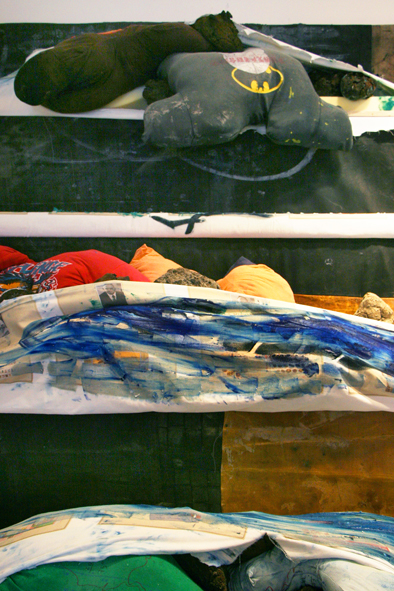
Oscar Murillo, 'Manifestation',  Oil, Spray Paint & Oil Stick On Canvas, Linen & Velvet, 2018-19


For the second time in a few posts, I find myself apologising for writing a report of an Oscar Murillo exhibition, too late for anyone to actually see it.  This time, it's mostly due to my having visited 'Manifestation' at David Zwirner's swanky Mayfair outpost, just prior to it closing - although, admittedly, it's still taken two further weeks to actually file this.  What can I say (excuses, apologies, etc.)? 


 Oscar Murillo, 'Manifestation', David Zwirner Gallery, London, July 2019


We'll just have to fall back on the fact of art production being far more of a continuum, than just a series of finite public events.  And, we're lucky in that respect, where Murillo is concerned.  The individual artefacts may linger, but the seemingly ever-morphing, context-responsive nature of his practice, means they are likely to reappear with freshness and renewed vigour, at another time and place.  Also, Murillo currently seems so prolific that the enthusiast can safely assume that, if they've missed this batch - there'll be a load more new work following along shortly.  Finally, his inclusion on this year's Turner Prize short list, means he's unlikely to fall out of the spotlight any time soon.  In reality, anyone keen to encounter his work for real (and I'd definitely recommend it), can actually do so at the accompanying exhibition - opening soon at Margate's Turner Contemporary.


Oscar Murillo, 'Manifestation', Oil, Spray Paint & Oil Stick On Canvas, Linen & Velvet, 2019,
(Detail Below)


Oscar Murillo, 'Manifestation',  Oil, Spray Paint & Oil Stick On Canvas, Linen & Velvet, 2019,
(Detail Below)


As far as this post goes, there feels little need to write another lengthy diatribe, further extolling Murillo's virtues, given that 'Manifestation' mostly cemented many of the opinions already expressed here after his recent 'Violent Amnesia' showcase at Kettle's Yard, Cambridge.  Of the two, the London show was possibly even more satisfying, purely from a painterly perspective - being largely comprised of a series of ambitious (and often  impressively large), recent paintings.  As I discussed in that earlier post, Murillo feels to me, like an exciting and confident painter - who is also unafraid to branch out in other directions (including various installation, collaborative, and time-based enterprises).  I really do admire and commend him, for that ambition, not least because it slightly mirrors my own recent aspirations (without the 'exciting and confident' part).  However, in Murillo's case, I have to accept that it really is the paintings, or painting-related works, that thrill me most.


Oscar Murillo, 'Chocolate Master After Hans Haake', Wood, Canvas, Fabric, Oil, Oil Stick,
Corn & Clay, 2019, (Detail Below


Oscar Murillo, 'When Tomorrow Becomes Yesterday',  Pen, Pencil, Graphite & Carbon
On paper, With Wood, Perspex & Oil, 2019


Oscar Murillo, 'Perpetual State Of Being', Video, 2018


At David Zwirner, the accompanying works comprised an (admittedly paint-daubed) site-specific installation, ('Chocolate Master After Hans Haake'), a modest, wall-based assemblage (again, featuring a painterly element, and entitled, 'When Tomorrow Becomes Yesterday'), and a video.  Of the three, it was the last, 'Perpetual State Of Being' which captured my imagination most effectively, as a camera wandered at random across a seemingly interminable landscape of abstract marks.  It's a simple enough an idea, and fairly low-tech in its execution (as is most of Murillo's oeuvre) - but an effective one nonetheless.  One of the features of Murillo's nominally static painting that excites me most is its demonstration of how many exuberant ways one might get across a canvas surface.  In the case of 'PSOB' the visual terrain traversed by the camera, and projected at immersive scale - directly onto the wall, makes that sense of restless movement, and of distance travelled explicit.  The title alone, seems to amplify the idea of Murillo's work as something in constant, energetic motion.


Oscar Murillo, '(Untitled) Catalyst', Oil & Graphite On Canvas, 2018


Oscar Murillo, 'Manifestation', Oil, Spray Paint & Oil Stick On Canvas, Linen & Velvet, 2018-19


Oscar Murillo, 'Manifestation', Oil, Spray Paint & Oil Stick On Canvas, Linen & Velvet, 2019,
(Detail Below)


But, as I say, it's those paintings that do it best for me.  All the pleasure I took in Cambridge, from Murillo's arsenal of mark-making devices, his painterly exuberance and celebration of paint's plastic materiality, was once more on display in London, juxtaposed with the more mechanical reconstruction of separate canvas sections and inclusion of printed motifs.  And the inclusion of another 'Catalyst' (of the kind that pleased me so much in Cambridge), demonstrated how the more complex 'Manifestation' works shown here, may well have grown out of their process (as the titling system might suggest).  In fact, the slightly ambiguous dating does allow for the possibility it could equally be the other way round (making the 'Catalysts' some kind of distillation - perhaps?).  Regardless of what order things arrive in, what really seems to matter most, is that sense of Murillo's ideas and forms perpetually evolving and morphing out of each other with a kind of self-generating dynamism.

But, if this most recent bunch are effectively just further milestones along the way - it still doesn't preclude them becoming somewhat stately, at the same time.  The results actually settle into a more contemplative, immersive mode when grouped together in a gallery.  On reflection, my lasting, take-home impression of this exhibition, probably was that very negotiation between that restless churn of each painting - when viewed at close quarters, and the paradoxical sense of repose apparent in each room as a whole.


Oscar Murillo, '(Untitled) Surge', Oil, Oil Stick & Graphite, On Canvas, Linen & Velvet,
2017-19, (Detail Below)


There were also also two more 'Surge' canvases here, to compare with the one shown in Cambridge.  All seem to evoke a sense of inundation on an oceanic scale, threatening to submerge any underlying imagery beneath the waves.  It's tempting to claim that Murillo is another artist with a penchant for working in self-contained series - but, in his case, it feels more organic, and less compartmentalised than that.  Perhaps it would be more accurate to describe these title or motif-connected works as 'families'.  Those familial ties seem to become stretched across both time and territory in his work, with individual motifs constantly  cross-fertilising as they reaching out for fresh soil.  Given his previously acknowledged themes of migration, community, and the stresses on social connectedness exerted by global economics, that sense of a fluid diaspora feels all the more appropriate.


Oscar Murillo, 'Untitled', Oil & Oil Stick On Canvas With Steel Pole, 2016-18


Oscar Murillo, '(Untitled) Surge', Oil & Oil Stick On Canvas & Linen, 2017-19


Oscar Murillo, 'Manifestation', David Zwirner Gallery, London, July 2019, (And Below)


Anyhow - enough waffle.  If Murillo's best work isn't about the sheer thrill of visual encounter, I don't know what is, these days.  Let the pictures tell the real story, then...


'Oscar Murillo: Manifestation' ran between 8 June - 26 July 2019, at: David Zwirner, 24 Grafton Street, London W1S 4EZ

'Turner Prize 2019' (Including Oscar Murillo) will run between 28 September 2019 - 12 January 2020, at: Turner Contemporary, Rendezvous, Margate, Kent CT9 1HG


Wednesday, 31 July 2019

'Constructed City' 1


All Images, Leicester And Nottingham, June - July 2019

As I intimated in my last post, I've spent a lot of recent hours photographing major building work.  There's plenty of that going on in my own Leicester back yard - and in Nottingham, where I'm a regular visitor, also. 


It definitely feels like it will probably trigger a new body of work, in coming months.  However, for now - it just feels like I'm in a gathering phase.  It's usually only after a period of immersion in the field that certain themes and associations really start to coalesce around a category of subject matter, and I'd never want to be without this process of just 'getting in among it' with the camera.  There's already the odd glimmer of something emerging, thematically - but mostly, I'm just happy to indulge myself with the sensory overload of all this stuff, at present.


Of course, there's a difference between the various meanings to be found in a subject, and the purely visual/formal correlations (closely connected though they may become).  One thing that's pretty obvious is that large construction sites are an absolute gift to my love of complex visual structures and formal geometry - as is amply demonstrated in this first little batch of images.  


I remember, as a student, being advised to let imagery evolve organically, by grouping visual material, be it primary sources or secondary influences, into connected categories - however simplistic.  Often, the easily made, immediate connections start to give way to other, less obvious, associations, in time.

In this case, everything here fits neatly into a pigeonhole labelled 'meshes and grids', and it's all pretty frontal and parallel to the picture plane.  So far - so much something I've always always loved.  But already, I'm also starting to think about relative degrees of complexity, and the introduction of disruptors into modular systems, as well as the whole idea of layering, and the compartmentalising of space, in three as well as two dimensions.  There also seems to be something worth exploring about just how many different ways there might be to fill-in space, both pictorially, and in terms of the urban landscape, in all of these.    


That'll do for now, then.  There'll almost definitely be a load more to follow, as the year progresses...