Showing posts with label Urban Transformation. Show all posts

Saturday, 7 September 2024

Pre-Mobile [The Booths]


All Images: West Leicester & Clifton, Bristol, August 2024


I have always experienced a certain trepidation about using telephones. Like other kinds of social awkwardness, this was a distinct impediment in my youth, but something I have learned to manage far more effectively in adulthood. Nevertheless, even now, I will still sometimes avoid a phone conversation if there is a viable alternative, or unless a practical imperative pleasurable or pleasurable social interaction are indicated. 


I doubt I am the only one to have experienced such alienation. Our culture is full of references to troubling or confusing telephonic interactions (although they are certainly reported far less often anecdotally). A pretty extreme cinematic example is Joel Schumacher’s 2002 psychological thriller, ‘Phonebooth’ [1.], in which Colin Farrell’s lead character answers a random, unexpected call to a public phone - only to become pinned-down in the kiosk by an unseen sniper. For most of the film, it becomes the highly constricted arena in which he must make potentially life-changing/ending decisions and face-up to his own moral shortcomings. 


Idea for a possible survey:


Which form of phone-call would you least welcome - 


  1. One in which a stranger imparts unexpected/disturbing information?
  2. One in which no one speaks (possibly enhanced by static, breathing, etc.)?
  3. One in in which a public phone begins to ring inexplicably and you are immediately posed the dilemma - to pick-up or ignore?


N.B: Any of these examples might constitute pivotal points in a narrative, or portals to alternative realities (looked-for or otherwise).


Some of my earliest memories involve entering a traditional, red GPO phone box with my mother, at the age of three or four. For somewhat anomalous reasons, the city we lived in also had cream-painted, privately-run boxes, but we were generally GPO customers. It’s possible there were calls to various people, but the ones I remember are those to my Grandmother, who lived on the opposite bank of the adjacent estuary (private line into our own home didn’t come until we ourselves relocated to the southern shore, a couple of years later). There are relatively few intervening miles involved, but in memory, the special journey to the kiosk, and the electronic distancing effect of the apparatus - with its associated infrastructure of cables and exchanges, gave the impression of contacting a foreign country. A trip to visit in person (pre-bridge) involved two train rides and a short paddle-steamer voyage, which only magnified that effect.


The Proustian potential of smell is well documented, and those old multi-windowed cast-iron booths had a particular aroma which remains vivid in the memory. Reason suggests it was essentially a blend of painted cast iron, residual cigarette smoke, and a hint of urine, perhaps - but even now I would simply identify it as that old telephone box smell. Almost as strong are the lasting impressions of filmed and scratched glass - distorting the street outside as I pressed my nose to each individual pane, or the heavily enamelled texture of the iron glazing bars beneath my fingers. Roughly level with the top of my head was a brushed-steel shelf (amazingly, now) - complete with an extensively-thumbed phonebook. My mother would lift me up there, with a coin or two pressed into my hand. Their insertion into the specified slot was a critically-timed procedure - performed exactly as she heard my Grandmother pick-up at the other end, but for me the real satisfaction lay in the sudden release and satisfying metallic clink as each coin dropped into the coin chamber. I might then leaf through the directory pages (futilely searching for some break in the dense and interminable list) as I waited for the handset to be handed over and my Grandmother’s strangely altered voice greeting me from the other side of the world.


Some years later, having left home, I moved between a succession of shared student houses. In very few cases were we prepared to split a phone bill (even if our irregular  comings and goings would have made it feasible). Once more, I found myself in public call boxes whenever it was necessary to make a call. If possible, I would often choose pen and paper instead. For a period, I became a prolific, and typically prolix letter-writer. 


On one occasion I visited the call box at the other end of our street, to make a fairly lengthy call. It was the end of the day, I was weary, and only when I got home did I realise I had foolishly left the kit bag I’d been carrying on the shelf where I once sat as a child (the accompanying directories being long-lost by then). Having only recently relocated to that address, I had stored all my personal documents in the same bag for safekeeping (passport, birth certificate, medical documents, etc., etc.) - but neglected to remove them before going out for the day. Its perceived value instantly multiplied way beyond the meagre cost of simply replacing a cheap canvas bag. It took no more than 5 minutes to run back to the phone booth, but in the interim the bag had been filched. Back then, restoring key official documents could involve an extended bureaucratic ordeal (involving a series of further phone-calls and letters, ironically). For several weeks, it felt like the monster had effectively swallowed my life.


Of course, technological ‘progress’ has long-since rendered the boxes all-but obsolete. Whilst I may be an habitual late-adopter, I’m not a total Luddite, and so I too carry a mobile device - just like (nearly) everyone else. If I’m honest, the range of typed/deferred  alternatives to spoken calls, and obvious flexibility it offers, actually suit me fine. However, any vestigial anxiety about phone calls is now replaced with the periodic stress of negotiating a new deal, and  the life-sapping chores of managing emails, social-media posts, updates etc. Communication over distance never really gets simpler, it seems. It may have become less of a deliberate or pre-planned operation, but the potential filters between us still morph and multiply, nonetheless.


The old cast-iron kiosks slowly retreated into that quaint dimension of British ‘heritage’ that  also encompasses Morris Minors (my family also drove those), welcoming pubs, and properly-funded public services. Most were gradually replaced by a more minimalist, glass-sided variant, adorned by an ever-changing succession of privatised company logos. Somehow, those always felt pretty shonky, despite their somewhat belated nod to functional Modernism. Sleek aesthetics and an ever-contracting societal regard for shared facilities are rarely a great fit, and so it became increasingly rare to find one in a pristine, un-vandalised or otherwise unadorned state. Their bland, flat sides proved impossible for corporate interests to overlook as potential advertising space, and fly-posters-by-night and graffiti enthusiasts clearly felt the same way.


Luckily, all that patina, entropy, entangled messaging, and creeping neglect remain visual meat and drink for my own lens (for the time being, at least). Indeed, even complete absence itself can often supply viable subject-matter, I find. Certainly, the pit-falls of nostalgia are far more usefully swapped-out for an appreciation of the inevitable processes of urban/social change. Either way, the ever-accelerating decline of/demand for the booths, and apparent reluctance of BT to maintain those that do linger, suggest they will probably become just another ghost of the Everyday before long - perhaps revealed in the form of a occasional wrecked carcass, or vacant concrete pad.


[1.]:  Joel Shumacher (Dir.), 'Phone Booth', Fox 2000 Pictures & Zucker/Netter Productions, 2002


Monday, 22 May 2023

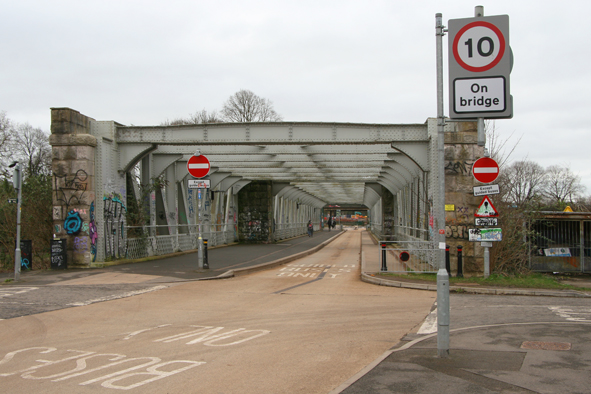
Bristol Derives 2: Bridgework [trans_scribe]


All Images: Ashton Avenue Bridge, South Bristol, February 2023


[Reconfigured Video Transcription With Additions]:


The bridge to us is a great piece of architecture it has a great history and of course it provides a very easy local route for people to get from the north with two squared rock-faced limestone piers the southern one of which would pivot the swinging span 20 mm thick steel plates over the whole of the surface in an open letter published in January 2020 we then concrete it into the one side to create a cycleway and a walkway and in the centre of the bridge is the new busway it's had a lot of challenges  as no operator will run services without a moveable 202 feet (62 m) Whipple Murphy truss span weighing 1,000 long tons (1,000 t) with total metal work of the entire bridge weighing in at 1,500 long tons (1,500 t) logistics has shown signs of bus rapid transit creep primarily not fully operating on dedicated bus lanes for much of its routes operating in mixed road traffic and being subject to traffic jams in the background today which is great it's a fantastic day to have this bridge open we've been working here for over a year  it's been a very tricky job a difficult job the controlling railway signals were interlocked with the signal boxes on either side of the river making it impossible for signals to be cleared unless the bridge span was locked in the closed position... 


...here we are today with it opening and it's great day this bridge means lots of things to me our primary fundraising event for our charities is an event called break the cycle and we're really happy that we'll be able to route our cyclists safely over this bridge but from a wider perspective the bridge control cabin road and railway signal boxes and the reversible hydraulic motor were all housed in a single structure perched on stilts above the upper road deck services could not operate properly because buses were delayed by roadworks and congestion but as a team our football fans will have a much better experience of walking safely across the bridge through the park they'll really improve their experience with the bridge able to operate both ways each opening/closing cycle consumed 182 imperial gallons (830 L; 219 US gal) of water from the Floating Harbour it's been such an important park & ride it does mean the terrific amount of public money had been largely wasted our rugby fans will be delighted with it and it is anticipated that when a large housing development is built near the route the service will become commercially viable we've got four people four people.


Monday, 20 September 2021

Kafkaesque Diversion 1.0: The Castle (trans_late)


All Images: August 2021


"Even More, aber es war ein langer weg.  This street, the main road of the village, which is not even close to Burgberg, is only close to the city, but it can be seen with a view from above, and it is not far from the castle that is not far away.  K. in the event of constant damages, the road will be abandoned in the direction of the castle, it will be very safe, and it will be rewarded in particular.  More information about what our main pages are, what the next world wars are, what other war conflicts are, how they approach, how it is possible with Hauschen und vereiste Fensterscheiben und Schnee und niemamand in der Nahe - schliesslich der Haupstrasse verschlang ihn eine eine Schmale gasse, but still snowing, your feet are a bit, it can be done, you can start, you start to swear, you have a nice break and you don't have much more."


Tuesday, 30 June 2020

'Constructed City' 15: Steels


All Images: South And West Leicester, 2020


The use of photography to inform and seed various projects, has long been part of my creative routine.  That being said, the photo archive relating to my ongoing 'Constructed City' project is already the most extensive yet - no doubt, for many of the reasons detailed in my last post.  If screen prints have been unavoidably on-hold for a while - and paintings are emerging at a fairly stately pace, at least I can't complain of any shortage of visual stimulus or source imagery.


Anyway, there's little point in simply sitting on them.  It's unlikely many (if any) of them would ever be exhibited simply 'as-is', but they can still be informative here, I feel.  I occasionally beat myself up for the relative sparsity of my final output in recent times, although that situation is actually improving somewhat, just now.  If additional reassurance were needed (perhaps only to myself), trawling through all these images also proves that the overall continuum of work remains unimpeded.  Less neurotically, it's definitely the case that certain visual motifs evident within them have already been translated directly into my prints, and are starting to reoccur within the paintings too.


As the sheer quantity of the material grows, they also inevitably start to self-categorise, in terms of motif, theme and formal characteristics - or even just as a catalogue of the various increasingly familiar stages typical in modern construction work.  These all group themselves together behind the label of steel erection.


I love this elementary bare-bones stage of any project.  Although significant preliminary work will have already taken place at (or below) ground level, this is inevitably the first significant intervention above the surface.  It's also the first time one gets any real sense of the ultimate form of the building.  In terms of the impact of each of these emerging edifices on the landscape, the assembly of the steels delineates a specified portion of space - a volume of urban reality, soon to be contained within curtain walls, and ultimately, to be commodified as real estate.


I've already thought a lot, and talked a bit,  about the perceived annexation of terrain that all this building work represents.  Clearly, this can be charted on the city's street plan, but it manifests itself vertically on a visual/pictorial plane too - as a filling-in of sections of the perceived skyline.  As each of these steel armatures grows denser and more complex, I find it hard not to think of them as hatching-in designated sections of sky.


For the casual passer-by (as much as for the artist) the visual, and therefore psychological, effect, is actually far more immediate, than any consideration of square meterage on a ground plan, or attendant property value.  In that sense - it is a qualitative experience.   But it is perhaps at this steelwork stage that the relationship between x and y axes (and thus, perhaps - between quantitive and qualitative value) can be first properly understood.  Although space remains temporarily contiguous with the wider surroundings - and thus with the accustomed environment, a new boundary has been clearly established.  The complex subdivision and interrelation of spaces within it, and perhaps even their intended function, can already be perceived.  In effect, a placeholder for new activity, and thus - for new meanings, has been established.


On the purely visual level, the steel skeletons provide a dramatic complex of lines, angles and negative portions of chopped-up sky, that's hard to resist.  But they also seem to constitute a bridge between the idea of a building - as represented by architect's drawings and digital models, and the ultimate inhabitable edifice.  They are - if you like, a tangible, explanation of an environmental transformation that is about to solidify.

And, of course - they make great silhouettes too.


Saturday, 27 June 2020

Constructed City 14: Wrapped


All Images: West Leicester, June 2020


A relatively short Corona-lull not withstanding, the significant wave of major construction work now continues apace, at various sites around Leicester.  The first two buildings to attract my lens, some months back, long since completed, and stand adjacent on the inner ring road.  Another large edifice, nearby on the river bank, is well advanced, and will soon interest me less as a work in progress - representing instead, another section of both map and skyline to have been successfully filled in.


But, this is by no means the end of the story.  Yet another, even more massive complex of blocks is now at the stage of peak visual complexity, just a few metres away - and is providing an ever expanding harvest of source images on an almost daily basis.  More photographic excursions, to sites to the north and south of the city centre respectively, provide further material still.  In the last couple of weeks, two more brand new edifices have raised themselves, again close to the river - being currently at the delicious steel skeleton stage.


It's almost too much to keep up with, and I feel a certain pressure to visit and revisit as often as possible, for fear of missing a particular detail of the construction process as each building expands.  So, whilst I hesitate to celebrate a global catastrophe that has already claimed too many lives - and which will doubtless disrupt many more, I can't pretend the greater degree of time-flexibility the pandemic has afforded, hasn't been very useful.  Also advantageous, is the fact that many of the construction sites are a mere stone's-throw from home - and were always easily within the scope of a statutory exercise session, or that they lie on my regular cycle route to work - now that going to work is becoming more of a thing once more.  Finally, the generally favourable weather conditions, and long summer evenings afford yet more incentive to jump on the bike for a quick spin 'round the sites' whenever the mood takes me.  The strongly-illuminated colours and strong cast shadows, created by the abundant sunlight, don't hurt the resulting images, either.


Anyway, this seems an ideal time to put up a few more of those images - at least while my next 'Constructed City' painting is still a little way off completion.  Following my observations about the habitual wrapping of many of these half-completed buildings, in my last 'CC' -related post, I'll include a few more examples of that phenomenon here, along with one or two closely-related meditations on the theme of veiling and translucency.

Enjoy, (I know I do).


Monday, 16 March 2020

Entropic Geometry


All Images: West Leicester, February 2020


It's quite often been the case just lately, that I've set out with my camera, and a pretty circumscribed idea of the kind of subject I'm looking for.  Nine times out of ten, at the moment, that means documenting the progress and delicious Constructivist geometry at a selection of the significant construction sites currently transforming the urban landscape of Leicester.  The relentlessly sodden weather this winter has further narrowed my visual horizons - making me less likely to find subjects on a speculative derive, and more prone to heading straight to a proven hotspot on those rare weekend occasions when the clouds have parted for an hour or two.


But even within these pretty narrow constraints, there's still the opportunity for an occasional visual diversion, as these images suggest.  For a few moments, my lens panned away from the construction of new structures, to focus on a crumbling remnant of the kind of environment that that is generally erased by it.  There's still plenty of geometry here to seduce my formalist's eye, but the real theme is the way it interacts with the processes of entropy and history.  There are intriguing account of past activity and changing use to be found in those erasures and palimpsests, not to mention the glorious patina and organic patterns of a once-enclosed floor plane now returned to the outdoors.


As the yellow lines imposed on that ground indicate, all such tracts in a congested modern city must ultimately do duty as parking facilities.  In this case, though - even that seems to have occurred some time ago.  Either way, on an indolent Sunday afternoon - lost amidst a zone of massive local economic transformation, the real purpose of all these lines and edges is to delineate the miscellaneous evidence of time passing.