Monday, 25 November 2013

'The Outer Edges' At Derby Quad


A few months ago, I wrote a post extolling the pleasures of Karl Hyde’s album, ‘Edgeland’ [1.] and ‘The Outer Edges’ [2.], a film he made in collaboration with Kieran Evans.  I won’t trawl over old ground here, as my favourable opinion of both pieces remains largely unchanged.  I’ve played the album repeatedly over the intervening period but only watched the film a couple of the times, (as is in the nature of the two media, I guess).  Therefore, I was more than happy to zoom over to Derby Quad one evening the other week to watch the film again on a big screen with a live score performed by Hyde himself, Leo Abrahams and Peter Chilvers [3.].


Karl Hyde,  (Photo: Perou/The Artist)


The beauty of living in the Midlands is that anyone in search of cultural stimulus, (or indeed, other pleasures), can shuttle quite easily between several neighbouring towns and cities, each of which offers a different combination of possibilities.  Of these, Derby is a city I visit less often, and it’s easy to categorise it as a relatively mundane place whose heart has been exchanged for an immense shopping complex.  However, the pre-existing town centre does feature some interesting aspects and a perfectly usable culture and media facility in the form of Quad.  Also, as I've repeatedly come to realise, it's in exactly these kind of places that I've increasingly found inspiration for my own work.  As Quad seems to be struggling financially, I was happy to hand over my money for ‘The Outer Edges’ and in reality, our tickets were good value considering the inclusion of the live musical element.


Derby Quad
View Towards Market Square, Derby, November 2013


Based in Hyde's own Essex homeland, the film was as enjoyable and approachable piece of Psychogeographical cinema as I had remembered, full of poignancy and the resonance of place.  The musicians produced an atmospheric, well judged, instrumental score with guitar, bass and laptop electronics, concluding their semi-improvised performance with just one song that emphasised what an affecting voice Hyde has.  Any hoped-for Q&A session failed to materialise but, on reflection, maybe it's wise to resist the impulse to over-explain a piece that is, I think, sufficiently well resolved to be its own explanation.  I was surprised to discover that my own vivid memory of a silhouetted BMX cyclist in one scene, (corresponding to the song ‘Shadow Boy’), was actually a motorcycle; proving just how inaccurate visual recall can be.  I also now wonder if some of the interviewees that provide the film’s human heart could be labeled too easily as Essex ‘types’.  However, Hyde belongs to this estuarine landscape and is therefore perfectly qualified to recognise that these people do inhabit it for real.


T'is The Season To Spend Lolly...

…Tra La La La La, La La La La.


On exiting Quad, my friend Dave and I mixed with raucous weekend revellers and the aftermath of a celebrity Christmas lights inauguration.  We spent a few minutes photographing the conjunction of cheesy illuminations and slightly bleak architecture in Derby’s Market Square, but discovered our most powerful subject matter in the now almost deserted multi-story car park where we’d left the car.  It provided a wonderful environment of utilitarian geometry, sickly fluorescent lighting and information graphics.  We lingered on in there, expecting a challenge from security guards that never came.


Assembly Rooms Car Park, Derby, November 2013


[1.];  Karl Hyde, 'Edgeland', Universal, 2013.

[2.];  Keiran Evans (Dir.) & Karl Hyde, 'The Outer Edges', Universal, 2013.

[3.]:  'The Outer Edges', Film Screening With Live Score By Karl Hyde, Leo Abrahams & Peter Chilvers, Saturday 16 November 2013, Derby Quad, Derby, UK.


Thursday, 21 November 2013

Yours Sincerely


Bob & Roberta Smith, 'We Need A New Counter Culture', Enamel On Board, 2012


My last post was partly an, (admittedly fairly superficial), book review, and partly - a bit of woolly political musing.  Mostly though, it was the externalisation of a debate I often have with myself about the temptations of fatalistic cynicism over the deficiencies of human life, versus the belief that numerous small, hopeful acts, however local or personal, might actually make some difference in the world.  It ended with the hardly original notion, (sometimes cited by artists), that their own creative practice is intrinsically a gesture of engaged positivity in the world, - a kind of political act, if you will.  This post extends that meditation and I can only apologise for its length.

In terms of overt political engagement, I’ve never been sure about the advisability of artists polemically taking on the social order in their work, (even though I’ve edged toward it a little myself, of late).  In the past, I’ve often told myself that an artist’s role should be to observe and comment rather than to actively seek to affect change.  After all, if you were seriously engaged you’d be pursuing a career in politics, volunteering at a food bank or doing pro-bono legal work, not mucking about with paint, wouldn’t you?


Certainly, we could argue all day, (in an anoraky way), over whether ‘The Times They Are A- Changin’ or ‘Blood On The Tracks’ is the more significant Bob Dylan Album, (occupying the two extremes of a spectrum from Protest to the deeply personal).  That’s before we even got into the subject of whether any piece of protest art ever actually changed anything anyway.  Actually, I think the issue is far subtler than that.  Anger over social iniquity, and existential sorrow triggered by the failure of one’s marriage seem equally valid emotions for a well-rounded personality to express in different situations and mass politics is actually just the agglomeration of a million personal stories, I suppose.  Either way, it’s probably the case that adding to different aspects of what nowadays is often called ‘The Conversation’, is all any artist can aspire to, (but valuablel all the same).


Grayson Perry


So maybe my internal debate is more to do with one’s motivation rather than actually what one does.  Perhaps it’s the difference between adopting an ironic, disengaged, or purely venal attitude to one’s activities, or a position of sincerity or authenticity, whatever the content.  This is something I thought about while listening to the artist, Grayson Perry deliver the ‘2013 BBC Reith Lectures’ on Radio 4 recently.


He’s a funny one, Grayson, with his pantomime drag act, (just where the amusingly kitsch flips over into the psychologically worrying); his jokey persona; and a willingness to pop up in the media at any opportunity.  It would be easy to dismiss him as exactly the kind of hyper-ironic, publicity driven careerist we’ve become used to in the post Duchamp/Warhol Art World.  He certainly wasn’t afraid to ride the lucrative YBA bandwagon of the late 90s/early 2000s, and to decorate his trademark, (luxury item), ceramics with exactly the kind of dark psychosexual imagery typical of that generation’s carefully marketed shock tactics.


Grayson Perry, 'Quotes From The Internet', Decorated Ceramic, 2005

Grayson Perry, 'We've Found The Body Of Your Child', Decorated Ceramic, 2000


Yet, whenever I hear Perry speak, I’m surprised by how much genuine substance and apparent sincerity he actually conveys.  He’s an intelligent, engaging and accessible communicator who can handle serious ideas without pomposity or obscurantism; and someone seemingly possessed of a mission to inform, entertain and enlighten as well as to shock.  He has talked with candour about his own difficulties growing up, and the domestic turmoil which may have shaped both his public T.V. alter ego, (Claire), and the disturbing content of some of his work.  He has also played an illuminating role in unpacking the linkages between aesthetic taste and the seemingly unquenchable British class system; and is never slow to prick the pomposity and numerous hypocrisies of the Art World he himself inhabits.


Grayson Gets On His Bike


Perry’s four Reith Lectures had the overall title ‘Playing To The Gallery’ and were his attempt to demystify various aspects of that world for people who may find themselves baffled or alienated by its vagaries, (I’d certainly include myself there, and I produce the stuff).  The subjects covered ranged from the mechanisms, power structures and financial realities applying to contemporary art production and marketing, to the philosophical and possible emotional motivations underpinning it.  They were a typically entertaining listen but I was particularly struck by how easily he was able to oscillate between being cheerfully ironic and rather movingly sincere in tone.

The third lecture, entitled, ‘Nice Rebellion, Welcome In’ [1.], dealt with how the idea of creative rebellion, or the notion of the Avant-Garde, relate to the contemporary Art World.  The idea of successive revolutions in seeing and expressing, each sweeping away the last, clearly no longer applies within modern art, and yet, somehow it still hangs around as a cultural memory.  Perry is hardly the first to point out that even very early on in the progress of Modernism, the Avant-Garde model was being undermined from within by the Duchampian dictum that anything can be art.


Marcel Duchamp (As R Mutt), 'Fountain' (Replica), Readymade Urinal,  1917


It’s an attitude that gained increasing purchase throughout the last century to the point that, for those on the inside, it’s now entirely taken as read.  Arthur Danto has described this 'End State of Art’ as a kind of multiculturalism in which all shades of possible opinion or expression coexist with equal validity [2.].  This notion that anything goes in Art may still be an impediment for a few, but in all honesty, can anyone really maintain a convincing posture of shock at any artistic manoevre, when mass digital media remind us daily that all forms of once transgressive behaviour can now be routine leisure activities?

"And if you think about it, all the things that were once seen as subversive and dangerous like tattoos and piercings and drugs and interracial sex, fetishism, all these things - they sort of crop up on X Factor now on a Saturday night on family viewing.  (LAUGHTER)  The one thing you won't see though: underarm hair.  (LAUGHTER)  The last truly dangerous thing." [3.].


Yves Klein, 'The Monotone Symphony' (Anthropometrie), Performance Event, 1960

In that context, abstract painting, welded metal sculpture, ready-made objects, blank videos or visceral (or scatological) performances can no longer be seen as ground breaking or revolutionary.  The most they can expect to raise is a mild frisson, - the pleasurable thrill of affront.  The obvious danger of all this is that we all become increasingly jaded and yes, cynical, in our approaches to producing and assimilating artwork.  How often do even those of us who really care about Art find themselves briefly glancing around a gallery, mentally categorising the work on display, (“Ah yes, - in the tradition of Alternative Taxidermy”), before sloping off to the bookshop or café?  Can we be surprised if new generations of artists respond accordingly, tailoring their output to engage with whichever taboos are currently most marketable?  Let’s face it; much of the output of the YBA artists, with which Perry was sometimes associated, could be placed in that category, if we’re honest.  Butchered livestock, bodily fluids, Myra Hindley, mutilated children; - Charles Saatchi bought (and sold) it all.  (Please don’t think I don’t get rewards from some of that work, but we do need to be realistic).

"And the creative rebel - they like to think they're sticking it to the man, they're sticking it to the capitalist system, and you know they're really show…like one of them Occupy protesters.  But of course what they don't realise - by being all inventive and creative, they're actually playing into the capitalism's hands because the lifeblood of capitalism is new ideas.  They need new stuff to sell!  You know people are going to get bored of the old stuff."  [4.].


Marcus Harvey, 'Myra', Painted Childrens' Handprints on Canvas, 1995


And so, nothing could encourage the kind of detached, ironic stance so prevalent within Art nowadays, more than the sense that this desensitised, mock rebellion has become just another marketable commodity.  Despite all that, Grayson reveals his own shameful secret, - a desire for sincerity or authenticity as art experiences.


“Me, I have to sort of protect myself against this because when I’m out in the evening and I’m with my mates and I’m being terribly cynical and ironic; but when I want to look at art, I want to have a sincere one to one experience with it because I am a serious artist. I’ve dedicated my life to it. So I go to exhibitions in the morning on my own when I can go, hmn, and you know maybe have a little bit of a moment. (LAUGHTER) I have to protect my tender parts from that wicked irony.” [5.].


Grayson Perry's  Teddy Bear, Alan Measles


Just maybe, sincerity or authenticity might be the only truly radical postures left for an artist to adopt these days and, as Perry points out, may certainly be the qualities they need to make their work.  Of course, even ‘realness’ can become another marketable USP, but it does seem to me that sincerity of motivation, (rather than, necessarily, of content), is the only thing that could even hope to distinguish Art from anything else that might be designated as purely ‘product’, (these days, it’s necessary to include information within the larger category of product, of course).  It’s impossible for artworks not to function partially as saleable merchandise, but essential, I think, for it to retain its other function, as a branch of Philosophy, if it's to endure as a distinct activity.


Ironically, in his final lecture Perry suggested that had he not been an artist, he might have gone into Advertising, [6.].  Perhaps he was being flippant again, but I’m encouraged to see that he stuck to the less cynical path he actually chose.  The most important idea I took from his Reith Lectures was, that there is still, (just about), something that distinguishes Art, as a separate practice, from the other transactions or discourse in which we may participate.   It feels like it's still worth adhering to such a course.


[1.], [3], [4.], [5.]:  Grayson Perry, ‘Nice Rebellion, Welcome In’, BBC Reith Lectures 2013, Lecture 3, The Guildhall, Derry-Londonderry, Broadcast: BBC Radio 4, 29.10.13.

[2.]:  Arthur C. Danto, ‘After The End Of Art: Contemporary Art And The Pale Of History (The A. W. Mellon Lectures In The Fine Arts)’, Princeton N.J., Princeton University Press, 1998.


[6.]:  Grayson Perry, ‘I Found Myself In The Art World’, BBC Reith Lectures 2013, Lecture 4, Central St. Martins College, London, Broadcast: BBC Radio 4, 05.11.13.


Monday, 11 November 2013

Cynical? Me? - You Would Say That, Wouldn't You?


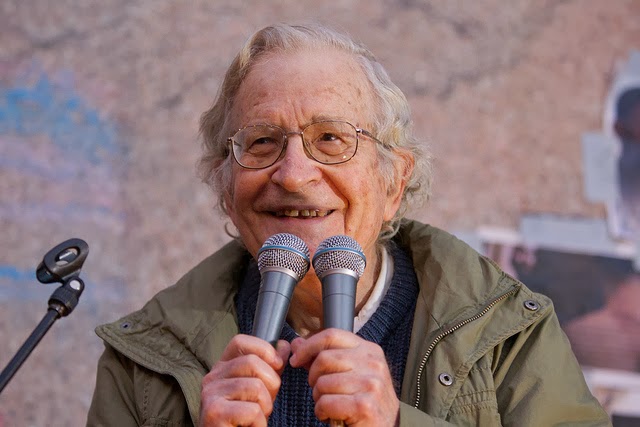
Noam Chomsky Addresses Occupy Boston, Dewey Square, 2011, (Photographer: Unknown)


Not so long ago I had a slightly perplexing day when three different people accused me of cynicism on separate occasions.  Perhaps I was just having a bad day but it did make me reflect on how easy it can be to fall into the habit of world-weary disappointment at the shortcomings of human behavior and thus, to automatically expect the worst.  I guess we all label each other based on superficial impressions so I shouldn’t be surprised if what one hopes is finely honed satire, heartfelt concern or justifiable anger just looks like bleak negativity to others.  In reality, it’s mostly a defence mechanism for the vulnerable, I suspect.  I thought about the issues of optimism versus pessimism and irony versus sincerity again recently in two different contexts, both reminding me that where there’s life, and creative intent, there’s always hope.  This post is about the first.


I’ve just finished reading Noam Chomsky’s little book ‘Occupy’ [1.].  Chomsky’s championing of the Anti-Capitalist Occupy Movement should come as no surprise given his well-established left wing credentials, and the book is a clear attempt both to document the progress of Occupy’s recent organized challenges to the status quo, (in The West at least), and to provide encouragement to those seeking to take its initial idealistic impetus onto the next level of political engagement.  Of course, from one ideological perspective, the cynic’s view of such demands for social or economic change is to dismiss them as just the same old songs from a bunch of naïve urban campers.  Even from those more likely to be sympathetic, it might just seem like something one might hope for in one’s heart is inevitably overruled by the more realistic, if disappointed, head.  One consequence of this may be a general sense of powerlessness in the face of ever-greater degrees of hardship and injustice.  Another may be weary acceptance of that what Mark Fisher has highlighted as the ‘Capitalist Realism’ orthodoxy [2.], (i.e. ‘just the way things are’).  Either way, inertia is the likely result.


Occupy Protesters At Vietnam Memorial, Lower Manhattan, 2012.
Photo: Anthony Lanzilote/New York Daily News


Where I find Chomsky’s book most encouraging is in highlighting that it is in multiple small, anonymous acts of positivity or engagement that real hope for an alternative future may be found and that progress may be incremental and relative rather than necessarily revolutionary or Utopian, (even though they may be the initial impulses).  Using the examples of Feminism, Anti-Vietnam War protest and The Civil Rights Movement he argues that, whilst there are still plenty of causes for complaint, some progress was made.  More importantly still, he insists that it’s through consistent voicing of discontent and ongoing consciousness-raising, that the overall assumptions and agendas of power can be gradually shifted.  No one would pretend Capitalism is about to cave in just yet, at least before it has caused a lot more more harm.  Nonetheless, the fact that many now recognise it is in no way predicated on the greater good of the majority, and indeed the self identification of the '99%', must surely begin to compromise its long-term integrity as a sustainable system.


Howard Zinn, 1922 - 2010


Perhaps, the most moving section of ‘Occupy’, and the crux of its message, is contained in the short chapter memorialising his old friend and noted Civil Rights campaigner Howard Zinn.  It includes the following quotation by Zinn:


“TO BE HOPEFUL in bad times is not just foolishly romantic.  It is based on the fact that human history is a history not only of cruelty, but also of compassion, sacrifice, courage, kindness.

“What we choose to emphasize in this complex history will determine our lives.  If we see only the worst, it destroys our capacity to do something.  If we remember those times and places – and there are so many – where people have behaved magnificently, this gives us the energy to act, and at least the possibility of sending this spinning top of a world in a different direction.

“And if we do act, in however a small way, we don’t have to wait for some grand utopian future.  The future is an infinite succession of presents, and to live now as we think human beings should live, in defiance of all that is bad around us, is itself a marvelous victory” [3.].


Occupy Protester, Zuccotti Park, Manhattan, 2012.  Photographer Unknown


This may all sound like the spent idealism of a previous generation but for those of us with a tendency toward despair with each news bulletin, it is at least some kind of testament of hope.  I also think the idea of living now, in a infinite succession of presents, as we think humans should, could be extended to a range of human activities and certainly to the field of creativity in general.  Regardless of the degree of direct political engagement one might incorporate into one’s artwork, there is some validity in the old idea that any artistic activity is an intrinsically political act.  It is, at source, an attempt to shape a better world, (however personal).  Furthermore, the creative, entertaining and inclusive aspect of many Occupy gestures, demonstrate that the desire to shape the world expressively and the impulse to bring about social, economic or political change are often very closely linked.


[1.]:  Noam Chomsky, ‘Occupy’, London, Penguin Books, 2012.

[2.]:  Mark Fisher, ‘Capitalist Realism:  Is There No Alternative?’,  Ropley, Hants., Zer0 Books, 2012.


[3.]:  Howard Zinn, ‘You Can’t Be Neutral On a Moving Train: A Personal History Of Our Times’, Boston, MA., Beacon Press, 1994.  Quoted in: Noam Chomsky, ‘Occupy’, London, Penguin Books, 2012.

Saturday, 2 November 2013

Friday, 1 November 2013

I Scream, You Scream...


We all scream for... [1.]


Leicester, October 2013


'Down By Law',  Dir. Jim Jarmusch, 1986. Starring: Tom Waits, John Lurie, Roberto Benigni


[1.]:  'I Scream, You Scream, We All Scream For Ice Cream', Howard Johnson, Billy Moll, A.K King, 1928.  Performed by, (Amongst Others), Fred Waring's Pennsylvanians.